















Breakthrough Musical Theatre: Metropolitan Opera's The Amazing Adventures Of Kavalier & Clay

By Judith Fein
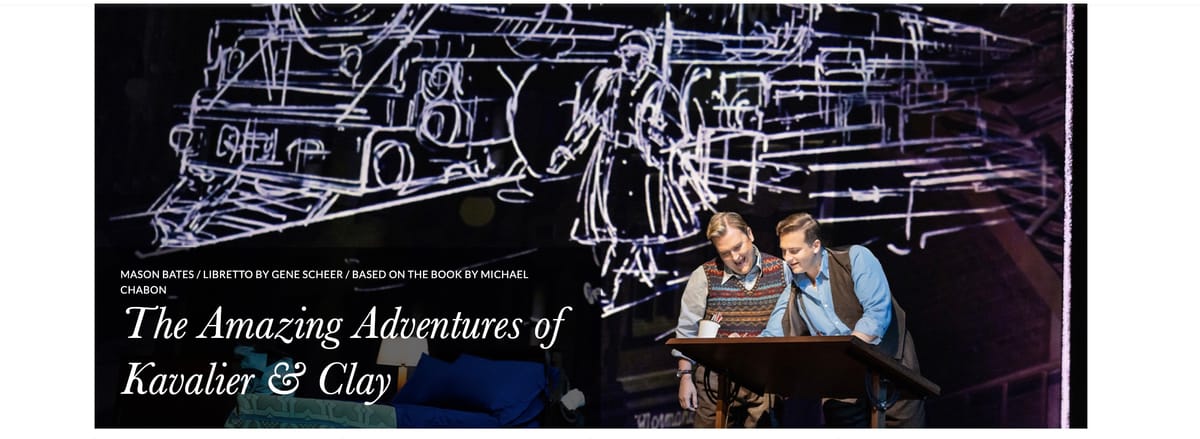
It is very rare that I weep in the dark because I am so moved, hold my breath from the brilliance of a production, or watch an almost three-hour show and immediately want to see it again. And I can’t recall whispering, “How did they do that?” over and over again about the sets, rotating and changing stage, lighting, animation, screens, projections, and video design. But it happened at the Lensic in Santa Fe when I saw the film of the Metropolitan Opera’s production of The Amazing Adventures of Kavalier & Clay, based on Michael Chabon’s Pulitzer Prize winning novel.
The mind-bending, precedent-setting, cliché-smashing production has, of course, been wildly praised, but it has also been dismissed as having a lack of: memorable tunes, emotional depth, top opera singers, a more lyrical and less clunky libretto throughout, and reliance on cinematic and visual elements rather than music. My personal response is: this show is more music theatre than classical opera, accessible to both opera cognoscenti and novices, visually stunning, cinematic, and features talented opera singers who are also gifted as actors. It is true that you don’t walk out afterwards humming tunes, and yes, especially at the beginning, some of the libretto is a little mundane, but the experience of seeing the show is unforgettable.
One of the major complaints— which I heard from a few audience members at the Lensic— is that the opera left out or changed important elements of the very long and complex novel.

Opera is a different medium from a novel. It exists in real space and time, must be told in a few hours, and has to be visual, auditory, and create “songs” that move the action and character development forward.
Before I saw the Metropolitan Opera video production of Kavalier & Clay, all I knew in advance was that it was a Jewish-themed opera. So, every second of the show was a surprise.
Kavalier & Clay is a very complex and expensive production with a huge cast and orchestra, three time periods and locales, cinematically seamless transitions from scene to scene, highly dramatic and emotionally powerful symphonic and also electronic and synthesized score by Mason Bates. It features animation, sets that appear and disappear, comic book visuals, and a progressively powerful and emotionally charged, relatable, entertaining and meaningful libretto by Gene Scheer. And the book’s author Michael Chabon participated in the creation and highly endorses it.
For those who appreciated the opera but longed for the novel, the former cannot replicate the latter because the demands of the medium are quite different. And in my very humble opinion, this cinematic and musical evolution in opera is a red carpet to a winning future in terms of new and younger and also frequent opera goers.
The story begins when a Houdini-like daredevil and talented artist named Kavalier escapes Nazi occupied Prague and arrives in New York City. He wants to make money to send to his family that is trapped in Prague to help them escape. He moves in with his cousin Clay, a comic book lover and idea man who works in a toy factory. Kavalier tries to explain his escape to Clay in his rudimentary English, and ends up drawing it for him. Clay hatches an exciting idea: they create a comic book together. Kavalier will do the art, and Clay will write the story. They develop a superhero called The Escapist. He saves people who are trapped by slavery and oppressive regimes like Nazism; he helps them to escape. They want to use art to rebel against authoritarian and murderous regimes.
They talk the toy factory owner into producing a comic book about The Escapist. It becomes a megahit and expands to become a radio show. Even with this success, Kavalier is unable to free his parents, and what saves him emotionally is that he falls in love with and marries Rosa, a talented artist who executes a plan to save Jewish children from the Nazis and bring them to New York. Among the children is Kavalier’s beloved younger sister Sarah. What happens to her causes Kavalier to spiral down into despair.
Kavalier disappears without even leaving a letter for Rosa or Clay, but they remain optimistic that he will return. Rosa takes over the comic book with Clay and the audience sees what Rosa and Clay do not: Kavalier doesn’t care about his own life or death. He has gone off to fight the Nazis.
Another element is the unfolding love story between Clay and the actor Tracy Bacon who portrays The Escapist in the radio play.
The unforgettable performances of Andrzej Filoncyk as Kavalier, Miles Mykkanen as Clay, Sun-Ly Pierce becoming Rosa, Lauren Snouffer transforming into 14-year-old Sarah, and Edward Nelson as the lithe and flexible Tracy Bacon are still appearing in my dreams. And if I were wearing a hat as I write this to you, I would doff it to Yannick Nezet-Seguin the conductor of the magnificent orchestra.
I cannot imagine any sentient being who would not be excited to be in the audience as they watch this heart and soul-enhancing show.
The final two performances at the Met are taking place February 20th and 21st, 2026. Please see below a link to the trailer of the opera, and information about where you will be able to the film in the near future.
Judith Fein is an international, award-winning travel journalist, speaker, author and acclaimed opera librettist. She lives in Santa Fe and recently wrote Slow Travel New Mexico, with 100 photos by her husband Paul Ross. It was selected as the best travel book by the Arizona and New Mexico Book Awards. She has written four best-selling books, contributed to over 130 publications, given many keynote talks, blogs for Psychology Today, and teaches storytelling. One of her stories was the #1 most read article in the New Mexico Jewish Journal, and she is proud of that. Her website is: https://www.GlobalAdventure.us/
The "Live in HD" production screened at the Lensic in Santa Fe in February, 2026. "Live in HD" productions are usually available on the Metropolitan Opera website about three months after the live performance closes. Expect Kavalier & Clay to be posted on the website by April or May, 2026 and it may also appear on PBS and in future at other local theaters. Check further at: https://www.metopera.org/season/in-cinemas/2025-26-season/the-amazing-adventures-of-kavalier--clay/.
Community Supporters of the NM Jewish Journal include:
Jewish Community Foundation of New Mexico
Congregation Albert
Jewish Community Center of Greater Albuquerque
The Institute for Tolerance Studies
Jewish Federation of El Paso and Las Cruces
Temple Beth Shalom
Congregation B'nai Israel
Shabbat with Friends: Recapturing Together the Joy of Shabbat
New Mexico Jewish Historical Society
Where the North Ends, A Novel by Hugo Moreno
Policy Statement Acceptance of advertisements does not constitute an endorsement of the advertisers’ products, services or opinions. Likewise, while an advertiser or community supporter's ad may indicate their support for the publication's mission, that does not constitute their endorsement of the publication's content.
Copyright © 2026 New Mexico Jewish Journal LLC. All rights reserved.