














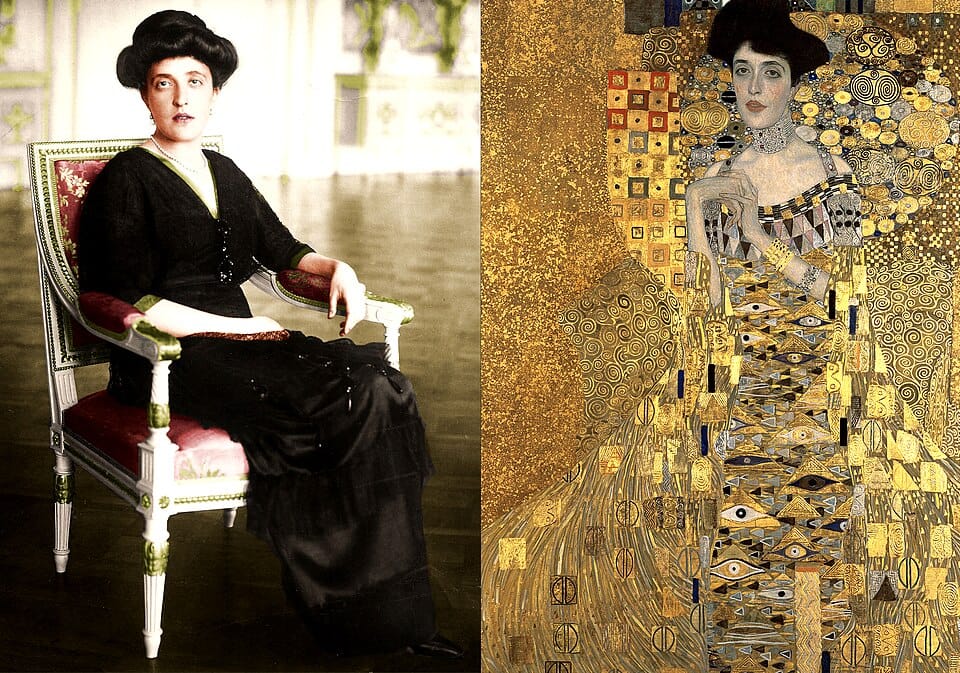
Portrait of Adele Bloch-Bauer
...to think of its aftermath, the sharp contrast between this celebration of life painted by Klimt and the Nazi wave of hatred that would destroy the Jewish life
By Ron Duncan Hart
In a recent trip to New York my wife Gloria Abella Ballen and I went to the Neue Gallery to re-visit favorite works from the Vienna Secession artists Gustav Klimt and Egon Shiele. For me it was to view the Portrait of Adele Bloch-Bauer I (1907), known as The Woman in Gold. Although I have stood before that painting on other occasions, it is like visiting an old friend with whom you can easily re-start the conversation no matter how long it has been since you last saw them. As I looked at the glittering painting of oil and gold leaf this time, I began to think of its aftermath, the sharp contrast between this celebration of life painted by Klimt and the Nazi wave of hatred that would destroy the Jewish life that this painting represented.
This is a painting of romanticism and festivity with dozens of spirals and golden squares cascading around the figure of Adele, a symbolism highlighting the cultural richness of Jewish life in Vienna of the Belle Époque. This almost mythical image portrays Jewish accomplishment in Vienna before the nefarious Nazi regime invaded Austria years later, crushing that life and destroying the rich cultural heritage Jews had helped build.
Adele was from a wealthy Viennese Jewish family, and her father was a banker and director of a railroad. She was active in the cultural world of Vienna and held “cultural salons” in her house with writers, artists, and other intellectuals in discussions of art and literature that we can only imagine. Adele and her husband Ferdinand Bloch-Bauer, a Viennese banker and sugar entrepreneur, were active patrons of the arts from painting to sculpture. Ferdinand commissioned this portrait of his wife that celebrates her place as a Jewish woman and cultural leader making Vienna a better place.
Adele died in 1925, and when the Nazis invaded and annexed Austria in March of 1938, Ferdinand fled the country. As a Jew, his businesses and properties were confiscated, and all Jewish employees were fired. His house became the offices of the German Railway Company. His art collection was seized and divided between Nazi officials and Austrian institutions. The Portrait of Adele was given to the Austrian Belvedere Gallery in Vienna. 65,000 Austrian Jews were sent to Sobibór and other extermination camps, and the community was officially liquidated in November 1942. The Jews of Vienna had made the world a better place, but the Nazis reduced it to ashes.
In 1998, more that forty years after the defeat of the Nazi regime, the Austrian government passed legislation permitting the return of art works stolen by the Nazis to the heirs of the original owners. Maria Altman, a niece of Adele living in California, filed a claim for the return of the Portrait of Adele and other pieces from the Bloch-Bauer collection, but her claim was initially turned down. After four years of litigation, the Supreme Court of Austria ordered the return of most of the works to Ms. Altman, including Portrait of Adele Bloch-Bauer, a painting 54 inches by 54 inches with oil paint and silver and gold leaf on canvas. Later, she would sell the portrait of her aunt to Ronald Lauder to be put permanently on public display in the Neue Gallery.
As I looked at this portrait once again, I began to think about political regimes that bring hatred to their countries and the contrast between the joy and happiness of what life can be with what the Nazis would bring. What happens to a country when hatred and vitriol become the leitmotif of the society? Hitler might have set the tone, but his millions of sympathizers and enablers who willingly adopted his hatred motif would decide the fate of their country.
The contrast between the love of life in the Adele portrait and the heinous countenance of the Nazi leader defines two extremes of what we can be as humans. Germans allowed Hitler to define their society with hatred and vengeance, symbolized by concentration camps and the gas chambers of Auschwitz-Birkenau, Sobibór, Treblinka, Chełmo, Majdanek, or Bełżec. In contrast, the Portrait of Adele Bloch-Bauer celebrated the cultural richness of Jewish Vienna, and it has become an icon of beauty that has survived and outlived that onerous regime.
Link: Neue Galerie NY
Ron Duncan Hart, Ph.D. is the Director of the Institute for Tolerance Studies in Santa Fe and the Santa Fe Distinguished Lecture Series. He is a cultural anthropologist and former Dean of Academic Affairs. He has awards from the National Endowment for Humanities, the National Science Foundation, Ford Foundation, and Fulbright among others. He is an award-winning author and his most recent book is Evangelicals and MAGA: The Politics of Grievance a Half Century in the Making, which received an American Jewish Press Association Rockower award ("the Jewish Pulitzers") for Excellence in Writing about Antisemitism.
Read Hart's multi-award-winning series on Jews and Christian Nationalism in the NM Jewish Journal. “Prophetically terrifying and a great history of the Evangelical takeover of the government leading us to a U.S. theocracy,” commented one judge. Read all Ron Duncan Hart articles.
Editor’s Note: Woman In Gold (2015) is a biographical drama starring Helen Mirren and Ryan Reynolds that chronicles the true story of Maria Altmann, Adele's niece and a Jewish refugee who fought a 7-year legal battle against the Austrian government to reclaim the Portrait of Adele Bloch-Bauer and other works stolen by the Nazis from her family. The film, a financial success and very popular with audiences, is currently available to stream on Netflix as of early 2026, and available for rent or purchase on other digital platforms.
Community Supporters of the NM Jewish Journal include:
Jewish Community Foundation of New Mexico
Congregation Albert
Jewish Community Center of Greater Albuquerque
The Institute for Tolerance Studies
Jewish Federation of El Paso and Las Cruces
Temple Beth Shalom
Congregation B'nai Israel
Shabbat with Friends: Recapturing Together the Joy of Shabbat
New Mexico Jewish Historical Society
Where the North Ends, A Novel by Hugo Moreno
Policy Statement Acceptance of advertisements does not constitute an endorsement of the advertisers’ products, services or opinions. Likewise, while an advertiser or community supporter's ad may indicate their support for the publication's mission, that does not constitute their endorsement of the publication's content.
Copyright © 2026-27 New Mexico Jewish Journal LLC. All rights reserved.



.jpg)