






Jeffrey Haas: Civil Rights Lawyer, Anti-Zionist

By Ellen Marks

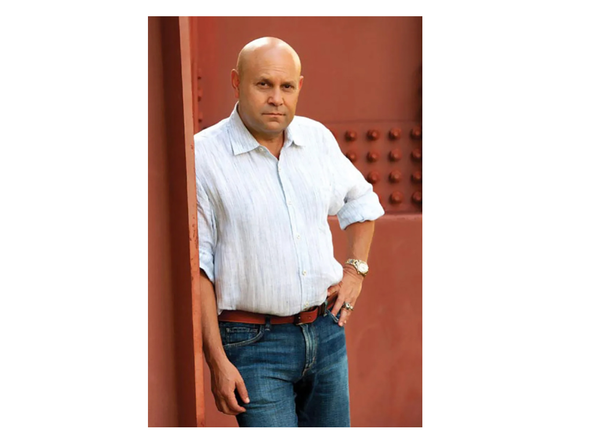
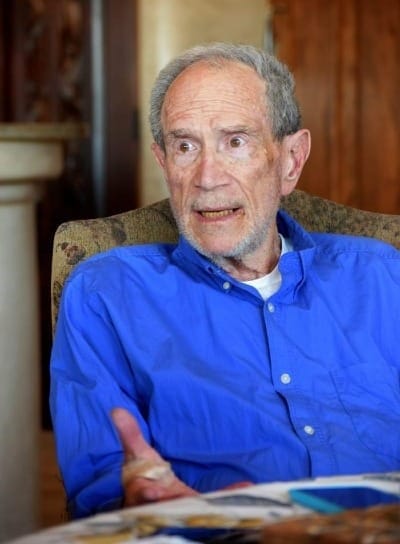
If it’s noon on Wednesday, you’re sure to find Jeffrey Haas at the corner of Paseo de Peralta and Old Santa Fe Trail in Santa Fe, protesting on behalf of Palestinians.
The 83-year-old Jewish co-founder of the group now called Santa Feans for Justice in Palestine has shown up weekly, part of a lifelong commitment of “fighting for justice and equality and equal treatment.”
“To me, an essential Jewish value is fighting for the oppressed, whoever that is,” Haas says.
Haas, who made a career as a civil rights lawyer in Chicago before moving to New Mexico in 2001, has been more visible than usual lately.
He wrote an opinion piece that was published in the Santa Fe New Mexican on Feb. 2, criticizing the upcoming Jewish Community Day to be held at the state Capitol. Jewish protest groups, all wearing black sweatshirts emblazoned with “Another Jew for a Free Palestine,” lined the edges of the rotunda as speakers took their place up front at the Feb. 4 event, the first of its kind in the state’s history.
Haas, who grew up in a family of German heritage in segregated Atlanta, is no stranger to controversy — in fact, his life has been formed by it.
His mother helped integrate some of the southern city’s hotels, his father worked with activist John Lewis on voting rights in the 1960s and his grandfather helped defend Leo Frank in 1913 when the Atlanta businessman was wrongly charged with murder and later lynched.
For the younger Haas, going into law was almost inevitable. His career would go on to focus on discrimination and civil rights, most famously as part of the Chicago legal team involved in the Fred Hampton case.
Hampton was a Black Panther slain in his bed by Chicago police in 1969, and it was Haas and his law partner who revealed that the FBI also was involved as part of the agency’s controversial 1960s counterintelligence work.
All of that forms the backdrop in Haas’ decision to organize the Santa Fe protest group, with its focus on Israel and Palestine.
The newest project for the group, he says, is educating people about the data collection company, Palantir, and its surveillance role in targeting Palestinians in Israel and immigrants in the United States.
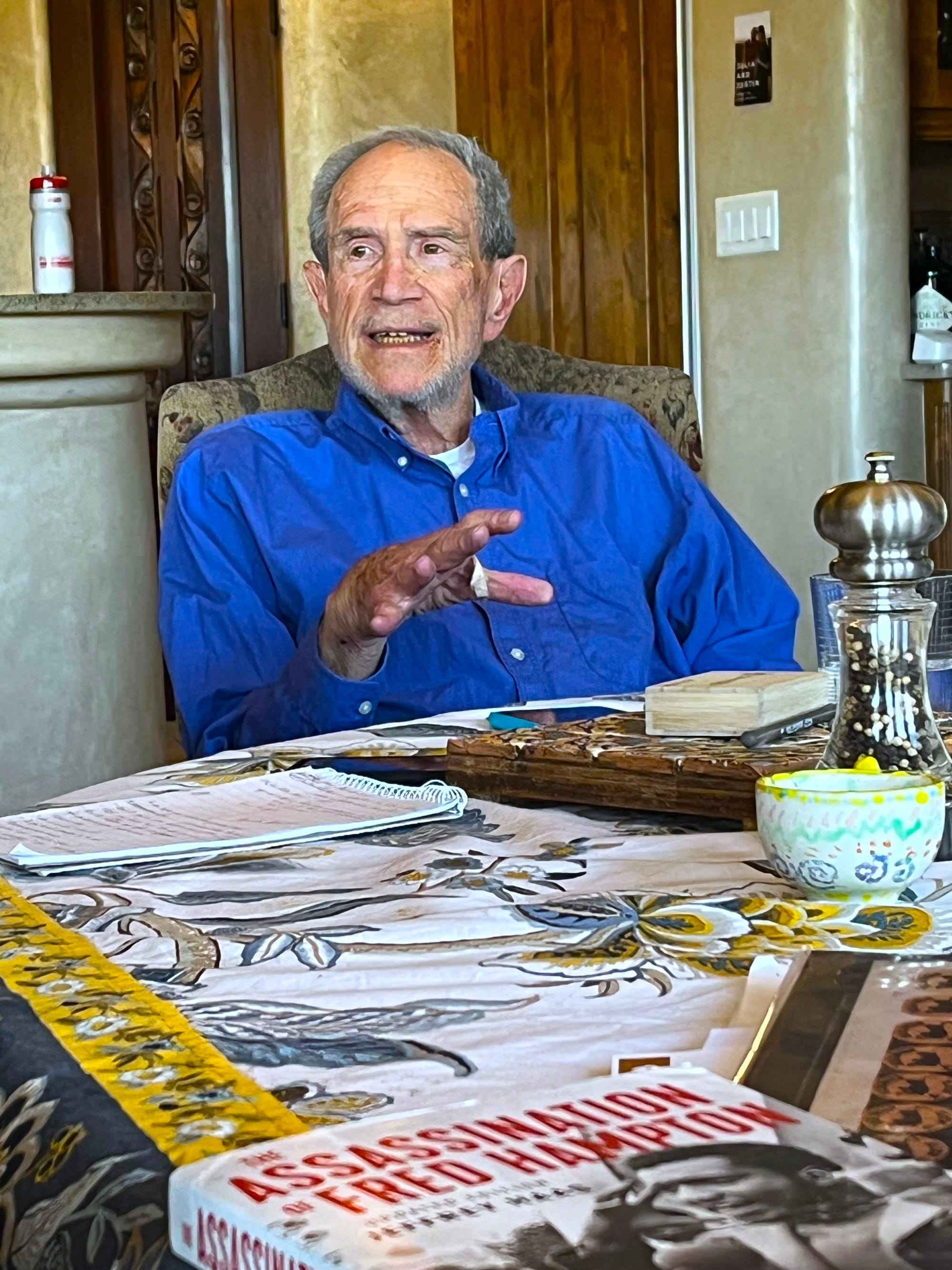
A pro-Palestinian group for Santa Fe
Santa Feans for Justice in Palestine (SFJP) describes itself as an educational and activist organization that promotes freedom for Palestinians and opposition to war in Gaza and Lebanon as well as the “Gazafication of the West Bank,” according to its website.
The group has led rallies and protests in Santa Fe and Albuquerque and voiced its views in radio appearances and newspaper opinion pieces. It also has hosted speakers and films.
In addition, it raises money in cooperation with the Middle East Children’s Alliance to provide food, supplies, medical care and other necessities to Gazan students and teachers, its website says.
SFJP also has been involved in a number of controversial moves, including helping to force the cancellation of performer Matisyahu at Meow Wolf in Santa Fe in February, 2024 – because the peace-promoting reggae artist had spoken out to support Israel in the Israel-Hamas war following October 7th.
And group members were among about 150 people who blocked the entrance to the Jewish Community Center in Albuquerque two years ago. It was a failed effort to force the cancellation of an appearance by Livia Link-Raviv, then-Israeli Consul General of the Southwest.
SFJP formed in 2008 after Israel launched a three-week war against the Gaza Strip called “Operation Cast Lead.’’ Haas and several other Jews named their new organization Another Jewish Voice of Santa Fe and for a short time held their meetings at Temple Beth Shalom, a reform synagogue in the capital city, until the room was no longer made available to them.
The name was later changed to Santa Feans for Justice in Palestine to reflect that “we’re not Jewish-identified particularly, but we have a lot of Jewish members,” Haas says. “I’d say it is mostly people concerned with human rights.”
Haas grew up with antisemitism, but when asked if he has experienced it by fellow anti-Israel protesters, he says, “I really haven’t much.”
“There is a line I think probably that one might cross in terms of criticism of Israel. On the other hand, I think what Israel is doing is genocide. And I don’t know a nice way to say that.”
The recent clash over Jewish Community Day erupted in the days before the event. Haas says one of the organizers told his group that the Israeli Consul General of the Southwest would be attending, although that did not turn out to be the case. His newspaper opinion piece blasted the event as a “conflation of the New Mexico Jewish community with Zionism.”
Alonet Zarum, co-chair of the Jewish Community Relations Coalition of New Mexico, responded with her own op-ed, saying the special legislative day was meant to commemorate the rich legacy of Jewish contributions to New Mexico.
“Yet we can’t even celebrate our identity as Jewish New Mexicans without someone trying to turn it into a debate about the Middle East. That is offensive.”
Haas said he and his son got a first-hand look at Israel and the treatment of Palestinians about eight years ago, talking to people in the West Bank, Hebron, Jerusalem and throughout the country. That experience also informed his viewpoint.
But what about sympathy for the Israelis taken hostage in the Oct. 7, 2023, Hamas invasion?
“Things didn’t begin on Oct. 7,” Haas responds. Thousands of “people in Gaza were killed by Israel through these periodic bombings prior to Oct. 7. It was a history.”
“I mean, I have personal sympathy for them, yes, but … I don't think that eliminates the struggle of Gazans to be free.”
So what’s his solution?
Haas says a two-state answer is no longer viable because Israel is seizing too much land. Instead, the answer lies in “one state with equal democratic rights for everybody. And there would probably have to be some redistribution of wealth.”
Haas does know that his views are controversial. “I’m not a self-hating Jew. I’m a Jew who hates what Israel is doing.”
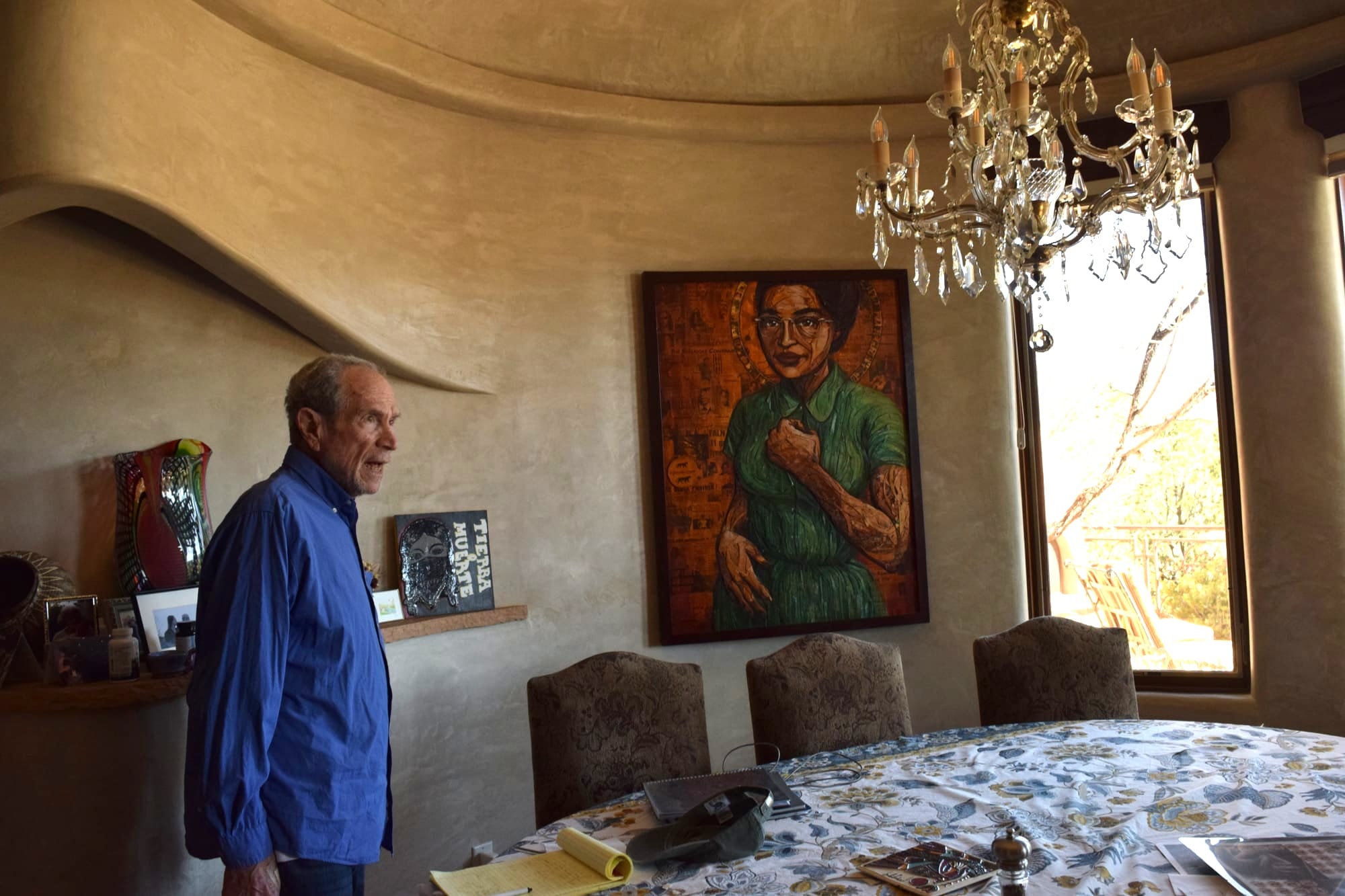
A Life Forever Changed
The incident that most marked Haas’ life was his involvement in the Hampton murder case.
Haas was fresh out of the University of Chicago law school when he and several others formed the People’s Law Office in 1969 to defend the Black Panthers and some other groups that were having legal problems due to confrontations with police.
Several months later, Haas received a call telling him the 21-year-old Hampton and fellow Black Panther member Mark Clark had been killed in an early morning raid on a Black Panther apartment.
Numerous Chicago police officers had opened fire, killing the two men and wounding several others. Panther members who were also there were arrested for attempted murder and various related crimes, but Haas’ law firm got the charges dropped when it was discovered that Chicago police had fired at least 90 shots to the Panthers’ one.
Haas and his firm went on to file civil rights lawsuits on behalf of the Hampton and Clark families, as well as the surviving Panthers.
The firm was instrumental in showing that the FBI had been involved in the killings after infiltrating the Panthers.* The FBI’s actions were part of the illegal activities conducted by the agency's notorious Counterintelligence Program, better known as COINTELPRO.
The trial — during which Haas was thrown in jail on a contempt charge (“That’s a little bit of a badge of honor,” he now says.) — went on for 18 months. It was reported to be the longest civil rights trial in a U.S. federal court at the time.
The jury eventually hung, but after 13 years of litigation by Haas and his partners, the plaintiffs came away with a $1.85 million settlement.
What Haas came away with was a deep and lasting distrust of the government.
“The legal fight to uncover exactly how far the U.S. government went to murder him (Hampton) changed the arc of my life and has inspired what I have done for the past 50 years,” Haas wrote in the 2019 edition of his book,“The Assassination of Fred Hampton.”
He says the experience also gave him an inside view of racism and a lifelong desire to keep “defending movements for radical change.”
He was, therefore, “naturally drawn to the pro-Palestinian struggle, particularly since the U.S. is so much behind what has happened there. I'm against all wars, imperialist wars, or wars where we're trying to maintain control over people.”
Haas also is on the Advisory Board of the Adalah Justice Project, a Palestinian-led U.S. based organization that works to build “cross-movement coalitions” and says on their website, “We support the cultural boycott of Israeli apartheid by launching strategic campaigns to compel artists to express solidarity with Palestine and not play in apartheid Israel."
Referring to the upcoming Passover holiday, Haas says, “Support for the oppressed is at the heart of my Jewish beliefs and ethics, and I believe most of Exodus is about the freeing of slaves.”
*Editor's Note: Proof of the involvement of the FBI in infiltrating the Black Panthers was first revealed as the result of an illegal burglary in 1971 of a small FBI office in Media, Pennsylvania by a group called the "Citizens' Commission to Investigate the FBI." The People's Law Office subsequently was able to prove the FBI's direct involvement in placing an FBI informant in Hampton's group, William O'Neal, who would later commit suicide.
RELATED: His Card Sat On My Desk Introducing the Spectrum Series
By Ellen Marks; "Coming Together: Jewish Community Day at the Roundhouse"
By Bonnie Ellinger: "With Communal Spirit, Nir Oz Will Rise Again"
By Diane Joy Schmidt: "We all came to the Capitol, for one reason or another, for Jewish Community Day" (includes photos of Haas with protest group outside State Capitol).
Ellen Marks has been a journalist for more than four decades, including stints in Boise, Idaho, Seattle and Albuquerque. She came to the Albuquerque Journal in 1986 and retired from there six years ago, but continues to do regular assignments for the newspaper.
Diane Joy Schmidt is the publisher and editor of the New Mexico Jewish Journal.
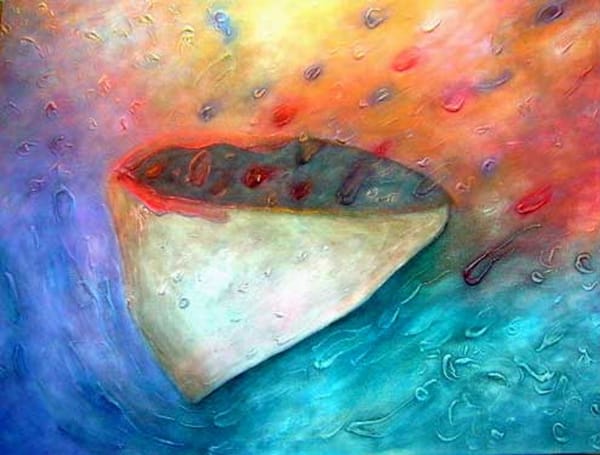
Daisy Kates is an artist in Placitas, New Mexico. Her painting Vessel is used in the Spectrum column icon. Daisy is turning 80 this year. She lives in her small house and studio high in the foothills of the Sandia Mountains. She spent her long career teaching pottery and ceramic art in social service settings as well as traveling to many far off places. After 50 years of working in clay and also painting, she now builds mixed-media sculptures primarily in steel.
More at: https://www.nmpotters.org/daisy-kates
Community Supporters of the NM Jewish Journal include:
Jewish Community Foundation of New Mexico
Congregation Albert
Jewish Community Center of Greater Albuquerque
The Institute for Tolerance Studies
Jewish Federation of El Paso and Las Cruces
Temple Beth Shalom
Congregation B'nai Israel
Shabbat with Friends: Recapturing Together the Joy of Shabbat
New Mexico Jewish Historical Society
Where the North Ends, A Novel by Hugo Moreno
Policy Statement Acceptance of advertisements does not constitute an endorsement of the advertisers’ products, services or opinions. Likewise, while an advertiser or community supporter's ad may indicate their support for the publication's mission, that does not constitute their endorsement of the publication's content.
Copyright © 2026-27 New Mexico Jewish Journal LLC. All rights reserved.