






Lost in a Labyrinth of Confusion: Where the North Ends — At Last

by Carl Montoya
I approached Where the North Ends with much anticipation. The premise — a time-traveling narrative connecting the contemporary period to pre-Pueblo Revolt New Mexico — promised an ambitious blend of historical fiction and mysticism reminiscent of Carlos Castaneda's work. Unfortunately, the execution left me frustrated and struggling to engage with what could have been a compelling story.
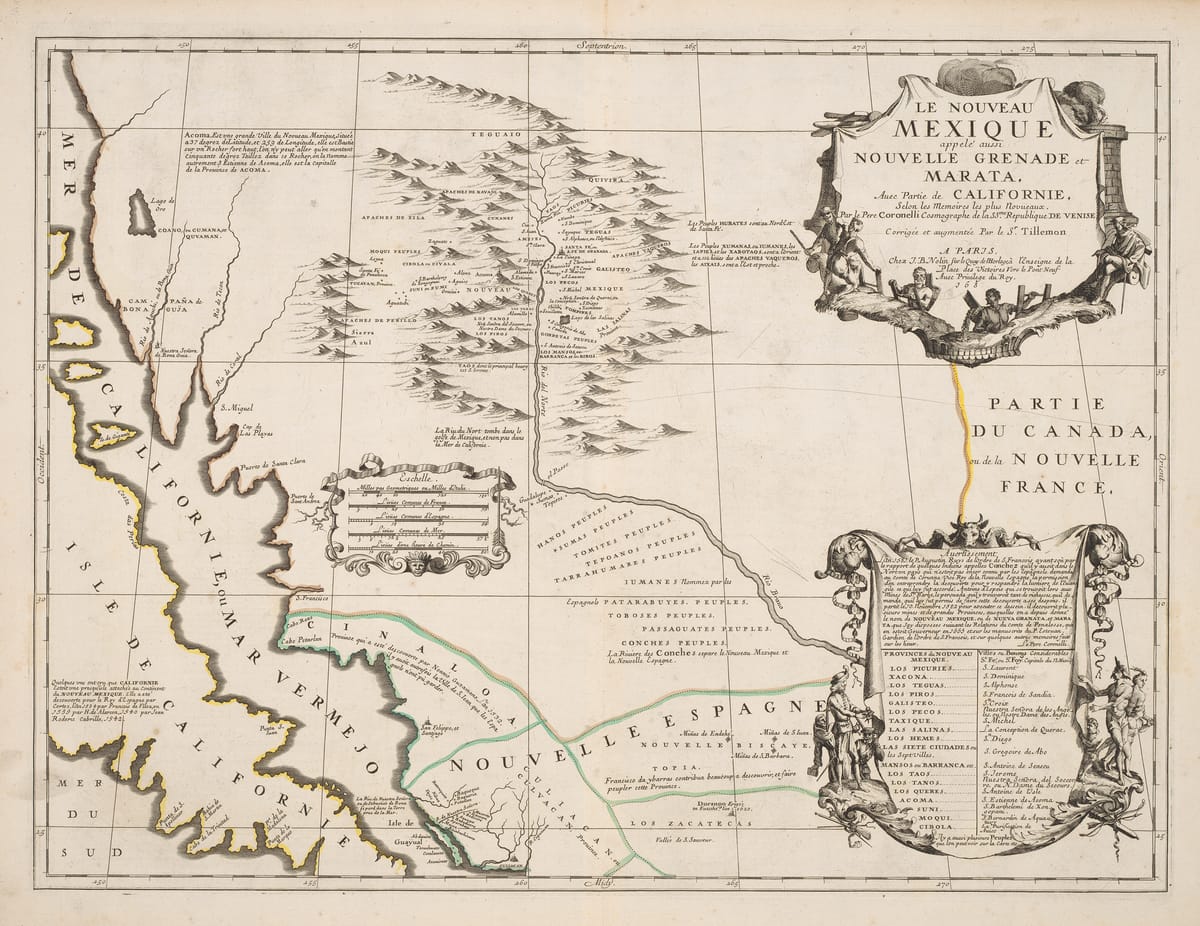
The novel follows Uriel Romero, whose bicycle accident in contemporary time seemingly transports him into the body of Diego Romero, a disgraced 17th-century Franciscan monk. The author weaves together themes of history, mysticism, trauma, and cultural identity to create multiple narratives: the exploitation of Native peoples by Spanish colonial authorities, various references to crypto-Jews, or a similar term, Siervos de Dios (Servants of God),* and a contemporary tragedy involving plagiarism and familial violence.
The strongest qualities of the book are its sense of place and historical grounding. The author clearly knows southern New Mexico intimately, and the descriptions of its landscapes, pueblos, missions, and colonial history feel authentic and carefully depicted. Readers familiar with the region or interested in the era will appreciate how real communities, forgotten settlements, and the Pueblo Revolt era are brought into the narrative. The book does a good job of exploring complex ideas: cultural oppression, religious hypocrisy, Native suffering, and the moral compromises of colonization that led to the Pueblo Revolt. Regrettably, although the author occasionally mentioned crypto-Jews or the Siervos de Dios throughout the book, the subject area itself was never developed.
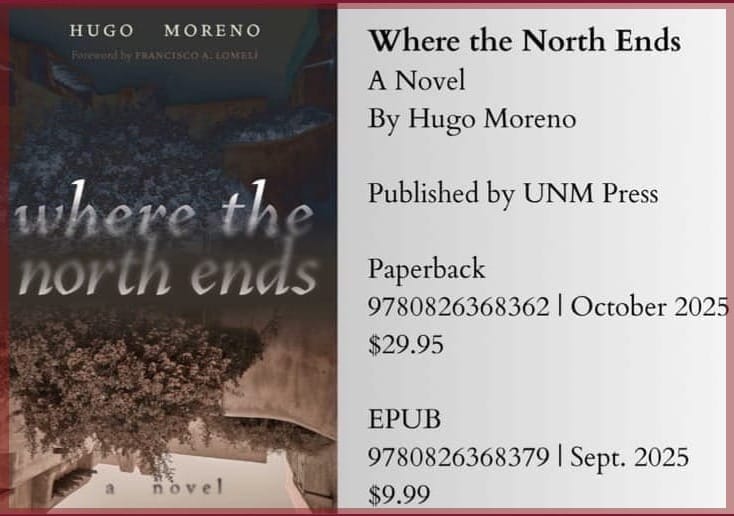
by Hugo Moreno
Foreword by Franciso A. Lomelí
Querencias Series UNM Press October, 2025
The novel’s greatest challenge is its bewildering structure. The narrative shifts constantly between time periods, realities, and psychological states without always providing clarity. It is often unclear whether the characters are alive, dreaming, spiritually traveling, or trapped in some undefined in-between existence. Rather than feeling intriguingly mysterious, the frequent transitions can become confusing and disorienting. The introduction of elements like a talking mule named Lucius and the various forays into the spiritual realms might have added mystical depth, but instead they contributed to a sense of narrative overload.
The story also unfolds at a slow pace, with long digressions, philosophical passages, and mystical sequences that oftentimes obscured rather than illuminated the central narrative. The spiritual and mystical elements, which are intended to deepen the novel’s themes, are especially difficult to follow. The book blends an appropriation of Indigenous spirituality with Catholic symbolism, supernatural experiences, visions, astral travel, and underworld journeys. While these ideas are imaginative, they often feel fragmented and overly abstract, making it difficult to stay grounded in the story. At times, the mystical elements feel more like obstacles than enhancements to the narrative.
For this reader, the emotional core of the book—particularly the contemporary storyline involving grief, guilt, family corruption, and personal challenges—could have anchored the story more effectively had it been clearer and more tightly structured. Instead, the shifting realities and spiritual detours often dilute the emotional impact rather than intensify it.
This is not a book for the casual reader. It demands patience, if not perseverance, with its non-chronological structure, ambiguity, and willingness to accept multiple layers of often confusing realities. For readers who enjoy experimental fiction that prioritizes complexity over clarity, this novel may appeal to you.
Where the North Ends is a challenging and difficult novel. It is richly imaginative, steeped in history, and ambitious in scope. But it is also dense, nonlinear, spiritually opaque, and at times exhausting to follow. Readers who enjoy complexity, ambiguity, slow-paced storytelling, and narratives that blur the boundaries of time may find it enticing. Those who prefer clarity, cohesion, and a more straightforward plot may find the novel frustrating and hard to fully engage with. I am in the latter category.
*The term "Siervos de Dios" (Servants of God) was a self-identifier by crypto-Jewish communities – referred to pejoratively by the Spanish Inquisition as "Judaizers" – in the 16th and 17th centuries, particularly within the jurisdiction of the Mexican Inquisition. Historian Martin A. Cohen’s work includes a specific chapter titled "Servants of God" (Chapter 6) which details how the circle of Luis de Carvajal the Younger utilized this language to define their secret religious identity. Source: Cohen, Martin A. The Martyr: The Story of a Secret Jew and the Mexican Inquisition in the Sixteenth Century. Philadelphia: Jewish Publication Society of America, 1973.
Carl Montoya, a native of Truth or Consequences, New Mexico, relocated to Arizona with his family and resided in Scottsdale during his formative years. He retired from the federal government, where his career encompassed several distinguished assignments mostly in the Washington, D.C. area. These assignments included: Office of the Commissioner of the Social Security Administration, Foreign Service Officer at Embassy London, Office of the Secretary of Health and Human Services, and Director of the Office of Intergovernmental Affairs. Carl’s career concluded as an Associate Regional Administrator in Philadelphia, where he retired and currently resides.
Carl is married to the former Donna Leibowitz and has four sons from a previous marriage. He is also a proud grandfather of four grandchildren. His interests include Judaism, genealogy, writing, and improving his Spanish fluency. Carl serves as a Board Member of Mikveh Israel, the Synagogue of the American Revolution, situated in Philadelphia. Mikveh Israel represents one of only three Spanish/Portuguese Sephardic Synagogues in North America. Carl and his wife, Donna, enjoy extensive travel during their retirement.
READ More by Carl Montoya:
 New Mexico Jewish Journal
Community Supporters of the NM Jewish Journal include:
Jewish Community Foundation of New Mexico
Congregation Albert
Jewish Community Center of Greater Albuquerque
The Institute for Tolerance Studies
Jewish Federation of El Paso and Las Cruces
Temple Beth Shalom
Congregation B'nai Israel
Shabbat with Friends: Recapturing Together the Joy of Shabbat
New Mexico Jewish Historical Society
Where the North Ends, A Novel by Hugo Moreno
Policy Statement Acceptance of advertisements does not constitute an endorsement of the advertisers’ products, services or opinions. Likewise, while an advertiser or community supporter's ad may indicate their support for the publication's mission, that does not constitute their endorsement of the publication's content.
Copyright © 2026 New Mexico Jewish Journal LLC. All rights reserved.