
Roberta Grossman: Making Sense of the Moment, Ruffling Feathers, Creating Conversations
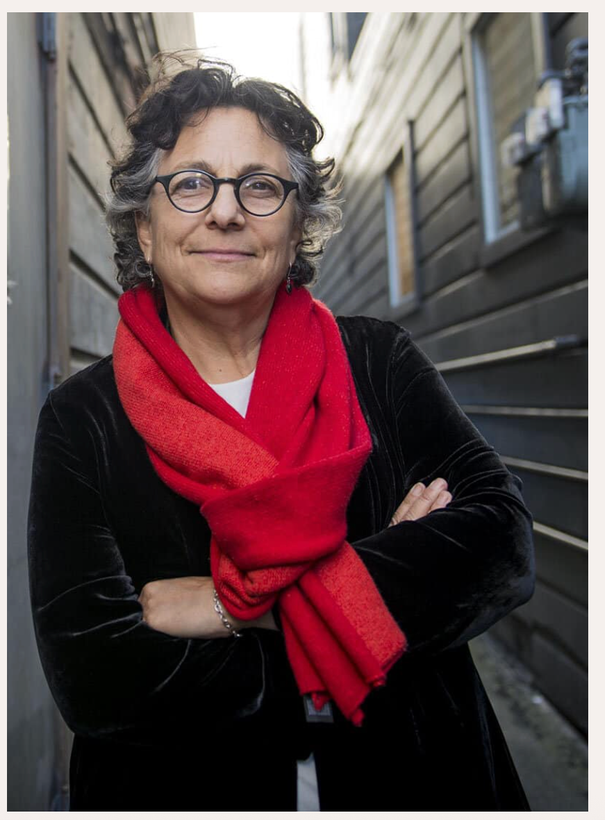
by Colette Freedman
It is a complicated time to be a Jewish woman right now. There is so much contemporary anti-Jewish rhetoric both from the left and from the right that it is hard to know where to feel safe. Last month, I was wearing my Star of David necklace while I was zooming with my mother and she immediately said, “You should probably hide that. I want you to be safe.” This is from a woman who was born in Connecticut in 1941 while overseas, six million Jews were being systematically slaughtered. It was heartbreaking … but understandable. How can we feel safe and still allow our voices to be heard? I don’t think we can. I think we have to take risks. We have to speak up and speak out. Watching Roberta Grossman’s documentary Who Will Write Our History, her protagonist, Holocaust surviver Hannah Auerbach states that she faces a “double exclusion” as a woman and a Jew. Hannah easily identifies the challenge of what many of us are currently and constantly questioning: How can we cut through the noise of a white supremacist Christian patriarchal society and let our voices be heard? There is so much rampant antisemitism – ignorantly in higher academia which truly doesn’t understand both sides of the issue and aggressively from militants who want the total destruction of Israel. So when I was asked to interview award winning film director/producer Roberta Grossman, I was feeling incredibly lost, silenced, afraid and alone. 24 hours later, having binge watched all of Grossman’s documentaries and chatting with this maverick, I felt more emboldened, more empowered and more hopeful. Because Roberta Grossman doesn’t just talk the talk, she walks the walk. Not only do her diverse melange of documentaries feature badass Jewish women who have pride in their Jewish identities and refuse to be silenced, Grossman has generously passed the baton to other filmmakers to create their own stories by founding Jewish Story Partners.
“There's so much polarization within the Jewish community, and it's so nasty. Everything feels like an existential threat,” Grossman shared, “I mean, when people are in trauma, I'm afraid everything feels like an existential threat. And that's what it seems like where we are right now. So how do we fix it? It's by making art, right? Because otherwise it's just both sides arguing. I don't know that we can be responsible for fixing things which are so deep, but I do think that we need to continue to support artists, because they are probably the people who will help make sense of the moment, or at least ruffle feathers and create conversations.”
And there it was my answer: A Jewish artist’s responsibility is to make sense of the moment, ruffle feathers and create conversations. It is not to sit silently but to be heard. Grossman has already done that beautifully with her wide range of documentaries, from her joyous film, Hava Nagila, about the origin of the famous Hebrew folk song which translates to “Let us Rejoice,” to Blessed is the Match, about the bravery of Hungarian poet and Zionist Hannah Senesh, who left the safety of her life to purposefully fight back. Senesh parachuted into Nazi-occupied Europe in an effort to save the Jews of Hungary during the Holocaust. She was captured by the Nazis, tortured and killed. Another woman who is still fighting back is high profile attorney Gloria Allred, whom Grossman deftly captures in her Netflix Original Seeing Allred. Grossman follows feminist lawyer Gloria Allred as she empowers victims of sexual abuse to speak out, champions same sex marriage and fights against gender discrimination. As an artist, Grossman’s films have made sense of many moments, ruffled feathers and created conversations.
In Who Will Write Our History historian Emanuel Ringelblum, along with Hannah Auerbach and a clandestine group of Jews from Warsaw’s Jewish Ghetto known as Oneg Shabes, decide to fight Nazi lies and propaganda with pen and paper. They believe that writing is the only way to have “ownership of self.” The multilayered ramifications of this story ring true today. Grossman uses a great deal of cinematic hybrid filmmaking as her actors are brought to life. When the Nazis discover Ringelblum and his family, the audience has come to know them, advocate for them and cry for them when they are murdered.
This passion that she has elegantly woven throughout her filmmaking is not just limited to the screen. Grossman created Jewish Story Partners as a continuation of her work to give voice to the voiceless, especially when there is currently a de facto boycott against Jewish artists. Even Israeli filmmakers, who were always generously supported by the government, are now getting a lot of censorship. So it's now more important than ever to create a 21st century archive of Jewish stories, stories that will help tell us in the moment who we are, and help us look back to see who we were. While less than one percent of Jewish philanthropists money go to Jewish artists, JSP has awarded nearly $4 million in grants to 118 films with Jewish content since its inception.
“I was really lucky to spend my life making films on Jewish subjects.” Grossman shares, “When I finished Who Will Write Our History, I didn’t know if I could top that. Then the Foundation for Jewish Culture shuttered. So Nancy Spielberg, Caroline Libresco and I talked about our vision and we approached Righteous Persons Foundation who helped us get off the ground. They’ve been our biggest and most consistent supporters and we’ve been growing our funding base from there. So I feel like we are doing something internally for the Jewish people: We are helping to create a very broad and diverse catalog of Jewish stories and hopefully countering misconceptions, anti-Semitism, and narrow views about everything from individual Jews to Israel.”
The heroic subjects of Grossman’s films, Hannah Senesh, Rachel Auerbach and Gloria Allred, are all optimists and activists who projected their voices through their writings and their belief systems. They believed they could make a difference. They were passionate and unafraid to fight back and to speak up. And they make us feel… and by feeling, we become activated to raise our own voices. In the end, Grossman makes films because films are an “empathy machine.” Michelle Obama famously said, ’It’s hard to hate up close’ and film brings us up close.
Many Jewish Story Partners films have gone on to win innumerable accolades and film festivals. The films are incredibly diverse and range from Israeli activist-comedian Noam Shuster Eliassi's Oscar short listed COEXISTENCE, MY ASS! which traces Noam’s personal, professional, and political journey in tandem with the region’s steady deterioration as she becomes progressively disillusioned with traditional peace activism to Marisa Fox’s My Underground Mother, which recently played at the Santa Fe Film Festival as did Grossman's short Extinguished Lives. The film questions “the price of silence” as Fox’s directorial debut unfolds like a detective story highlighting a secret journal from a Jewish women’s camp that reveals a shocking story of Nazi trafficking, sexual violence and empowering agency told by a band of sisters who became resistors when they were mere teenagers.
These are just two of the 114 films to which Grossman and her team have given grants. But it’s not just about money, the JSP offers hours of continuum support, and one-on-one consultation support with filmmakers. They watch cuts, give notes, and talk about festival strategies. In the end, Grossman and her foundation believe, “Cinematic storytelling generates empathy, inviting us to see and celebrate each other across perceived boundaries and to gain insight into the human condition. Film is also a vital conduit for the free exchange of ideas in a democratic, open, and pluralistic society.”
Jewish Story Partners hopes to spark dialogue among both Jews and non-Jews with its wide array of independent, filmmaker driven films which express artistry, excellence and singularity. Meeting Grossman and watching her films has inspired me to be bold, be brave, speak out, ruffle a few feathers and create conversations.
To learn more about Jewish Story Partners visit jewishstorypartners.org
Last call for entries for 2026 - January 16, 2026 11:59 PM PT
Colette Freedman is a filmmaker, playwright, novelist and educator. www.colettefreedman.com
Read also in NMJJ: "Extinguished Lives" world-premier short documentary; interview with filmmaker Roberta Grossman, SFIFF OFFICIAL SELECTION
Community Supporters of the NM Jewish Journal include:
Jewish Community Foundation of New Mexico
Congregation Albert
Jewish Community Center of Greater Albuquerque
The Institute for Tolerance Studies
Jewish Federation of El Paso and Las Cruces
Temple Beth Shalom
Congregation B'nai Israel
Shabbat with Friends: Recapturing Together the Joy of Shabbat
New Mexico Jewish Historical Society
Where the North Ends, A Novel by Hugo Moreno
Policy Statement Acceptance of advertisements does not constitute an endorsement of the advertisers’ products, services or opinions. Likewise, while an advertiser or community supporter's ad may indicate their support for the publication's mission, that does not constitute their endorsement of the publication's content.
Copyright © 2025 New Mexico Jewish Journal LLC. All rights reserved.