




Flourish and Struggle: The Elusive Jewish Communities of Barcelona
By Jonah Wald
During December of 2025 and going into the January of 2026 I went with my family to Barcelona, Spain. We learned a lot about the rich history of this area and I became very interested. These are some things I learned on my trip.
The Spanish Inquisition was the systematic forced conversions, trials, expulsions, and persecution of hundreds upon thousands of Jews and Muslims that lived in Spain from 1480-1834. Before the Spanish Inquisition approximately 300,000 Jews lived in what is now called Spain, more than 5,000 of these Jews lived in the region called Catalonia. The history of Barcelona’s Jews is a time of intellectual flourishing under royal protection and systemic vulnerability to social and political shifts.
How did they get there?
The history of Barcelona’s Jews reveals a complex period for Jews: periods of intellectual and economic flourishing existed alongside constant vulnerability to royal power and popular violence. Jews have been documented living in Catalonia since 600 BCE. When I will talk about “the Jewish communities of Catalonia” I am referring to the communities initiated around 200 BCE. Jews served common roles in society like money lenders, physicians and diplomats, the Jewish families were not much different than the Christian majority. The Jews also served as butchers before the King of Spain outlawed the transaction of meat between Jews and non-Jews. This action provided a sense of control of the Jews for the king.
Protection under the King
The Spanish Jews had a very unique relationship with the king. Since they had no allegiance to the church, they turned to the king. They did not pay normal taxes to the local agent of the king. Instead they paid their taxes to the king himself, having a treasurer of the community go to the king as a representative to negotiate the taxes for each year.
The king also considered the safety and security of the communities. He did this by building walls around the Jewish communities so that nobody could come in and harm or harass the Jews. The walls were helpful for security; they also served as a form of control and dominance from the king. On the flip side, while most people could not terrorize the Jews, he could, so the Jews the king’s personal people that he could do as he wished with us. This fragile royal protection shaped Jewish economic roles — especially money lending.
Money lending
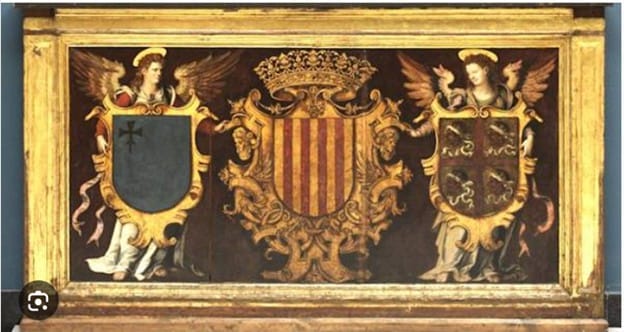
During this time when Jews existed in Spain the Jews faced severe job persecution from the king. This is where the Jewish stereotype of Jews being greedy with money comes from. Economic restrictions imposed by Christian authorities created resentment, not Jewish behavior, the king forced the Jews to become money lenders by banning everything else. The king restricted the Jews and Muslims to money lending in around the 13th century. However, the only difference between the two groups was that the Muslims were not allowed to charge interest, so the Jews ended up being the crown’s tax sponges, squeezing other communities. This caused a lot of people to think that Jews were stealing all of their money, but of course this is not true. This made the Jewish communities both valuable and vulnerable because the king now had “perfect” control over the communities. This made the Jews important but vulnerable monetary assets to the king of Spain. Laws like this were very hard for Jewish families to live under, as you can imagine.
Jewish thinkers
Even though times were not easy for the Jews some of the greatest Jewish philosophers came out of this era. Some of the most well-known ones were Ramban and Rashba. All of these scholars are the pillars of who we are as a people.
Ramban or Nachmanides was a Catalan rabbi and Jewish scholar. Many of his works are either written in Catalan or Hebrew. He was born in northern Catalonia. Ramban’s works consisted of tons of Talmud and Torah commentary.
In 1263 the Barcelona Disputation took place. This is the most famous out of many debates between Jews and Christians. These “debates” were highly rigged on the benefit of the Christian side, although Ramban was known to be a very skilled debater for his time. This specific debate was interesting because it took place in the Call between Ramban and Pablo Christiani. Pablo Christiani had been a Sephardic Jew who was a student of Reb. Eliezer of Tarascon. He married a Jewish woman and had Jewish kids with her. Later he converted to the Roman Catholic Church and converted his kids to become a Friar and dedicated his life to converting Jews to Christianity. If Ramban lost that debate his community was to be punished, but if he had won that debate his community would have been punished for angering the church. King James I of Aragon actually gave Ramban a prize of 300 gold pieces after the debate, saying he had never heard "so unjust a cause so nobly defended." So this was an interesting debate because it shows the culture of Spain in that time, and how conversos like Pablo had to prove their allegiance to the church.
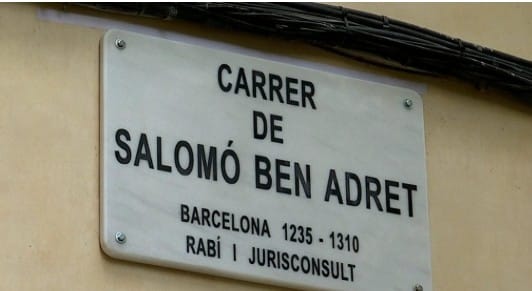
Finally, Rashba or Solomon ibn Adret was born in the crown of Aragon or modern day Barcelona. He was the main Rabbi of Barcelona for most of his life. He also has a street named after him in the historic El Call neighborhood.
Anti-Jewish Riots
Even though the official “inquisition” started in 1480, in 1391 there was a violent anti-Jewish massacre known as the pogrom of 1391. This was the very beginning of the Sefardic diaspora. During this thousands of Jews converted to the Roman Catholic Church to stay in Spain. These people are known as conversos.
Throughout the 15th century tensions rose between the Jews and Christians in Spain. Many more of these riots took place in what is now the historic El Call neighborhood, except on a smaller scale.
Legacy and Memory
When you walk through the streets of the Gothic quarter of modern-day Barcelona you will see the old synagogue which is now a Judaica store/museum. It was not always a Judaica store/ museum, for a long time this building served as a laundromat, and pub before it was rediscovered. You will also see small medieval doorframes on these door frames. You can see little carved out divots in the right-hand side of the doorways. These are the small spots where a Jewish family’s mezuzah was placed. After the massacre of 1391 the cemetery of Montjuïc (Jewish Mountain in Catalan), the Christians went to Montjuïc and stole stones from the Jewish cemetery, you can actually see the Jewish burial stones next to the entrance to the Cathedral of St. Eulalia.
Even though the streets are the same as they were in Roman times and you can see history in every old alleyway. There are not very many public plaques or recognition of the Jewish suffering in the area. It is not just that the Jews left; the city tried to forget that they were even there. This is because the king of Spain (King Felipe VI of Spain) is a direct descendant of Ferdinand II of Aragon who was the monarch who instituted the inquisition laws. He has repeatedly dismissed claims of it, but this is a prime example of the worldwide erasure and absence of Jewish history and resilience that still lingers in Spain.
The Jewish Museum of Barcelona
In the Call there’s a nice but small Jewish museum that talks about many of the great scholars of the area and some of their discoveries. They provided records on the Jewish communities and talked about the history of Montjuic. However, I was so surprised that they didn’t mention the Inquisition. This was a municipal museum, owned and operated by the City of Barcelona. I think they didn’t put the Inquisition in the museum because it makes them look very bad and so they were acting as if they were doing good, but didn’t complete the job. _
Our family connected with the organization Mozaika that leads tours and knew a lot about the current and historical Jewish communities of Barcelona. Their Instagram page is at @mozaika.bcn.
Jonah Wald is an eighth-grade student at Bosque School who also attends B’nai Israel Religious School. He enjoys reading and writing and is involved in a range of other activities in his free time.
Community Supporters of the NM Jewish Journal include:
Jewish Community Foundation of New Mexico
Congregation Albert
Jewish Community Center of Greater Albuquerque
The Institute for Tolerance Studies
Jewish Federation of El Paso and Las Cruces
Temple Beth Shalom
Congregation B'nai Israel
Shabbat with Friends: Recapturing Together the Joy of Shabbat
New Mexico Jewish Historical Society
Where the North Ends, A Novel by Hugo Moreno
Policy Statement Acceptance of advertisements does not constitute an endorsement of the advertisers’ products, services or opinions. Likewise, while an advertiser or community supporter's ad may indicate their support for the publication's mission, that does not constitute their endorsement of the publication's content.
Copyright © 2026 New Mexico Jewish Journal LLC. All rights reserved.