




No One Came to Taos to Be Jewish or The book you weren’t looking for but are glad you found
By Corinne Joy Brown
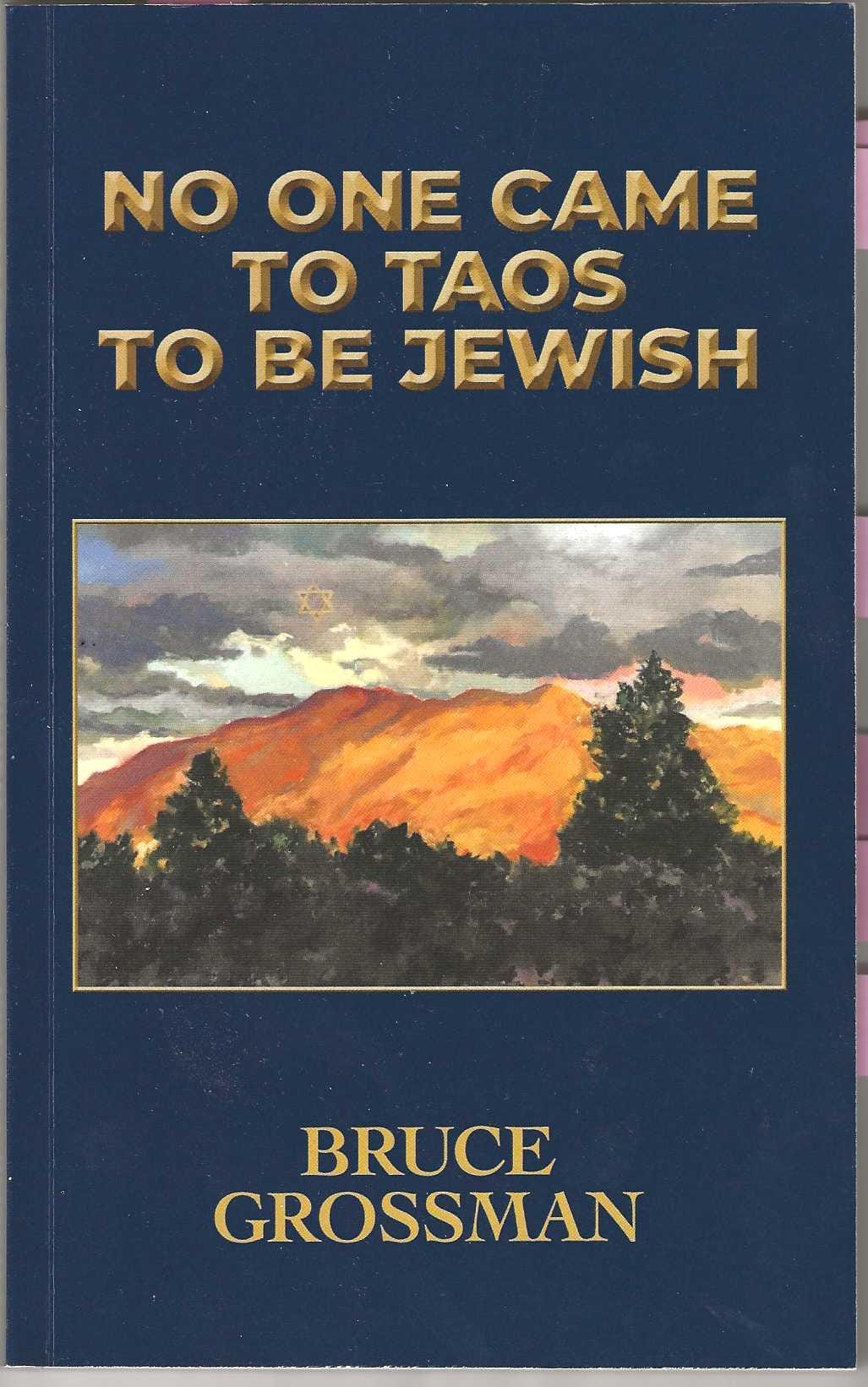
By Bruce Grossman
Nighthawk Press 2022
Amazon.com
Op Cit Bookstore Taos
Softcover $14.95
For those of us who came of age in the sixties and seventies, you might remember that an entire population known as the Baby Boomers seemed to be on a quest to find themselves. It was a tumultuous era of domestic riots, a war in SE Asia, and a West Coast message to “Tune in and Drop Out”. College students avoided the draft, draft dodgers avoided the government, and flower children sought solace through music, meditation and art.
I’m not saying that’s what drove author Bruce Grossman and his wife Susan to consider visiting Nepal, which at the time was their ultimate goal, but Northern California, their former home, had lost its charm. After a cross-country road trip searching for some kind of nirvana and all of America’s national parks, plus a cold, dark winter in New England with friends, a realization occurred that the state of New Mexico beckoned with over 300 days of sunshine per year. It seemed like an invitation.
An old friend who lived in a romantic-sounding place called Taos had always suggested they “drop by if in the neighborhood”. That was it: Bruce and Susan headed west in 1976 and the rest—as they say – is history. Only that might be the biggest understatement of the year. The friend had moved on, but their first taste of life in the Taos Valley over the next six months felt blissfully promising, (assuming one was willing to study Spanish.) Nonetheless, adventure still called and they decided to travel abroad before committing permanently to a new home. After exciting trips to far-off places, in 1978 they returned to settle in Taos, New Mexico.
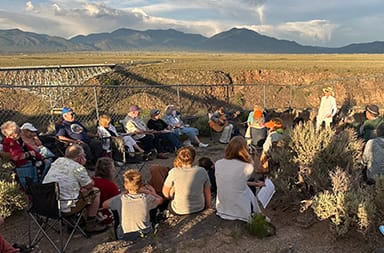
In this heartfelt account of Bruce Grossman’s personal evolution in the “wilderness” of Northern New Mexico, along with the simultaneous growth of an extraordinary community of strangers who all happened to be Jews, comes a bracing story with a universal message that touches the hearts of anyone with a Jewish soul. That message, not surprisingly, is nothing less than how communal Jewish life spontaneously arises to nourish, protect and sustain Jews wherever they may land.
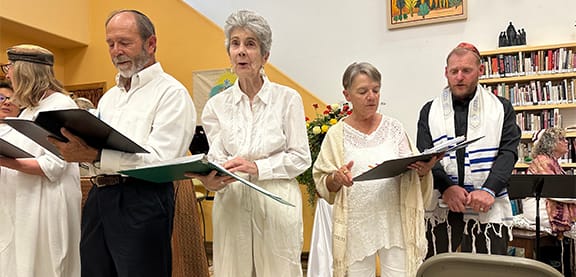
This book is divided into three parts; each, as the author says, “with its own voice.” The first is Bruce’s own accounting of how he came to find his Jewish heritage at the base of Taos Mountain. It also deals with the growth of his family, the painful end of his marriage to Susan in 1997, and his later introduction to Cindy Sadow at a local wedding; a remarkable woman who eventually became his second wife and much more. But most of all, without giving away the grist of his personal transformation, I encourage you to read for yourself Bruce’s unexpected and newfound relationship with God, Judaism, its rituals, and its practice – a hallelujah if I’ve ever read one.
The second chapter is about the three main rabbis of Taos, and how their arrival or emergence reflected the growth and needs of the community. Rabbi Judith HaLevy arrived in Taos in 1976 and, like Bruce, had not come there to “be Jewish.” She had lived in Israel and Mexico, spoke both Hebrew and Spanish, and quickly became embedded in Taos local Jewish life, taking on more and more responsibility. Finally ordained in 1992, she served as interim Rabbi at Temple Beth Shalom in Santa Fe. then moved on to Los Angeles to help run Metitva, a new center for contemplative Judaism with Rabbi Jonathon Omer. In 1996 she became the Rabbi at the Malibu Jewish Center. As fate would have it, however, she joyfully returned to Taos in 2018 and resumed leading the community.
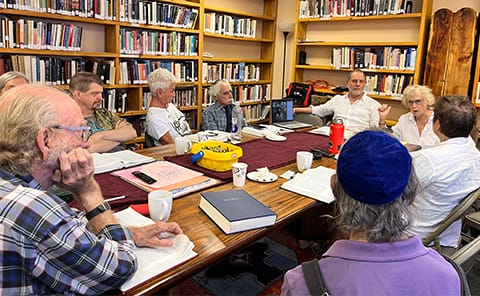
Rabbi Chava Carp, another early Jewish resident, came from Chicago to Taos in 1980. The next year, a retreat of over 100 people, (created by simply reaching out to anyone in the phone book with a Jewish sounding last name) created a thirst for something more structured. Chava’s mother was the principal of a Jewish school on the upper West Side of NYC and Chava was trained at Hebrew Union College and the Jewish Institute of Religion in order to become a Jewish Studies teacher. By default, she stepped forward in 1982 to start a school. The families soon began holding High Holiday services, seders, and women’s retreats, as well. By 1989 the need for more formal organization became clear and a non-profit organization was formed called B’nai Shalom. After serving as the spiritual leader of B’nai Shalom for several years, Chava decided to pursue ordination as a rabbi. For several years she traveled back and forth to Philadelphia to study with noted Rabbi Zalman Schacter-Shalomi, founder of the Jewish Renewal Movement, as well as other luminaries like Rabbi Tirzah Firestone and Rabbi Shlomo Carlbach.
In 1993, she became Rabbi Chava Carp. By 1997 she moved to Albuquerque to work for Jewish Family Services, followed by a return to her love of teaching children at the Solomon Schechter Day School (both of which later closed). More recently, she’s been active in providing spiritual guidance and leadership in northern New Mexico and Taos, as well as shabbat services for the B’nai Shalom Havurah plus regular Torah studies.
The final rabbi of note wasn’t really a rabbi at all but a local tzadik who was beloved by the community. Ron Kalom had always been a devotee of the famed Rabbi Menachem Mendel, the Chasidic rabbi of Kotzk, Poland (1757-1859). At some point in his life, he began to refer to himself as the “Kotzker de Taos”. Kalom arrived in 1968, escaping the chaos of Chicago and the Democratic convention. The town of Taos became his home for the next 51 years. According to Grossman, “Kalom also didn’t come Taos to be Jewish, …but Judaism dwelt within him like a sacred spring.” An army vet (the Korean war) and a dropout from Hebrew Union College, Kalom was deeply spiritual in his own way. He and his wife opened a thriving pizza restaurant that became a hub for writers and artists. Sometimes services were held there as well, leading to a regular Saturday prayer group. By 1993 that small group had become The Taos Minyan. Kalom’s life and influence reads like a folktale; one of passion, empathy and love for the people and the community. Always ready to serve whenever needed, Kalom responded, “Hineni”.
“Here I am.” The beloved Kotzker is fondly remembered by all.
***
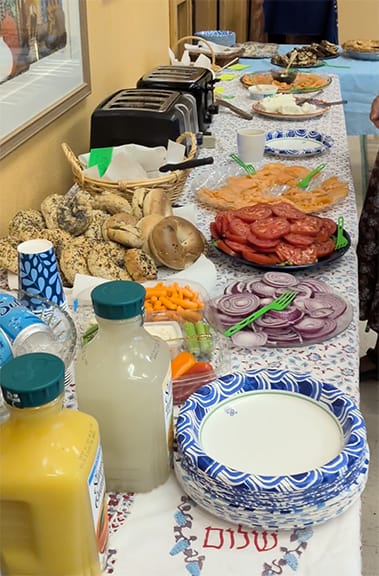
The last section of the book is a detailed chronicle of the B’nai Shalom Havurah, the Taos Minyan, and the Taos Jewish Center. A brief history of the Jewish cemetery is included as well.
The story over-all strikes a chord. As a Jewish person who also lives in the American West, I’m well aware that many Jews fleeing congested cities rife with cultural stereotypes move out West because of the anonymity it provides. Our wide-open spaces absorb anyone who chooses to go their own way. One can affiliate or not. Many never do, choosing instead to blend in wherever they settle, observing as little or as much of Jewish life as they prefer. This story of the Taos Jewish community proves the strength that comes with connection.
***
Grossman’s chronicle of awakening feels like a coming-of-age story, filled with insight and self-awareness. He was certainly not the only Jew who found himself in Northern New Mexico, focused on living a fulfilling life that was in no way particularly Jewish, but in his case, certain life cycle events such as the birth of a baby boy, prompted a definite shift.
Grossman wanted his child’s birth to honor an age-old ritual. That ritual required a mohel and a rabbi, and somehow, amongst the many other “unaffiliated”, a local Jewish doctor and educator were found. As time passed and the family grew, his older son wanted a bar mitzvah, (something he saw in a film) which catapulted both father and son into study, re-introducing Grossman to a rite of passage he’d never fully appreciated. Along the way, a cohort of Jewish friends developed and the warmth of observance and learning evolved into a real congregation. Strangers no more, a community emerged out of the vast desert and mountains, filling the need for a rich, syncretic spiritual life.
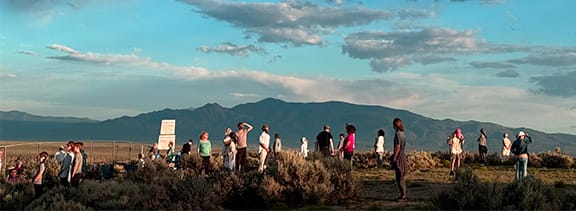
In Grossman’s own words, following the observance of the High Holidays in 1993, “We gathered on the Kalom’s large deck, overlooking Sunset Park off Valverde Street, directly across from the Taos Public Library. In our bare feet we stood and davened (prayed) through the entire service…with Taos Mountain looming to the north, Tres Piedras dancing in the West, and the fall air invigorating our lungs, it was one of the most memorable Jewish experiences of my life. Four guys, four different tones, four souls all leaning into the ineffable and inspiring light of the southern Rocky Mountains. It was an audacious reckoning with an ancient tradition. Suddenly I felt the spiritual freedom and authenticity that had eluded me all of my life.”
***
Grossman’s ability to tell a story is masterful, as are his characterizations of people and events. His writing flows and feels more like an intimate conversation with a friend than a manuscript, much more than any history of a time and place. If you wonder why I believe everyone should read this satisfying work, I credit the author of the prologue, Karl Halpert, whose words could not be better said. “Five hundred years ago, we fled Spain for the wilds of this very Rio Grande Valley – emphatically, albeit cryptically, to be Jewish. Bruce memorializes a personal continuance of our preternatural wanderings and affirms: This is our portion.”
Savor this memoir no matter where you live. You’ll be glad you did.
###
Corinne Joy Brown is an award-winning author of historical fiction and non-fiction inspired by the American West with ten books in print, including her acclaimed novel Hidden Star about Crypto-Judaism. She also writes memoirs, plus freelances for a variety of print publications focused on design, architecture, fine art, and popular culture. Corinne writes middle-grade fiction as well, and has published a series of art books for young readers who love horses. A past-president of the Denver Woman’s Press Club, a founding member of Women Writing the West, and the editor/publisher of HaLapid, an academic journal serving the Society for Crypto-Judaic Studies, she is a Fellow of the University of Colorado History Department at CU/Colorado Springs. She and her husband live in Colorado and enjoy their German Shepherd, Ziggy. Stav Appel has inspired her next novel. Visit her at https://corinnejoybrown.com/
Read also:
 New Mexico Jewish Journal
 New Mexico Jewish Journal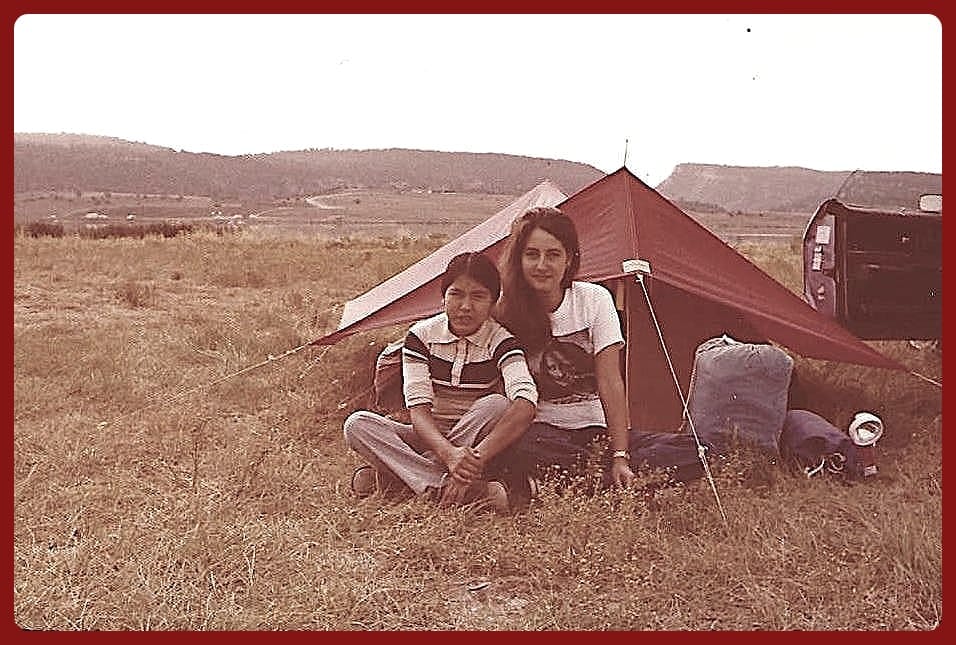
 New Mexico Jewish Journal
From Mabel Dodge Luhan to Rosh HaShanah, An Unexpected Connection
Corinne also co-chaired the Society for Crypto-Judaic Studies 35th annual conference Aug 10-12, 2025 in Los Angeles. Go to http://cryptojews.com for more info.
Community Supporters of the NM Jewish Journal include:
Jewish Community Foundation of New Mexico
Congregation Albert
Jewish Community Center of Greater Albuquerque
The Institute for Tolerance Studies
Jewish Federation of El Paso and Las Cruces
Temple Beth Shalom
Congregation B'nai Israel
Shabbat with Friends: Recapturing Together the Joy of Shabbat
New Mexico Jewish Historical Society
Where the North Ends, A Novel by Hugo Moreno
Policy Statement Acceptance of advertisements does not constitute an endorsement of the advertisers’ products, services or opinions. Likewise, while an advertiser or community supporter's ad may indicate their support for the publication's mission, that does not constitute their endorsement of the publication's content.
Copyright © 2025 New Mexico Jewish Journal LLC. All rights reserved.