













The Search is the Goal: A Review of El Iluminado and a Conversation with Ilan Stavans

by Corinne Joy Brown
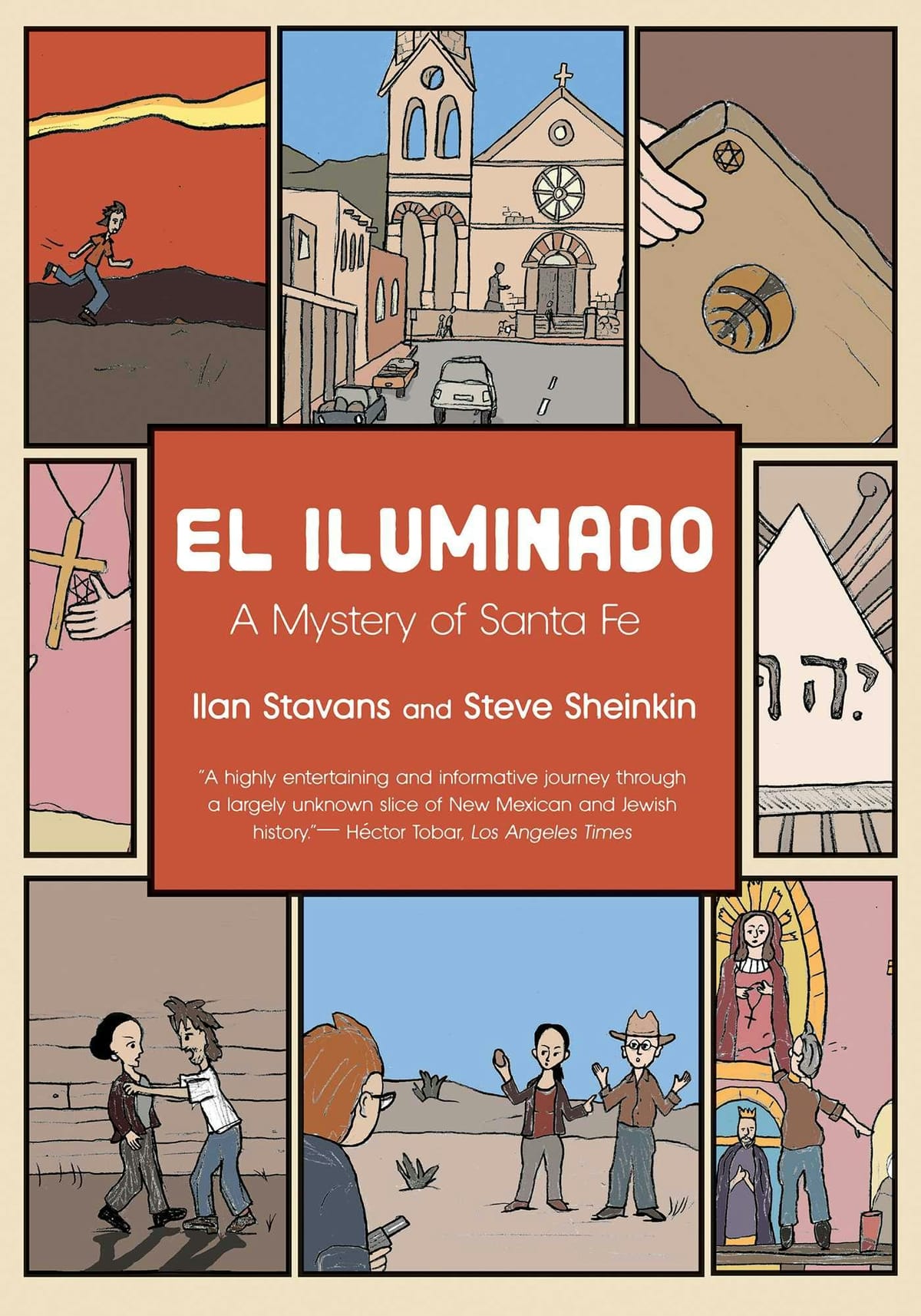
What happens when a professor of Spanish literature and language becomes a character in his own graphic novel, functioning as both author and subject? Nothing less than the creation of a story that holds more suspense and depth than the best “who-dunnit” ever written, one where fiction and reality are clearly blurred.
While crafting a novel around the sudden death of a New Mexican murder victim outside Santa Fe, New Mexico, professor Ilan Stavans is unwittingly drawn into the search for the killer only to discover that there’s more to the situation than he thought. Behind the crime is the search for a missing manuscript or diary, reported lost centuries earlier and belonging to a Spanish Colonial Jewish martyr, none other than Luis de Carvajal the Younger. In time, Stavans realizes that if one can find the answer to one dilemma, he might find the answer to the other. In a novel that gallops along at a furious pace with enough red herrings to fool a real detective, its triumphant finish reveals more than the details of the crime—it’s an homage to the story of New Mexico’s crypto-Jews, as well as Jewish values, thought and meaning. With charming illustrations and brisk dialogue, one may never go back to reading regular fiction again.
Editor's Note: Mimesis and anti-mimesis have now played a cat-and-mouse game. Originally published by Basic Books in 2012, El Illuminado returns in a new edition from UNM Press this March. It makes sense to do so now – since the book's debut, life has imitated art in ways that must be read to be believed, as Corinne Joy Brown explores below.
A Conversation with Ilan Stavans , Lewis-Sebring Professor of Humanities at Amherst College
Preceding the re-release of the graphic novel El Iluminado, this writer had the pleasure of discussing with the author just how this unique illustrated book first came to be. The first edition released in 2012 did very well and was even optioned for film. The new release, on its way in early 2026, will undoubtedly gain a new, appreciative audience. The following interview reveals much about the author who is inseparable from this story.
NMJJ: Why the graphic novel?
Ilan Stavans: I grew up in Mexico City at a time when a tangible transition from the written word to a mix between words and images was taking place. I especially loved Mexican comic strips, in part because of all the muralists in the Mexican (visual) tradition – a way to tell stories for the people. I loved to experiment with this form and when I met Steve Shenkin, the illustrator, I found we had common ground.
NMJJ: What did it mean to you to write it?
IS: Over all, what interests me is the way people create stories to survive, to affirm who they are or to make a stand. We are constantly escaping our own narratives. It’s amazing to me the lengths people go to understand what makes us who we are. What’s most fascinating over all is our collective obsession, the search.
NMJJ: How does it work exactly? Making such a novel?
IS: One of the key parts in a graphic novel allows for the play between images and words. You have to have a balance. It’s like a tango. To understand the connection, the illustrator and I took a trip to Santa Fe with many side trips into the desert and elsewhere. For Steve it was an adventure. As Shakespeare said, “All the world’s a stage…”. I think we are all trapped in a kind of Mexican Tella-Novella. (Sometimes, I can actually feel the background music…).
I see things projected into the world…I often like to think of the tale of Don Quixote and his quest. The search was always the goal, the journey itself. Success or failure can only be measured by the transformation one goes through and the impact of that transformation. It’s not winning the lottery but entering the lottery. Allowing yourself to ask ‘what if?”
To sacrifice one’s life for a dream is to truly know its worth.
I just knew someday I would love to be a character in a graphic novel. Finally, I became one, a character in a novel whose plot everyone knows – except me!
NMJJ: How does this story reflect the real you?
IS: On one page in the story, I am described as “a writer alone in a room.” To expand, “a writer alone in a room is capable of magically changing the world outside.” For anyone who writes, it’s a bit like being on an island, yet there’s something liberating and lonesome as you confront your own inventions. Then, when you’re done with the work, you throw it back into the sea, hoping you find a reader
NMJJ: For whom exactly did you write this?
IS: I wrote this book for three different audiences. For the living—our contemporaries, those who’ve helped shape us. But I also write for the future. We hope the written word will survive the present. Then too, I write for a third audience—those who came before. Although they are long gone, there is still a dialogue between them and us. We go back and forth. One of the things I do as an instructor is to bring back the voices of the people who have passed. No one ever dies fully…
NMJJ: What about Luis de Carvajal and his fanatic commitment to Judaism?
IS: I feel a deep connection to this man. I liked his story, what he fought for. He was in many ways, however, too rigid. But he was persistent; a rebel at his core. He asked the essential questions. In fact, we are all writing our own stories. Other people are also writing them for us—I think we are part of a larger story. I could easily say my God is a story teller, one who sets things in motion. The theme of El Illuiminado is that we need to understand the circumstances, and then listen to the voices from the past.
NMJJ: How does this story address crypto-Jews and their story?
IS: Crypto-Jews are “the Jews within the Jews”. They hide, but find ways to open up, sending messages. We are fascinated by the secrecy that protects them in their exile. And the mystery.
NMJJ: At the end of the book, the professor heads home. As someone who was born outside the US, how do you define the idea of home?
IS: I can show you where a house is but not a home. Home is where you feel secure, but not so secure that you won’t venture out. A home is where you feel balanced and loved and then offer it to others. The element of impermanence is very Jewish on one hand, and also a defining factor of the present. You don’t understand what a home is until you leave it behind. It’s a return to home that allows you to fully appreciate what it is. Home shifts for us and gets reshaped by the places we live, the people we spend time with…even the clothes we wear. Often, home is elsewhere; it’s inside, it’s a faith, a conviction, a sense of mission, an endless search.
NMJJ: Is this new release of the book different than when it first came out?
IS: I don’t see it differently. Current readers are asking however, “why doesn’t this professor go to another city and have another adventure?” I hadn’t thought about it. I am very happy with the fact that it exists and how people approach it.
NMJJ: Is the paperback edition, just released by the University of New Mexico Press, different from the original paperback? It includes a new epilogue.
IS: Aside from a couple of silent amendments, it is identical to the hardcover, with the exception, as you suggested, of a new epilogue. The graphic novel was passionately embraced by its readership. But between 2015 and now, lots has taken place--intriguingly! – in regards to Luis de Carvajal the Younger. His handwritten memoir, which stands as the first autobiography written by a Jew in the New World, was stolen in the early 1930s from the Archivo General de la Nación, the Mexican Archives. In spite of a concerted effort to locate it, the text appeared to have vanished completely. Then, in 2016, in response to the publication of El Iluminado, I got a phone call from a New York philanthropist asking if I would be willing to help authenticate an item that had recently emerged and was about to go on sale at an auction house. That phone call led to an involvement with the CIA and other government agencies. It turns out the item was indeed Carvajal's memoir. The philanthropist acquired it, put it on display at the New York Historical Society, and then repatriated it to Mexico where the Mexican Jewish community built a special exhibit making it available for viewing. I wrote a little book about my involvement in the case called The Return of Carvajal: A Mystery. The epilogue to the paperback edition of El Iluminado further explores the implications of this rediscovery and plays with the idea that life imitates art and not the other way around.
NMJJ: On a closing note, and excerpted from a most memorable conversation, here is what else the author thinks this book is about:
IS: “The belief that each of us is unique—that deep inside there is a light that guides our path.”
Amen.
Corinne Joy Brown is an award-winning author of historical fiction and non-fiction inspired by the American West with ten books in print, including her acclaimed novel Hidden Star about Crypto-Jews She also writes memoirs, plus freelances for a variety of print publications focused on design, architecture, fine art, and popular culture. Corinne writes middle-grade fiction as well, and has published a series of art books for young readers who love horses. A past-president of the Denver Woman’s Press Club, a founding member of Women Writing the West, and the editor/publisher of HaLapid, an academic journal serving the Society for Crypto-Judaic Studies, she is a Fellow of the University of Colorado History Department at CU/Colorado Springs. She and her husband live in Colorado and enjoy their German Shepherd, Ziggy. Stav Appel has inspired her next novel. Visit her at https://corinnejoybrown.com/
Read also by Corinne Joy Brown in NMJJ:
No One Came to Taos to be Jewish or the book you weren’t looking for but are glad you found
New Mexican by Proxy or How My Soul Came to Belong to New Mexico
The Torah in the Tarot by Stav Appel, Coming from Ayin Press
From Mabel Dodge Luhan to Rosh HaShanah, An Unexpected Connection
Community Supporters of the NM Jewish Journal include:
Jewish Community Foundation of New Mexico
Congregation Albert
Jewish Community Center of Greater Albuquerque
The Institute for Tolerance Studies
Jewish Federation of El Paso and Las Cruces
Temple Beth Shalom
Congregation B'nai Israel
Shabbat with Friends: Recapturing Together the Joy of Shabbat
New Mexico Jewish Historical Society
Where the North Ends, A Novel by Hugo Moreno
Policy Statement Acceptance of advertisements does not constitute an endorsement of the advertisers’ products, services or opinions. Likewise, while an advertiser or community supporter's ad may indicate their support for the publication's mission, that does not constitute their endorsement of the publication's content.
Copyright © 2025 New Mexico Jewish Journal LLC. All rights reserved.