









The Last of the Ellis Island Jews
By Min Kantrowitz
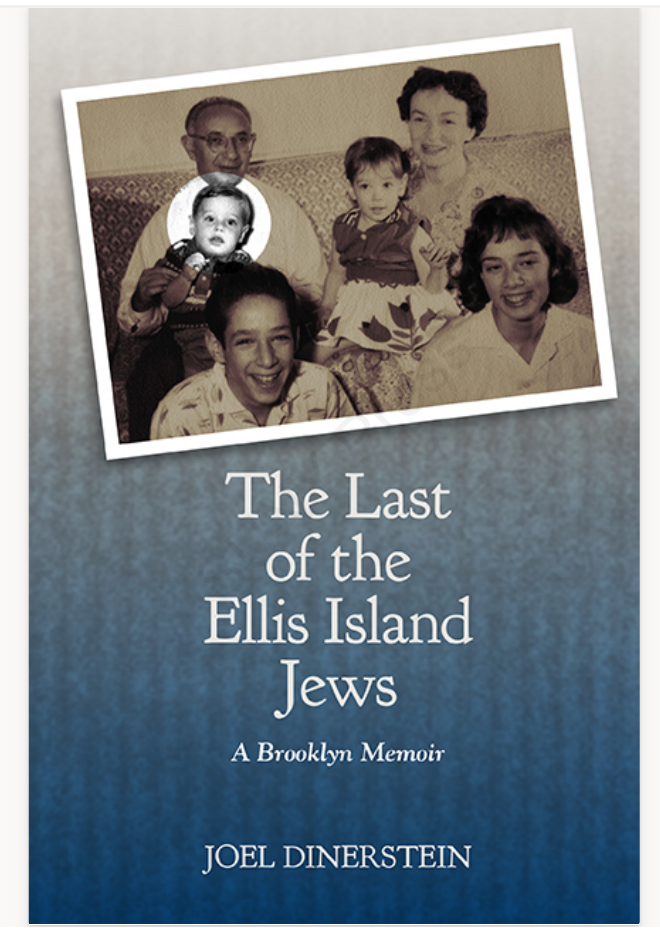
The Last of the Ellis Island Jews: A Brooklyn Memoir (SUNY Press) is an intimate family memoir of a lost world. Spanning the years 1923 to the early 1990s, Joel Dinerstein’s recollections of his family as they transitioned from the shtetl through adjusting to life as a poor, struggling Jewish immigrant family in Brooklyn to becoming assimilated successful American Jews is full of detailed anecdotes and rich recollections.
There are many books that describe the challenges and accomplishments of this transition generation, the first generation of children of Ellis Island immigrants, but they rarely describe the personal (sometimes very personal) details Dinerstein includes in this nostalgic memoir. What distinguishes this work is the rich narration of family events which capture the essence of the particular place and time without being a dry ethnography.
Dinerstein presents his family, warts and all, as examples of contrasting responses to confronting a rapidly changing world. In high school, he encounters racial stereotyping and, with his best friend, also goes out for the Erasmus Junior Varsity football team, two five-foot-one white Jewish guys in a majority Black school of five thousand students. The successful bonding among the diverse players may have played a part in Dinerstein’s later academic life as a scholar of race and music.
His father, prone to rage, had little understanding or acceptance of Dinerstein’s desire to excel academically. He describes his mother, struggling in an unfulfilling marriage, still speaking in a particularly Brooklyn-ese mix of Yiddish and English. With two older siblings, already out of the house and on their own paths to adulthood, Joel and his sister Adele moved through the landmarks of a typical New York assimilated Jewish teenage-hood — boring Bar Mitzvah lessons, obligatory family visits and rejection of the religion which, in Joel’s immediate family, had been reduced to perfunctory kashrut observance, cultural expectations of dating other Jews and eating bagels and lox. And yet the power of Yiddish linguistic patterns took hold: saying “Nu?”, kvetching and kibitzing with the neighbors, and waxing nostalgic about the traditional Ashkenazi Jewish food like blintzes, latkes, kugel, chopped liver and chicken soup, which he also describes as starchy, bland and spiceless. Reminiscing about his mother, he says “Jewish food was both Mom’s birthright and her existential claim on the world.”
Joel’s chronological narrative of his high school and college years provides highlights of changes in American culture during those years — concerns about Vietnam, racial unrest, the influence of music and hippie subculture. Through it all, the author’s Jewish identity is a subtext: he rejects religion, and yet provides a detailed description of his powerful meeting with “The Rebbe” in Brooklyn, he recalls family seders, a bris and his own Bar Mitzvah with a tragicomic clarity.
Why present this book in an article in the New Mexico Jewish Journal? Many New Mexico Jews have stories that mirror Dinerstein’s: the rise from uneducated immigrant to professional in just a few generations, the adaptations to rapid cultural change in America through the ‘60s and ‘70s, the need to wrestle with Jewish traditions and maintain meaningful Jewish identity. Yiddish words have become part of standard American English. The culture changes, we adapt, but I wonder what Joel’s mother would think of a green chile bagel?
Rabbi Min Kantrowitz is a Rabbi, educator and author. A 2004 graduate of the transdenominational Academy for Jewish Religion, California, she is the author of “Counting the Omer: A Kabbalistic Meditation Guide” (Gaon Press) and co-author of “One God: Three Paths” a prayerbook written by a Christian and a Moslem and a Jew. Rabbi Kantrowitz is a Rabbis Without Borders Fellow who has served as Rabbinic Advisor to Congregation Nahalat Shalom, on the Board of Directors of Hopeworks, the Steering Committee of Hillel at UNM, and as a founding member of the advisory board of the New Mexico Jewish Journal. Rabbi Kantrowitz is a former psychologist, a former architect/planner, a wife, mother and the proud Bubbie of three grandsons.
Read Jewish Values by Rabbi Kantrowitz:
Jewish Values: Love your neighbor as yourself #1
Jewish Values: B’Tzelem Elohim "in the image of God" #2
Jewish Values: Shmirat ha Adama to guard/protect/watch the earth #3
Jewish Values: Rodef Shalom - Pursue Peace #4
Jewish Values: Tzedek, Tzedek Tirdof - Pursue Justice #5
Jewish Values: Pe’ah - Dignified helping the needy #6
Jewish Values: Gemilut Chasadim - To Bestow Lovingkindness #7
Jewish Values: Tikkun Olam #8
Jewish Values: Talmud Torah #9
Jewish Values: Tikkun Olam #8, December, 2025, was awarded Second Place, Columns, General, New Mexico Press Women Communications Contest 2026.
Community Supporters of the NM Jewish Journal include:
Jewish Community Foundation of New Mexico
Congregation Albert
Jewish Community Center of Greater Albuquerque
The Institute for Tolerance Studies
Jewish Federation of El Paso and Las Cruces
Temple Beth Shalom
Congregation B'nai Israel
Shabbat with Friends: Recapturing Together the Joy of Shabbat
New Mexico Jewish Historical Society
HaMakom - Passionate Judaism in Santa Fe
Chavurat Hamidbar Fellowship of the Desert
Santa Fe Jewish Film Festival
Sisterhood Congregation Albert, Congregation Albert Judaica Shop
Policy Statement Acceptance of advertisements does not constitute an endorsement of the advertisers’ products, services or opinions. Likewise, while an advertiser or community supporter's ad may indicate their support for the publication's mission, that does not constitute their endorsement of the publication's content.
Copyright © 2026 New Mexico Jewish Journal LLC. All rights reserved.