














The Most Antisemitic Experience of my Life

By Judith Fein
Photos by Paul Ross
When someone asks me why I became a travel journalist, I say it’s because I love learning. Every day I try to learn something new, and traveling is the best way to learn many new things at the same time.
What I most like learning about is other peoples’ beliefs, behaviors, foods, community activities, history, culture, and traditions. I have traveled halfway around the world for ceremonies, burials, and religious or spiritual services. I don’t feel I have to agree with what I experience, but I do try to understand it and the role it plays in peoples’ lives. And I try not to be judgmental.
But very recently, I attended something that not only made me judgmental, but also deeply offended. For some it was a meaningful and spiritual event. For me it was coming face-to-face with hatred and blame at a deeply hate-filled and rampantly racist time.
It wasn’t far to get there — less than three hours from Santa Fe in New Mexico. It took place at the Farmington Convention Center in McGee Park. And it was a production of “He’s Alive” — The Passion Play of the Four Corners. It featured 150 actors from the area, was performed four times, and it is put on in 32 places around the world by the Passion Play Ministries International. They have been based out of Farmington for 25 years. The same play I saw was presented in Egypt and India, Denver, Wheeling, West Virginia, and South Africa. It is performed as part of Lent, and the Christian organization that presents it says it is the greatest message of hope the world has ever known, and its focus is on redemption and hope.
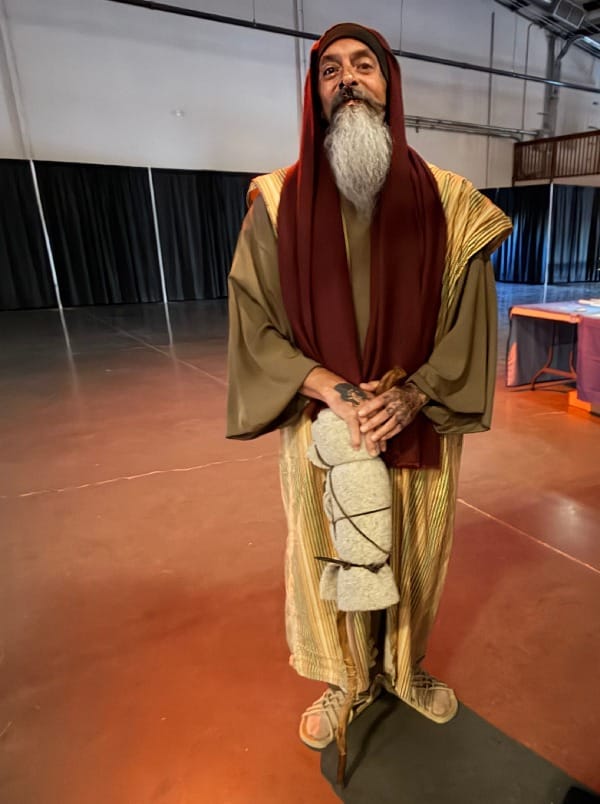
It sounds really interesting, which is why I went. I was a little surprised when I read on the back of the program extracts from an article written by C. Truman Davis, M.D., MS. It is a doctor’s perspective on the crucifixion of Jesus, and he describes how the heavy thongs of the whip that was used to beat Jesus “cut deeper into the subcutaneous tissues producing first an oozing of blood from the capillaries and veins of the skin and finally spurting arterial bleed from vessels in the underlying muscles. Finally, the skin of the back is hanging in long ribbons and the entire area is an unrecognizable mass of torn, bleeding tissue.” You can imagine that it gets even more detailed and gruesome as Jesus gets nailed to the cross and dies horribly with unrelenting agony and pain.
I tried to think of how pain was depicted in historic portrayals of the Jewish slaves suffering under the yoke of the Pharaoh in Egypt as they forcibly built structures made of mud brick. I recall how disturbing it was to see a Jewish slave being whipped and how, when Moses saw it happening, he killed the taskmaster who did it. But I never experienced any of the bloody depictions of history that I saw onstage in Farmington.
It seemed to me that people who attended “He is Alive” were shown the terrible brutality of the torture and murder of their Lord, and how he endured it for their sake and took on their sins and transgressions. And then he overcame it all, and returned from death to offer redemption and eternal life.

The words of the doctor include the fact that prisoners at the time of Jesus were stripped of their clothes before they were crucified, but “in deference to Jewish custom, the Romans returned His garments.” He was permitted to wear a loincloth, which was allowed the Jews. Well, I thought, there is respect paid to Jewish custom in this telling of the story.
And I also know that Jews, like Christians, had somebody who freed them by taking on their sins. It wasn’t a divine being but, rather, a goat. Actually, there were two goats, and it happened during Yom Kippur — a time of atonement and purification. The first goat was sacrificed, as Jesus was. And the second, the “scape goat,” had a laying on of hands by the high priest, which, symbolically, transferred the sins of the community onto it. This was also the case with Jesus, who was Jewish, and so were his disciples.
So, as they play began, I relaxed into the story, understanding how powerful it was, how it impacted the lives of billions of people, and that experiencing the pain of Jesus made their gratitude so real, and urgent, and, for many, transformative. Some Catholic people I know here in New Mexico took their children to see the Mel Gibson film, The Passion of Christ, which I heard was also graphic and gory. It is a way of identifying with and glorifying their god for his sacrifice.

But then my understanding stopped when I realized how deeply antisemitic the play in Farmington was. The word “Jew” was filled with blame for the murder of Jesus. Pontius Pilate, the Roman governor, was a compassionate soul, and both he and his wife were against killing the innocent Jesus. But the Jews put enormous pressure on Pontius Pilate until he finally gave the thumbs down to saving the innocent man.
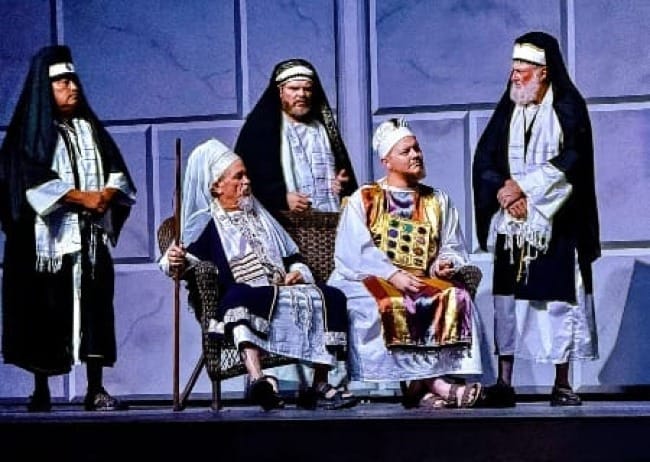
The scenes with the Sanhedrin, the Jewish supreme judicial, religious, and political body in ancient Israel, were very hard to sit through. It seemed as though their main goal was to eliminate Jesus, who threatened their power and control over the people. The scenes were long and relentless, and I was squirming in my seat every time they appeared on stage with their mission to punish, torture, and crucify a fellow Jew. They grew colder and harsher and more murderous as the play progressed, and had not a grain of humanity, compassion, or spirituality.
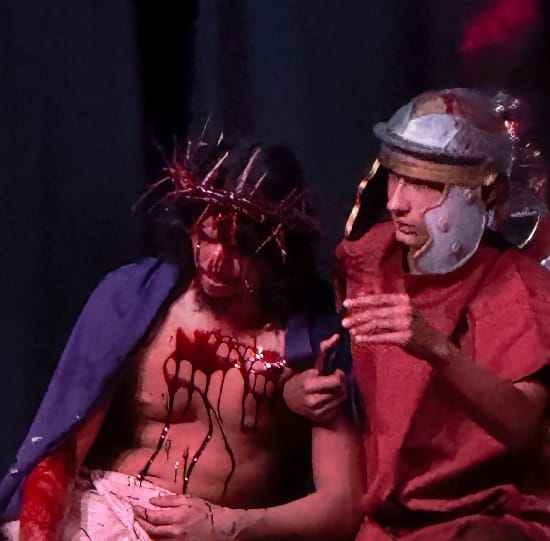
But they were not the only ones being blamed for the deicide. The crowd of Jewish people in the production turned against Jesus and they were angry and unified in their desire to crucify him. And, of course, the disciples of Jesus, all Jewish, turned against him and one of them, Judas, betrayed him for money.
The scenes that featured the Jewish crowd, the cowardly disciples, and the bloodthirsty Sanhedrin were long and drawn out, as was Jesus’ emotional suffering when he knew he was going to be sacrificed.
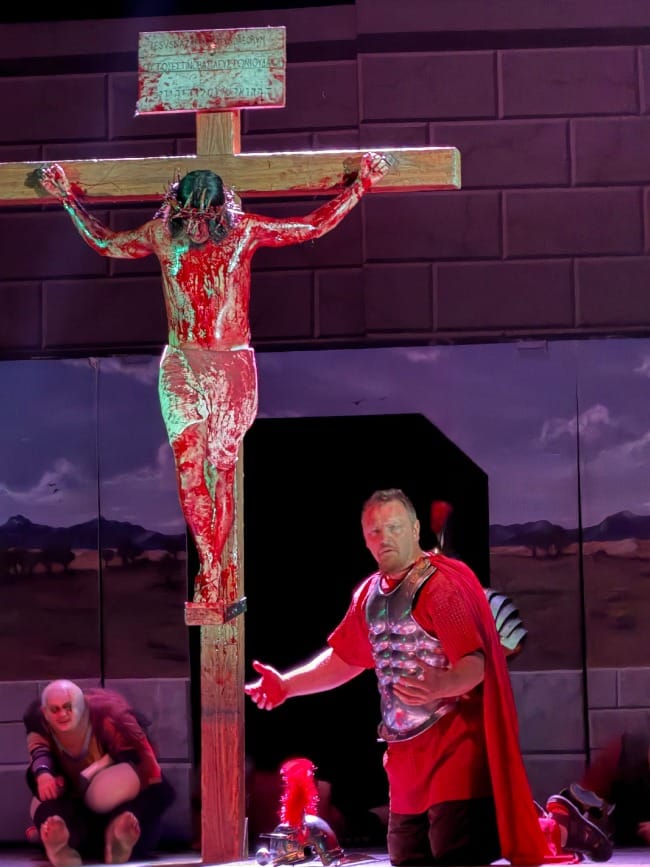
I thought I would quite visibly walk out of the huge convention hall. But nothing would be accomplished by that. And maybe things would get kinder to the Jews onstage if I waited a few hours until the end.
And then I recalled that several popes exculpated the Jews for the death of Jesus. Pope Benedict XVI wrote in his book Jesus of Nazareth: Part II, that there is nothing in scriptures that blamed the Jews and, in fact, the sacrificial blood of Jesus brought about reconciliation.
Pope Paul VI made a Nostra Aetate declaration with the Second Vatican Council where he repudiated the notion of collective Jewish guilt.
So, for more than 60 years, the Catholic Church exculpated the Jews but this Passion Play keeps it going. I got more and more enraged as I sat there, surrounded by an audience who was exhorted to come forward at the end of the play and get relief from their woes while hanging out with Jesus, Caiaphas (the Jewish High Priest and leader of the Sanhedrin) and others.
As the audience flocked towards the stage, I made my decision.
I would not go out quietly into the night after what I had experienced.
While the pastor invited the congregation forward for healing, I quietly pulled out my iPhone and did a little research as I watched all those people who came forward wanting help. I did not in any way want to interfere with what they were experiencing. I learned that several passion plays were modified after there was pressure from Jewish groups like the AJC and ADL, and from audience members like me. The most famous passion play, the Oberammergau, which is performed every ten years in Germany and was praised by Hitler for its antisemitic effect, heavily revised the script. They removed anti-Jewish dialogue, modifying and reducing the bloodthirsty nature of the Jewish mob, and also introduced the role played by the Romans in the crucifixion. Some other productions emphasized that Jesus was an observant Jew, and even introduced Hebrew text and inclusion of the Torah to show respect for the religion. It was only a small group of Jews who caused his condemnation and crucifixion.
But, in the Farmington version, which is now world-wide, the play remains deeply offensive.
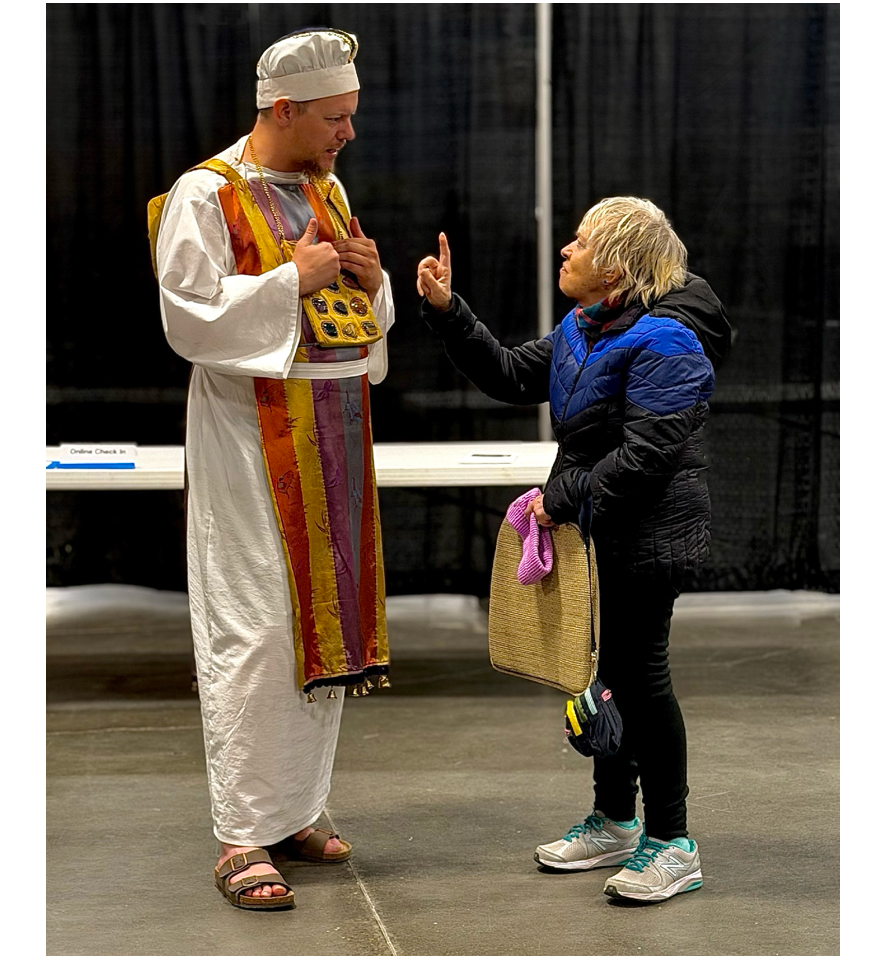
I waited until the audience was leaving the theatre space, and the actors moved to the main lobby. People were congratulating them on the play and their performances. I approached the High Priest Caiaphas directly and asked if I might speak to him. He was smiling and cheerful and said, “Of course.” I think he believed I was going to express my appreciation and support. Instead, I said very slowly as I looked in his eyes: “This is the most antisemitic experience I have ever had in my life.”
He looked confused. I indicated the hoshen, or breastplate he was wearing where 12 stones were embedded. “I see you are wearing the hoshen with the urim v’tummim,” I said. “Do you know the meaning of this object of divination the High Priest wore? Do you think the high priest was told to torment and torture Jesus, and have him hung on a cross to die?”
His face was blank. “Are you aware of how many times the word “Jew” was said in the play, and every time it was derogatory and dismissive?”
“I only said the word ‘Jew’ once,” he protested. “And I am not aware of it being used very much at all.”
I told him I would like to see the text. He didn’t have it. “Every Jewish person in the production was awful, with the exception of Mary, who kind of disappeared from the story until the end. You played the role of a spiritual leader who spent almost all of his stage time trying to get Jesus killed. Your cohorts in the Sanhedrin, the Jewish population, they were all responsible and blamed for the crucifixion. I am Jewish, and it was deeply offensive to sit through this.”
“May I ask what sect you belong to?” Caiaphas asked.
“None,” I replied.
“I just want to explain to you that we do not want to whitewash the suffering of our Lord. We don’t want to gloss over it or make it less horrible than it was.”
“So that includes blaming Jews for what happened to him? The play could have said a small group of the Sanhedrin and some Jews in the population were in favor of his crucifixion. But not “Jews” in general. Do you know that this play was performed in the Middle Ages in Europe to turn people against the Jews? That the antisemitism resulted in pogroms, the murder of Jews, Nazism, and it persists until today.”
“All we want to do is tell the truth of what happened to our Lord.”
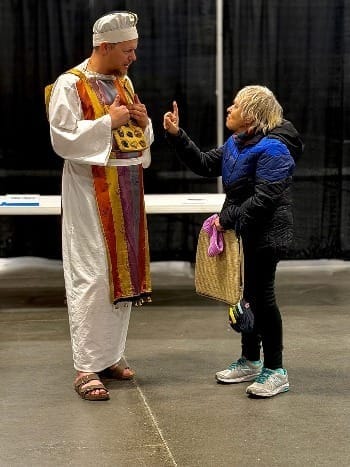
Caiaphas was well over six feet tall and I am well under five feet tall. I started wagging my finger towards his face, but I could only reach his stomach height.
“I don’t think you can hear what I am saying, but maybe later you will understand if you think about it.”
And with that I headed towards the exit door. My husband joined me and held up his phone in front of me. My anger faded and I burst out laughing. He is a photographer and he had taken a photo of me wagging my finger at Caiaphas’s belly.
It is one of the funniest photos I have ever appeared in. And at least I felt I had opened my mouth and not passively accepted such clueless antisemitism so close to home.
Santa Fe-based Judith Fein and Paul Ross are award-winning international travel journalists, and Ross is also an acclaimed photographer. They have contributed to 130 international publications, and published four best-selling books related to travel. Fein is a much-admired keynote speaker and workshop leader. The duo are Senior Travel Editor and Senior Travel Photographer for the New Mexico Jewish Journal, and greatly appreciate its inclusiveness and appeal to a broad and diverse population. The couple’s website is https://www.GlobalAdventure.us
Community Supporters of the NM Jewish Journal include:
Jewish Community Foundation of New Mexico
Congregation Albert
Jewish Community Center of Greater Albuquerque
The Institute for Tolerance Studies
Jewish Federation of El Paso and Las Cruces
Temple Beth Shalom
Congregation B'nai Israel
Shabbat with Friends: Recapturing Together the Joy of Shabbat
New Mexico Jewish Historical Society
Policy Statement Acceptance of advertisements does not constitute an endorsement of the advertisers’ products, services or opinions. Likewise, while an advertiser or community supporter's ad may indicate their support for the publication's mission, that does not constitute their endorsement of the publication's content.
Copyright © 2026-27 New Mexico Jewish Journal LLC. All rights reserved.