



The Santa Fe Jewish Cemetery: A Cemetery Of and For The Whole Community
By Doris Francis, JCCNNM Cemetery Committee chair
2026 marks the 30th anniversary of the Jewish Cemetery in Santa Fe. Under the leadership of the Jewish Community Council of Northern New Mexico (JCCNNM), our community will be commemorating this significant occasion at our annual Day or Remembrance.
Below is a brief review of the cemetery’s history with special recognition of those community-minded individuals who have generously established and supported our community’s unique burial ground.
History of the Dedicated Santa Fe Jewish Cemetery
In the Jewish tradition, securing a place for burial is the first thing a community must do, even before creating a synagogue or a religious school. In Judaism, burial of the dead is deemed a religious commandment.
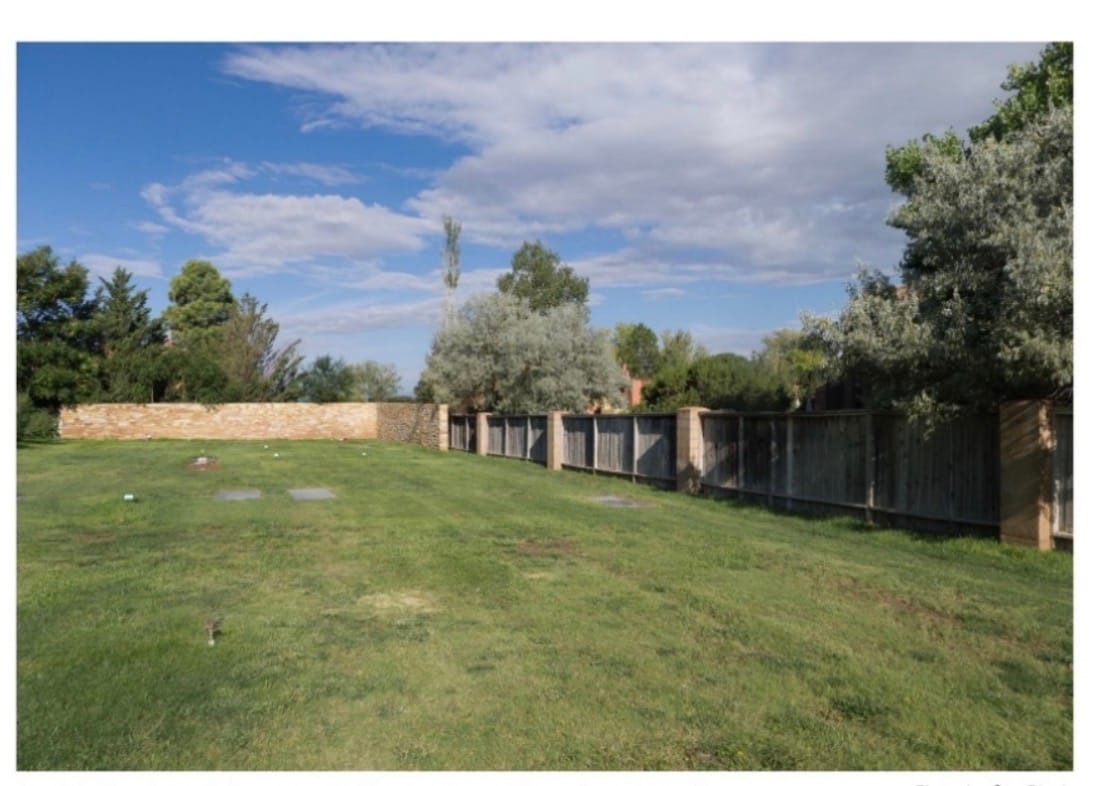
In 1996, representatives of Temple Beth Shalom and Congregation Beit Tikva worked together to establish a dedicated Jewish section in a privately owned burial ground at 417 Rodeo Road. An Orthodox area was soon added, making this cemetery unusual. Rather than the more common situation, in which each synagogue has its own burial ground, today this one community cemetery is shared by all the different, self-described congregations in Santa Fe: Temple Beth Shalom—Reform; Congregation Beit Tikva—Reform-leaning; HaMakom—Renewal/Conservative; the Santa Fe Jewish Center—Chabad. Four congregations in all. The Reform and Conservative/Renewal congregations share one area, Chabad and the Orthodox share a separate, but contiguous, space. Each has its own rules and type of grave marker.
To enable the Jewish Santa Fe community to establish a dedicated cemetery, the then owners of this private cemetery stipulated that sixty percent of the grave sites be sold pre-need. Gail Rapoport, founding chair of the cemetery committee of the Jewish Community Council of Northern New Mexico (the non-profit organization that oversees the up-keep and improvement of the cemetery, as well as the enactment of traditional Jewish rituals preparing the deceased for burial) spearheaded this project, selling the requisite number of plots by the end of the 1990s. Soon, a beautiful stone corner wall was erected by the Gould family in honor of their deceased husband/father, adding dignity and stature to the flat field of level footstones and ledgers surrounded by a board fence.
In 2013 when Gail retired, the author, a Jewish anthropologist who has published research on London’s ethnic cemeteries and has training in landscape design and the conservation of historic cemeteries, became chair of the cemetery committee. Believing that the care of cemeteries is a religious and social responsibility, Doris’ vision was to transform the Santa Fe Jewish section into a more sanctified and contemplative space. The JCCNNM board chairs—David Izraelevitz, Ron Duncan Hart, and Lance Bell—each provided guidance and support during their tenure.
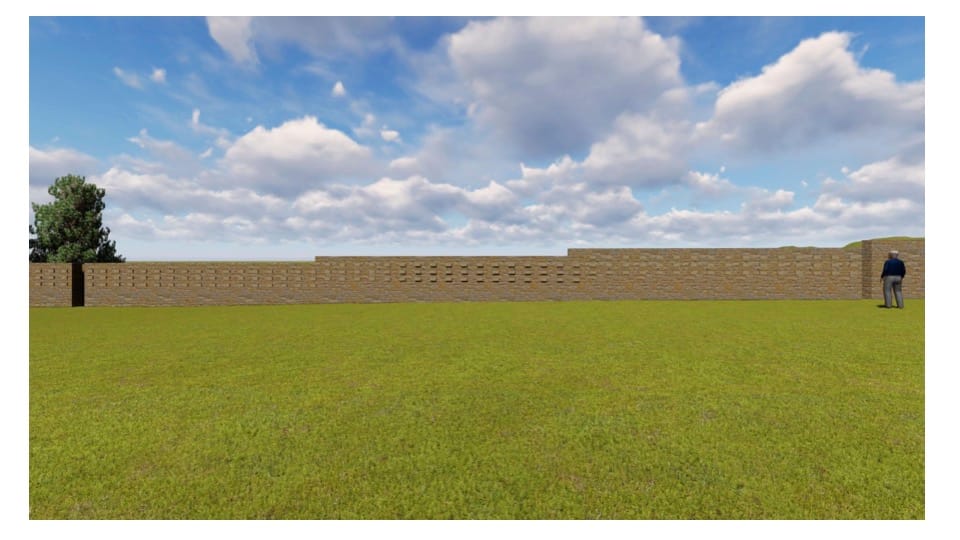
Years earlier, the cemetery had been sold to Tim Rivera, who has a Crypto-Jewish background. Tim understood the Jewish community’s burial needs and was receptive to the committee’s request to expand the Jewish section and improve the grounds. Anthropology interviews with mourners and cemetery visitors revealed a clear consensus: everyone wanted “to be buried within the corner wall.” Extending the stone corner wall would therefore be the first step in upgrading the Jewish section. The expanded wall would symbolize both enclosure and inclusion within the Jewish community, protecting the sacred, consecrated space from the secular surroundings of the two-story apartment buildings bordering the site and marking the Jewish section—with its distinct ritual practices—as part of, yet separate from, the rest of the cemetery.
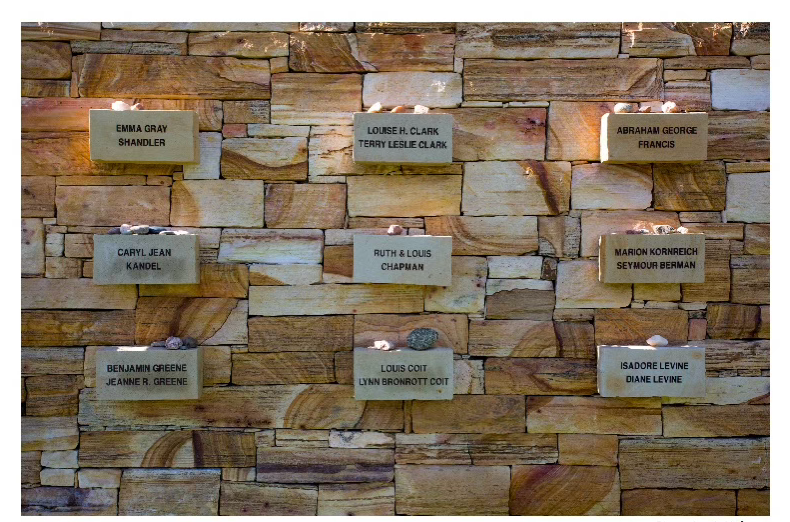
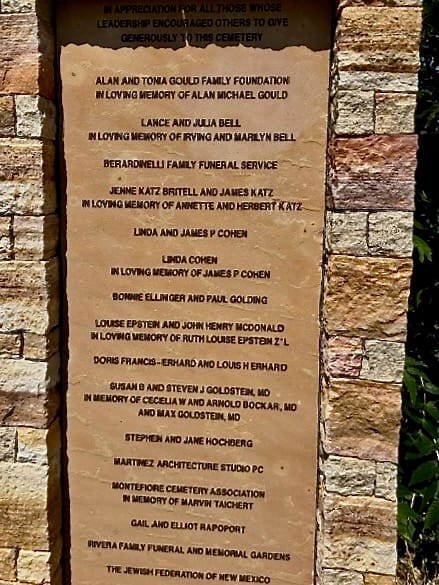
An advisory committee composed of Rabbi Levertov and Rabbi Malka Drucker, Richard Martinez, the pro bono project architect, John Morris, the stone mason, and Jane Hochberg and Gay Block, two community leaders, was formed. Together we created the Legacy Memorial Plaque Project as a fund-raising strategy to pay for the wall extension. Joy Silver and Atma Wiseman skillfully guided us in thinking through the concept of legacy and its multiple applications and meanings for the Plaque Project. The cost per plaque, $613, includes a tax-deductible portion of $400 to be used to build the wall. Plaques are made from locally sourced stone and engraved by a local craftsman. Each plaque measures approximately 10” x 5” x 2.5”, with ample space on top to leave a stone, a token of respect marking a visit.
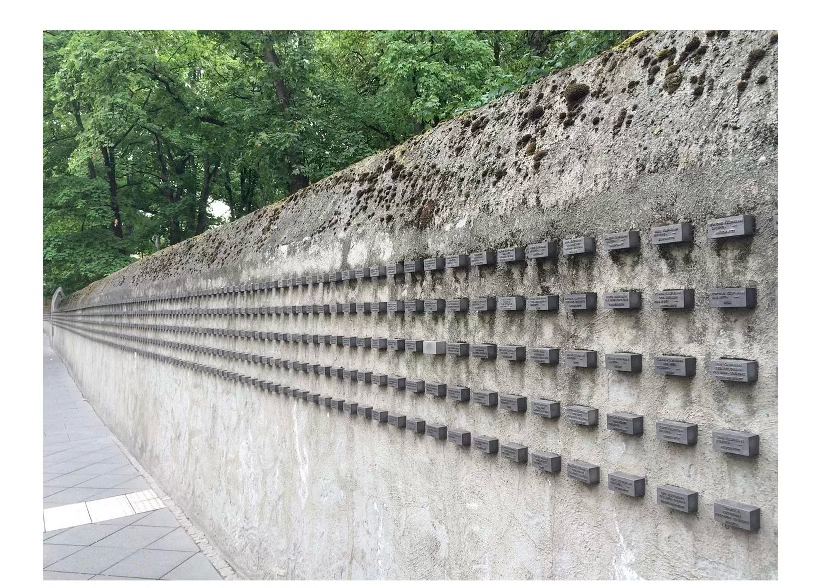
The design of the plaques, which David Izraelevitz suggested, was inspired by an image of the Frankfurt Holocaust Memorial Wall (Börneplatz Memorial Site Frankfurt) where 11,908 blocks on the outside wall of the Jewish cemetery individually memorialize the Frankfurt victims of the Shoah. However, in Santa Fe, the materials for the memorial plaques were changed from the dark and cold concrete and metal of the Frankfurt wall of death to a locally sourced, naturally occurring stone that resembles the warm colors of Jerusalem. Whereas the Frankfurt plaques list the person’s name, dates of birth and death, and place of deportation, wording on the Santa Fe plaques is restricted to the name(s) of the remembered individual(s). This is in keeping with the practice on the Vietnam Veterans’ Memorial in Washington, D.C. The simplification enhances the elegance and power of each plaque and makes them all visible from a distance. The name represents the person, their essence, their legacy.
In conceiving the Legacy Plaque Project, the committee, with the suggestions of Rabbi Levertov and Jane Hochberg, drew on an established Jewish tradition of memorial plaques, customarily mounted on synagogue walls and serving to memorialize deceased family and local community members. At the Santa Fe Jewish cemetery, which according to Jewish tradition is a holy place more sacred even than a synagogue, a place that speaks to the finite nature of life and the inevitability of death, this practice was expanded by Rabbi Malka to include the concept of bimkom kever, which means “in place of the grave.” This convention was used after World War II to inscribe on the burial stones of their family members the names of Holocaust victims who had no marked graves.
Through an evolving interpretation of bimkom kever, close relatives and friends who are not buried in Santa Fe and/or those for whom there is no grave, can be memorialized by placing their names on memorial plaques mounted on the cemetery’s stone walls. In mobile American society, few people still live in places where their extended family members are buried. The Legacy Plaque Project allows those who visit the Santa Fe Jewish cemetery to recall loved ones without having to travel to far distant, and often inaccessible, burial grounds.
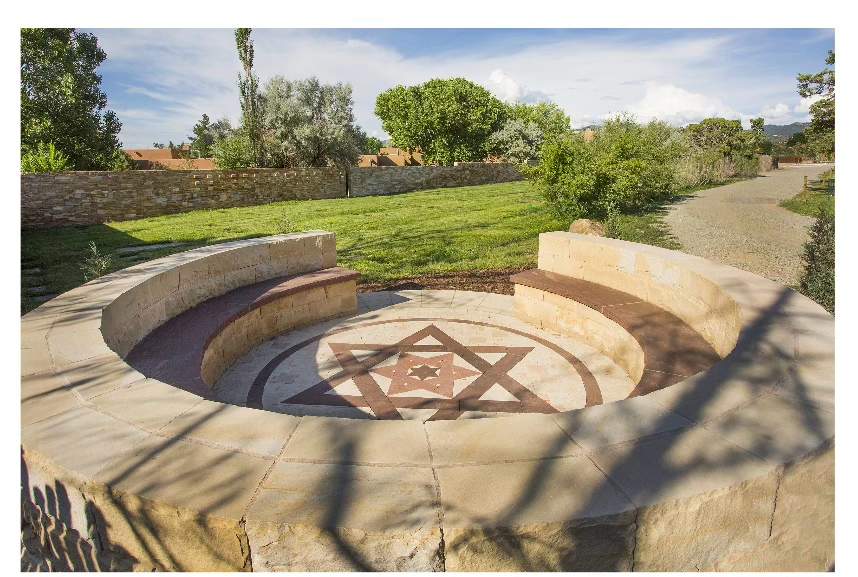
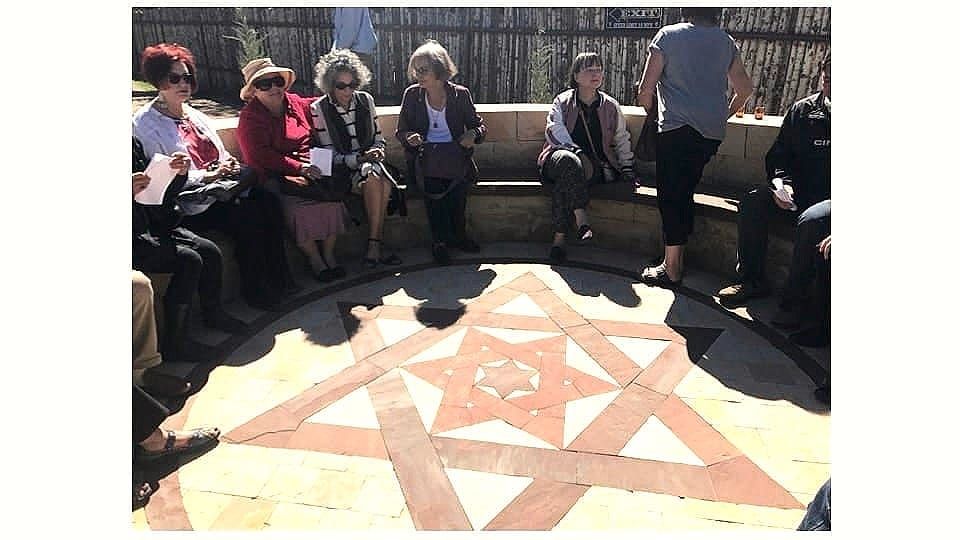
From its inception, the Santa Fe Jewish community enthusiastically adopted the Memorial Plaque Project. Over 108 plaques have been sold to date, raising funds to finance three separate extensions of the wall – 108’ in 2014, an additional 99’ in 2019–2020, and the final wing wall in 2024 – as well as construction of a circular seating area overlooking the site and encouraging reflection and contemplation. Special thanks are given to Gloria Abella Ballen and Linda LaBove for their artistic and graphic skills in designing the Star of David. Supplemental funding was raised through private donations with wide and generous community participation, as well as through annual grants from the New Mexico Jewish Community Foundation. An endowment fund has been established through the Carla Freeman Fund at the Santa Fe Community Foundation to cover future maintenance and repairs, as well as support for indigent burials.
In 2022, Tim Rivera sold the cemetery to Security National Life Insurance Company, a corporation with other cemetery holdings, headquartered in Utah. The JCCNNM has worked hard to cooperate with the new owners with the clear aim of maintaining the integrity of the Jewish section. The Rabbis’ Rules and Regulations provide guidelines for the management of our area. Special appreciation to those individuals who stepped up in 2024 to purchase 32 graves, demonstrating clearly that the JCCNNM cemetery committee is a worthy steward, capable of managing and supporting our allotted section.
During the Jewish High Holy Days, a time of reflection and self-examination, Jews traditionally visit their community cemetery. The Remembrance Day event, begun in 2013 in Santa Fe’s Jewish cemetery section, is usually held between Rosh Hashanah and Yom Kippur. During the service, psalms are read, new plaques are unveiled, and sponsors are invited to speak about the people whose names are honored. The event offers participants the opportunity to visit their plaques, reflect on the values that shaped their loved ones’ lives, and consider the ideals that guide their own.
Creation of Community
The stone walls covered with memorial plaques that surround Santa Fe’s Jewish cemetery are like a prayer shawl wrapping together the different Jewish traditions that share this one cemetery section. They speak to the successful creation and persistence of a community whose citizens continue to follow the ethical principles of their religion: to remember their dead, to serve their community, and to transmit family history and memory to future generations. Adherence to these traditions via innovative new practices has helped elevate the cemetery from an uninviting space surrounded by a fence of wooden slats to a sacred site of community ownership and pride, a place that encourages contemplation and reflection. Tim Rivera called the Jewish section with its walls, plaques, and seating area the “spiritual center of the cemetery.” The Jewish section has become a transformative space of learning and intergenerational connection that holds the possibility of an ongoing relationship between the living and the dead. It signifies to others who share the same cemetery that Jewish people honor, respect, and remember their community ancestors.
At the annual Remembrance Day service mentioned above, the collaborative participation of Rabbis from all four traditions visually and symbolically speaks to the unity of the Santa Fe community. As Rabbi Martin of Congregation Beit Tikva eloquently noted:
This event reminds each family and the whole community of their moral responsibility to honor our parents; it is the community vehicle to remember our loved ones. It transcends denominational boundaries. It is not one congregation meeting privately; we are all together for this special ceremony. … We are in the open space of the cemetery, seated facing the wall with its commemorative plaques. To me, its beauty and aesthetics are powerful, overwhelming … It is like the Western Wall in Jerusalem, the same color and radiance…it is the totality of Jewish history, the special remembrance of the Temple in Jerusalem which was destroyed by the Romans in the first century. It has resonance for all: for generations past and what we are looking forward to in each new generation. The Santa Fe wall with its plaques is a metaphor for the Western Wall. It is the center of our remembrance and faith – it re-emphasizes the essence of Judaism.
To order a plaque: dfrancis07@outlook.com
To purchase a burial plot at Memorial Gardens: 505-989-7032; ask for Sandra or Fernando
View invitation also at:
 New Mexico Jewish Journal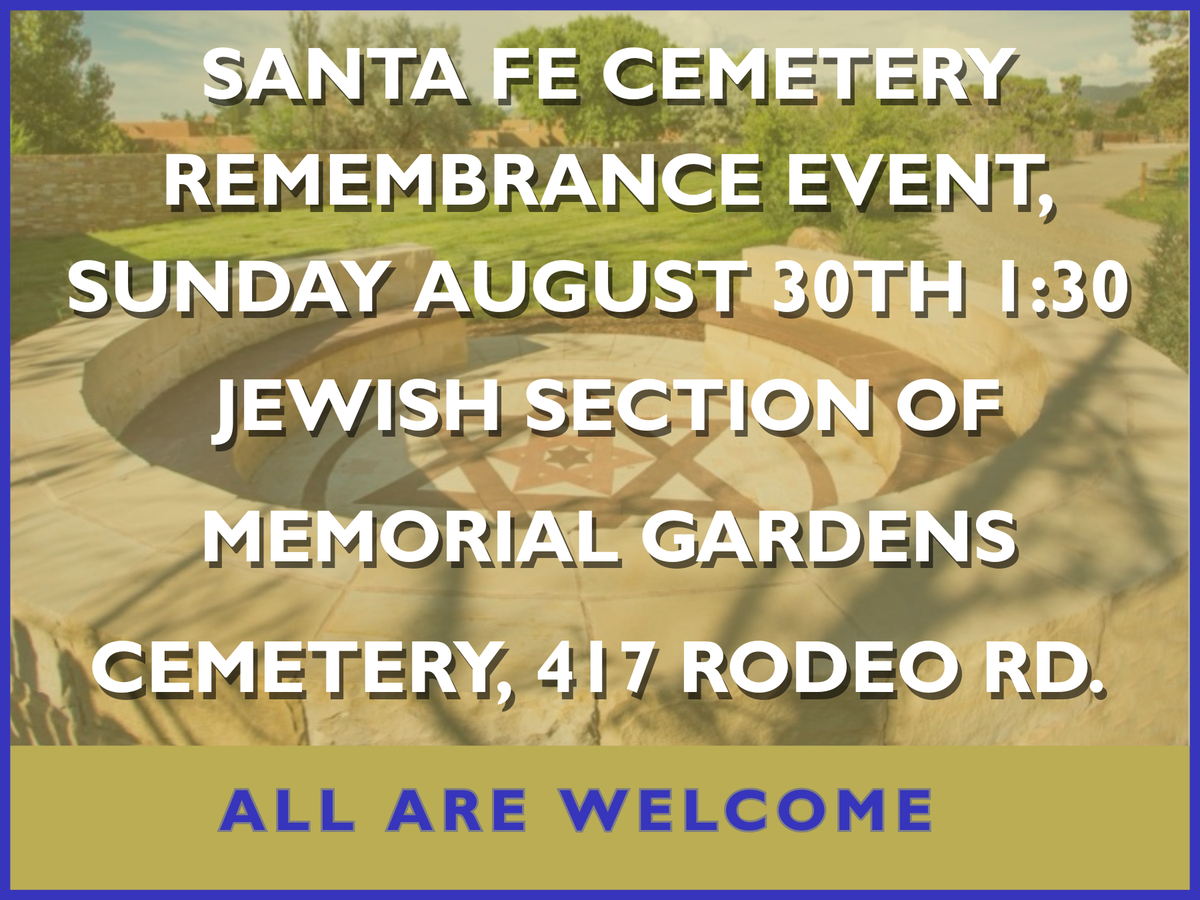
Doris Francis is an anthropologist who has studied and written extensively about London cemeteries. Her book, The Secret Cemetery, which includes sections about Jewish rituals and in practices, was recently reissued by Routledge.
Community Supporters of the NM Jewish Journal include:
Jewish Community Foundation of New Mexico
Congregation Albert
Jewish Community Center of Greater Albuquerque
The Institute for Tolerance Studies
Jewish Federation of El Paso and Las Cruces
Temple Beth Shalom
Congregation B'nai Israel
Shabbat with Friends: Recapturing Together the Joy of Shabbat
New Mexico Jewish Historical Society
HaMakom - Passionate Judaism in Santa Fe
Policy Statement Acceptance of advertisements does not constitute an endorsement of the advertisers’ products, services or opinions. Likewise, while an advertiser or community supporter's ad may indicate their support for the publication's mission, that does not constitute their endorsement of the publication's content.
Copyright © 2026-27 New Mexico Jewish Journal LLC. All rights reserved.