

















How Talmudic Law Shaped One of History's First Copyright Rulings

by Aidan McGloin
"This day 476 years ago: Early Copyright Case Decided by Rabbi"
This article was originally published in the Inland Empire Law Weekly, August 16, 2026, and is republished here with permission.
Checking my phone, I saw another message that came in just before it: after a nine-month hiatus, Rabbi Min Kantrowitz had just sent in her latest Jewish Values essay. And the title? "Talmud Torah."
As it is said in Yiddish, Mann tracht un Gott lacht. Man plans, God laughs. At least this time it was pretty funny. Aidan's post has been Rabbi Min approved. – djs.
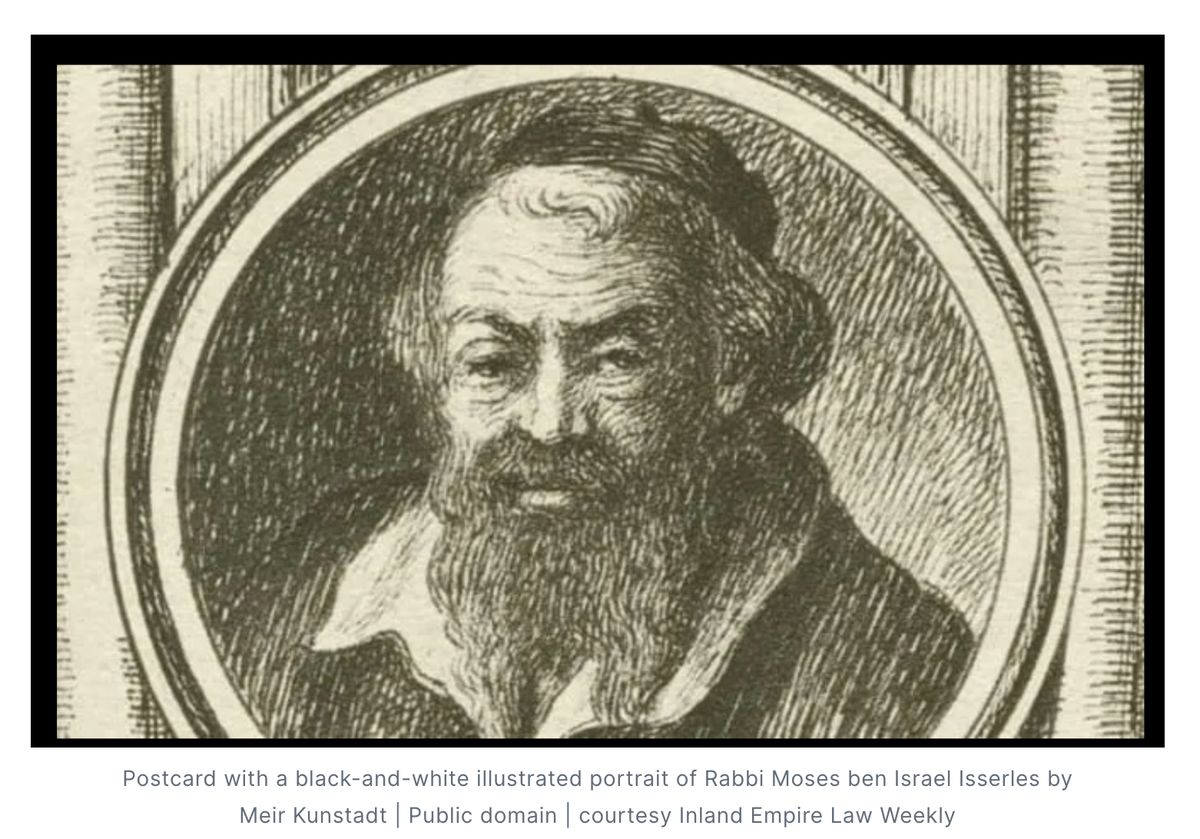
On Aug. 16, 1550, one of the first acknowledged copyright rulings was published by Rabbi Moses Isserles of Krakow, Poland.
For some historical context, the printing press was invented 111 years earlier, in 1439.
Meir ben Isaac Katzenellenbogen, the chief rabbi of Padua and leader of the Jews of Venice, had undertaken a publication of the Mishneh Torah. The book is a compilation of Jewish law by the 12th-Century Rabbi Moses ben Maimon.
Katzenellenbogen had asked the Italian printer Marco Giustiniani to print the book, but he declined the offer. So the rabbi went instead to Alvise Bragadin. Shortly after the Bragadin copies were published with Katzenellenbogen's funding, Giustiniani published his own copies. Giustiniani, who came from a wealthy printing family, promised to sell his copies for one gold coin less than Bragadin's copies.
Katzenellenbogen appealed to Isserles, an authority in Jewish law.
Isserles found Giustiniani's actions to have violated Jewish law. University of California Law Professor Neil Netanel published a translation of Isserles' ruling, available here.
Isserles' ruling was based on the lessons of 3rd century Jewish scholar Rav Huna. Huna said that established workers have a right to tell newcomers to shut down operations if the newcomers' business would hurt their livelihood:
"There was a certain resident of an alleyway who set up a mill in the alleyway and earned his living grinding grain for people. And subsequently another resident of the alleyway came and set up a mill next to his. The halakha (commandment) is that the first one may prevent him from doing so if he wishes, as he can say to him: 'You are disrupting my livelihood by taking my customers'."
Isserles found that there would be certain financial harm to Katzenellenbogen.
"(Giustiniani) has proclaimed that he will sell each of his books for a gold coin less than those of (Katzenellenbogen). And who will see this and not come to him to buy from him," Isserles wrote.
Isserles had a couple of other reasons for his ruling: Jews must give preference to fellow Jews and rabbis, and it was improper for Giustiniani to keep uncorrected copies of the manuscript in his house for more than 30 days.
Since Giustiniani was not Jewish and not subject to Jewish law, Isserles directed Jews to buy Bragadin's stock before they bought from Giustiniani. Jews who did buy from Giustiniani would be excommunicated and ostracized.
Ironically, Giustiniani would go on to publish a copy of the Talmud which contained Huna's parable about the mill. He also would appeal to the Catholic Church, which in 1553 would order the burning of all copies of the Talmud throughout the Catholic world.
Netanel, the professor who translated the ruling, published a book on the development of Jewish copyright law: From Maimonides to Microsoft. The book is available to purchase from Ebay for $31.
Related: "Talmud Torah" by Rabbi Min Kantrowitz
Community Supporters of the NM Jewish Journal include:
Jewish Community Foundation of New Mexico
Congregation Albert
Jewish Community Center of Greater Albuquerque
The Institute for Tolerance Studies
Jewish Federation of El Paso and Las Cruces
Temple Beth Shalom
Congregation B'nai Israel
Shabbat with Friends: Recapturing Together the Joy of Shabbat
New Mexico Jewish Historical Society
Policy Statement Acceptance of advertisements does not constitute an endorsement of the advertisers’ products, services or opinions. Likewise, while an advertiser or community supporter's ad may indicate their support for the publication's mission, that does not constitute their endorsement of the publication's content.
Copyright © 2026-27 New Mexico Jewish Journal LLC. All rights reserved.