


















Jonah, The “Whale,” and What Causes, Prolongs, and May Ease Depression

By Judith Fein
“Oh Jonah he lived in a whale. He made his home in that fish’s abdomen,” sings Spo’tin’ Life in the song “It Ain’t Necessarily So” from George Gershwin’s opera “Porgy & Bess.” In familiar adaptations of the Pinocchio story, the wooden puppet and Geppetto were swallowed by a whale. In the novel “Moby Dick” by Herman Melville, the sermon by Father Mapple is about Jonah and the leviathan.
Every time I reread the puzzling biblical tale behind these works, the same thought occurs to me: this is a story about depression. I wrote it down, sent it to a rabbi and another highly respected teacher and biblical scholar. They approved it. So, I am taking a deep breath and sharing it with you.
It all began when God told the prophet Jonah to go to Nineveh and cry out against the wicked ways of the inhabitants of that large pagan city. He was to prophesy that they would be destroyed unless they repented and changed. Instead, he immediately ran away from God’s request. A little of his backstory may help understand his flight. In the past, God had sent him to prophesy that Jeroboam II, the evil king who led the Israelites into sin, would nonetheless have success in restoring the ancient borders of Israel.
Jonah’s prophecy came true, he was a success as a prophet, and his ego was puffed up. He did not want to go to Nineveh (near present-day Mosul, in Iraq) and tell the people their city would soon be overthrown. He considered the Ninevites the enemy, but knew from experience that the Divine was merciful and would never completely destroy them. So, consequently, his doomsday prophesy would be false and he would be rejected, ridiculed, and blamed for it. Instead, he hurried down to the sea and boarded a boat to hide from God’s presence. It seems a little naïve: if you’re on a boat in the middle of the sea, wouldn’t it be easier for the Almighty to find you?
Jonah descended to the lowest part of the boat, lay down and fell asleep, despite a terrible storm. The captain woke him and told him to ask his God to keep the crew from perishing. But once again, he refused what he was asked to do.
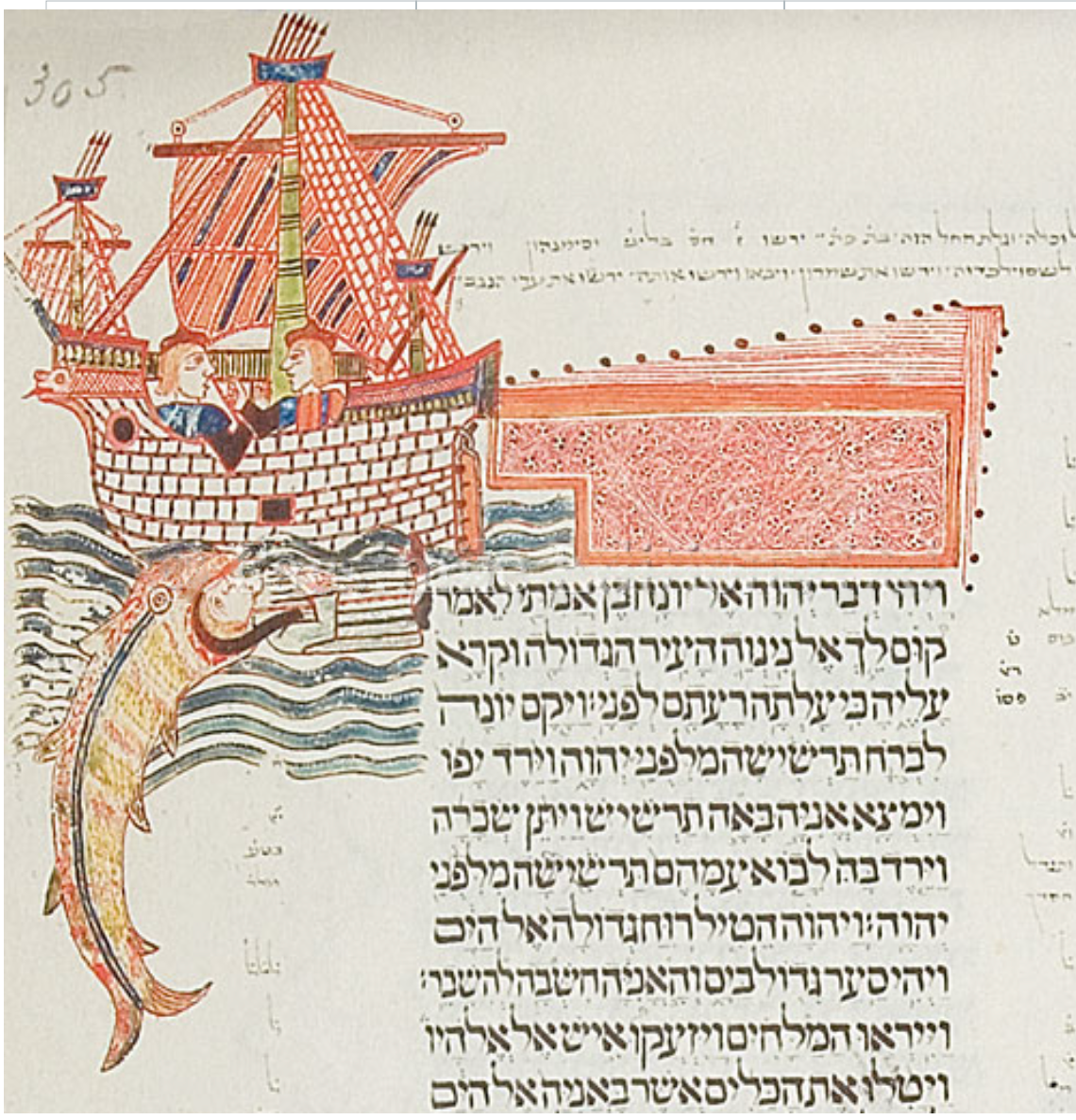
The sailors cast lots to see who was to blame for the storm, and the lot fell to Jonah. They asked him who he was, what his occupation was, and to what people he belonged. He said that he was Hebrew and his Lord made the sea and dry land. He told them that he was fleeing the Divine. When they asked what they should do, he told the frightened sailors to throw him overboard and the sea would calm. He said he knew the storm happened because of him. The sailors could not row back to shore in the storm so they knew of no other option and threw Jonah overboard into the raging sea which immediately calmed.
Then the crew offered a sacrifice to God and made vows. And what happened to Jonah, who had fled his prophetic mission?
First, the waters encompassed him and his body and soul were drowning. Then he was swallowed by a great fish (not a whale) for three days and nights. The biblical Hebrew text uses first the masculine word dag for the fish, and then the feminine form dagah, so we’re not sure of the sex of the fish. There was a midrash or interpretation of the biblical text that said Jonah was inside a pregnant female fish, where he would have been squeezed and compressed.
He was so stressed that he called out to God and said he knew God did this to him and promised to look again toward God’s holy temple and offer sacrifice. At God’s command, the fish vomited Jonah out onto dry land.
Once again God told Jonah to go to Nineveh. He made the long trip there but only half-heartedly proclaimed that in 40 days Nineveh would be destroyed. The Ninevites— including their king— took the prophecy very seriously. They fasted and put on sackcloth and ashes. They proclaimed that they would repent, turn from evil, and turn to God, who saw their change and spared the city. Jonah became angry.
He fled the first time God asked him to go to Nineveh because he feared that God was merciful and would spare them and his prophecy would not come to pass. He would be seen as a failure as a prophet. His pain was so intense that he asked the Lord to take his life, and God asked if it was right for him to be so angry. Jonah did not answer. He left the city and sat at a distance to see what would happen to Nineveh. The heat was very intense, so God made a plant (kikayon) to provide shade over his head. The next day God made a worm that damaged the plant and made it wither. Jonah grew faint and weakened emotionally and physically. He had no more plant to protect him from the heat. He wanted to die. God asked if it was right for him to be so upset about the plant dying. He said yes, and justified his anger. God asked Jonah if he was upset about a single plant dying, shouldn’t the Lord be upset and show pity for Nineveh with its 120,000 inhabitants who couldn’t tell right from wrong? Jonah’s anger was about God saving the Ninevites when he had prophesied that they were evil and would perish.
And then? That is the end of the story. It just stops. Why is there no conclusion? I think the conclusion and resolution need to happen inside the person reading or hearing the story. Jonah asks multiple times to die. A modern reader may recognize features associated with suicidal depression, but the ancient text does not give him a clinical diagnosis. His is an emotional and spiritual ailment.
Recapping, God sent Jonah on a prophetic mission to his enemies in Nineveh. But because of fear of failure, Jonah ran away from his mission. In our lives, we each probably have a mission, a purpose, or driving force. It may be small and personal, or it may be huge and impact our loved ones, community, country, or even humanity itself. Facing it could prove difficult or challenging or even threatening and dangerous. But if we ignore it, if we run away from it, it can generate negative feelings about ourselves and our lives— and lead to depression.
Jonah boards a boat and goes to the lowest deck, which symbolizes his lowest feelings about himself. While everyone is battling the storm, he lies down and sleeps deeply. Depression can cause tiredness, withdrawal, and exhaustion. And once awakened, he refuses his mission again as a prophet of God, to ask the Lord to save the sailors.
Jonah believes that he and his behavior caused the storm and he descends into such intense self-blame, shame, guilt and worthlessness, that he asks to be thrown overboard so he will die. He is literally drowning in misery and later says it affected not only his body but his soul. He is swallowed by a great fish, which expresses his complete overwhelm by being inside of despair —so squeezed, compressed, hemmed in, helpless and alone that he wants to die. He sees it as something or some force outside of him, and doesn’t yet understand that it is happening inside.
God shows mercy to his fugitive prophet, and commands the big fish to vomit Jonah up on dry land. Then, once again, Jonah is instructed to go to Nineveh. For a moment, he decides to accept his mission, and travels to Nineveh. But once there, his prophecy is strikingly brief. What he feared, happened. God spares the Ninevites and Jonah feels that he has failed. He flees the city and feels so overwhelmed by his own spiritual and emotional devastation, that he wants to die. The Lord pities Jonah and creates a plant to shield him from the heat of his suffering. But still Jonah doesn’t comprehend. So, God makes the plant wither and die.
Jonah is now with no inner emotional resources. He is isolated and separated from the flow of life. Nothing shields him from suffering. And the teaching from the Lord is that just as Jonah reacts so strongly to the death of the plant, the Lord reacted to the idea that the Ninevites would perish. Jonah was not a failure. His judgment moved a city to change. What he must learn to be a successful prophet is about God’s mercy and how he, too, must show compassion even to his enemies. His true mission is to give people a chance to change, to help them to know right from wrong and rejoice if they change and are forgiven by God.
As for the end of the story, in order for Jonah to emerge from the dark, depressed place where he lives, he must go back with renewed vigor and understanding to his mission. God can’t do it for him. He has to do it for himself. He has to stop fleeing what he is destined to do, no matter how hard it is for him. That is the path for him to come out of his inner darkness. That sad story will only end if he accepts that God and he himself can forgive anyone, even idol worshippers, sinners, and wicked people. He must learn that lesson and apply it to his prophesy. This is not the cure for all types of depression— just the kind of not accepting or fulfilling one’s mission in life, from which Jonah suffers.
I was stunned to learn that Jonah was a real person, a relatively minor prophet who lived in the 8th century BCE (approximately 793-753 BCE). The story about him may be part biography, parable, teaching story, or a mixture. But for the first time I understood why the story of Jonah is read in the synagogue on the afternoon temple on Yom Kippur, the Day of Atonement. It teaches that no matter what you have done, or what your religion is, if you seriously repent and atone and ask for forgiveness, your request may be granted. And the story of Jonah shows that, and also illustrates the necessity of accepting and showing mercy and compassion. It is unthinkable for a prophet to be angry that people aren’t destroyed. He must try to help people and give stern warnings but also hope they will change and be spared.
I wanted to know more about the prophets, who they were, where they came from, and the role they played in ancient Israel. It has been suggested that the story of Jonah was written several hundred years after he lived, perhaps during the Persian period after the Babylonian exile.
One day, not too long ago, I was listening to a talk presented by a terrific organization named Qesher.com. They offer zoom talks by Jewish specialists around the world who speak about the Jewish histories of cities or countries they come from. This particular talk was given by a brilliant woman from Iraq named Sarah Sassoon, whose specialty is the prophets, and the period that includes the Babylonian exile, the return to Israel, and the little-known and almost forgotten history of Jews in Babylon.
We began an intense correspondence and I want to share with you what I learned from her in two following articles.
The prophets were the gurus of ancient Israel. They were messengers, critics, teachers, and visionaries. Shouldn’t we know what they said, who they were, and what their messages were? And perhaps— as I do— you will find them relevant to your life today.
Judith Fein is an award-winning travel journalist who, with her photojournalist husband Paul Ross, has contributed to over 130 international publications. She is the author of four successful and best-selling books, gave a TEDx talk about Deep Travel, and lectures widely. For six years, she ran the Dropout Jews of New Mexico— an experiential approach to Judaism that would help people connect to it in ways that had meaning for them. Each creative, hands-on gathering was led by a different person so everyone got to be a leader. Many publications like the BBC and Hadassah Magazine wrote about the unusual group. Judith’s website is: https://www.Globaladventure.us
Community Supporters of the NM Jewish Journal include:
Jewish Community Foundation of New Mexico
Congregation Albert
Jewish Community Center of Greater Albuquerque
The Institute for Tolerance Studies
Jewish Federation of El Paso and Las Cruces
Temple Beth Shalom
Congregation B'nai Israel
Shabbat with Friends: Recapturing Together the Joy of Shabbat
New Mexico Jewish Historical Society
HaMakom - Passionate Judaism in Santa Fe
Policy Statement Acceptance of advertisements does not constitute an endorsement of the advertisers’ products, services or opinions. Likewise, while an advertiser or community supporter's ad may indicate their support for the publication's mission, that does not constitute their endorsement of the publication's content.
Copyright © 2026-27 New Mexico Jewish Journal LLC. All rights reserved.