









LITTLE EDNA'S WAR: An Extraordinary Child in the Warsaw Ghetto

By Dianne R. Layden, PhD
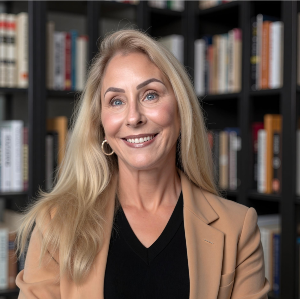
Janet Bond Brill spent 37 years with her mother-in-law Edna before losing her — and she refused to let Edna’s story disappear with her. The result is Little Edna’s War, a Warsaw Ghetto memoir written in Edna’s own voice as a child, with details by adult Edna’s vivid recollections and deep historical research. “Edna personified bravery, humility, an unwavering will to survive, and a love of life that few could ever mimic or fully appreciate,” Brill writes. “She suffered deeply, endured gracefully, fought tenaciously, and reconciled compassionately.” For Brill, writing the book was an act of devotion. For readers it is a compelling contribution to Holocaust literature, particularly the history of women and children during the Holocaust that otherwise might have been lost.
Readers are introduced to the Szurek family in the summer of 1939 – Papa Avraham, Mama Shulamit, and eight children: Schlomo, 18, Mordecai, 16, Hannah, 14, Yakov, 12, Miriam, 10, Edna, 4, and twin boys just months old, Jozeph and Binjamin.
Edna describes Warsaw as magnificent – “a tapestry of monument-lined boulevards, elegant palaces, verdant parks, and classical bistros.” The Szureks’ street “nestled within a upper-class neighborhood known for its architectural beauty and the Jewish bourgeoisie and intelligentsia who called it home. Residents dressed in Parisian fashions, dined in fine restaurants, and immersed themselves in the city’s cultural offerings. Our flat occupied the first floor of an elegant Art Nouveau apartment building with a courtyard adorned with benches and trees." At night, Papa played the violin, Mordecai played the piano, and Mama, a trained soprano, sang.
Their large apartment at 18 Mila Street was “adorned in Mama’s beloved Biedermeier style – paneled walls featuring elegant moldings, illuminated by the warm glow of crystal chandeliers. Rich hardwood floors were partially concealed beneath vibrant Oriental rugs, while floor-to-ceiling windows were framed by flowing draperies. The wood frames of sofas and chairs displayed intricate hand-carved details, the cushions embellished with delicate embroidery.”
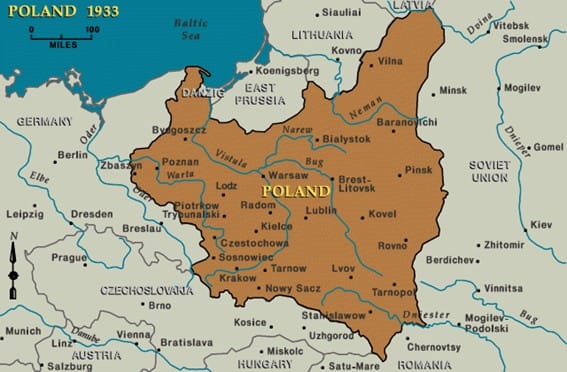
The Warsaw Ghetto, 1939-1945
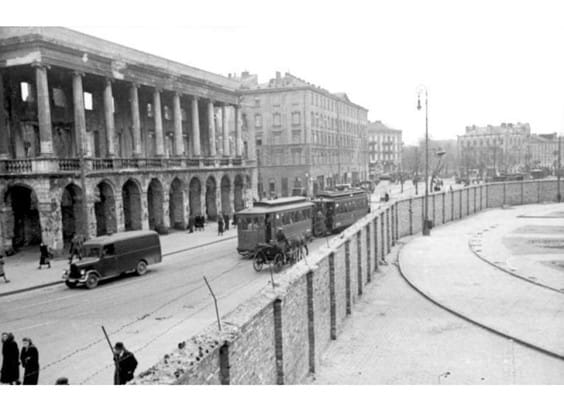
Warsaw before World War II had the largest Jewish population in Europe. The Warsaw Ghetto was the largest ghetto in occupied Europe, with about 380,000 Jews before the war, 30% of the city’s population (“An Exercise”). German conquest began with bombing on September 1, 1939, turning buildings and streets into rubble. Soldiers appeared on the streets. Jews were targets. The Judenrat was created, a Jewish Council that enforced German policies over Jews. Identity cards specified who is a Jew. Jews were told to bow or curtsy when Germans passed and could keep only 2,000 zlotys in homes ($350-$400 in 1940). Warsaw was divided into the ghetto and the “Aryan side” forbidden to Jews, who were forced to wear the Star of David when they left home. The ghetto’s population at its peak was about 450,000 within 1.3 square miles, with severe crowding in streets and rooms. The ghetto wall, built by Jews under strict supervision, was sealed in November 1940 – 11 miles long, 10 feet high, topped with barbed wire and broken glass, with Jewish guards inside and German guards outside. Jews were forced to move into the ghetto, and Aryans were forced to move out. Aiding Jews could result in death.
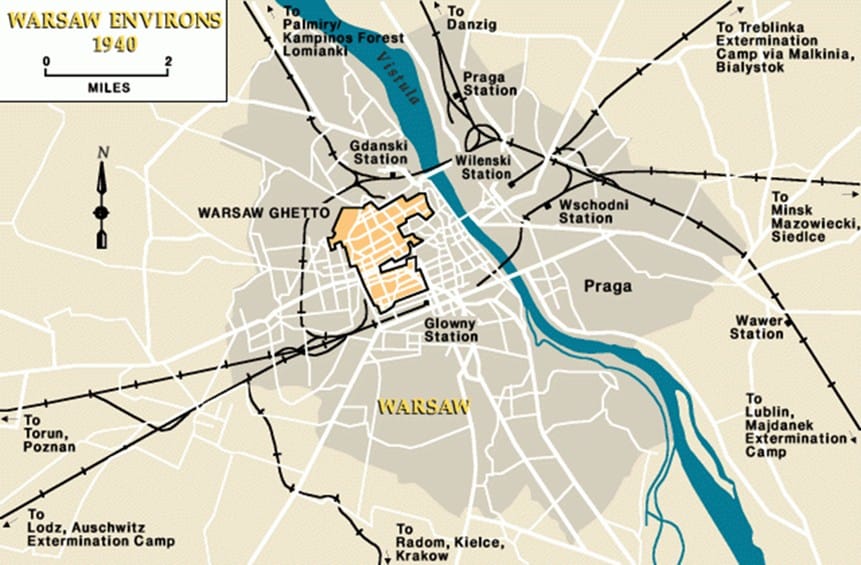
Jewish businesses were repurposed to meet Nazi wartime needs and eventually confiscated. Poles could no longer work for Jews. Soldiers entered Jewish homes to determine how many families could move in and what valuables to take. Food became scarce, and ration cards and soup kitchens provided too little nourishment for survival. Schools closed and children were sent to find food, a lifeline. Dead bodies appeared on the streets, and beggars might steal food people carried. Anyone objecting to German rule might be beaten or killed. Jewish women were raped. Able-bodied Jewish men were sent to labor camps for Nazi construction projects, including the Majdanek concentration camp near Lublin, about 100 miles from Warsaw. German orders were given from trucks with loud bullhorns.
The Szurek family experienced the trials of the Warsaw Ghetto. For example, more families moved into their home and valuables were taken, including Papa’s violin and Mordecai’s piano. Papa’s factory was confiscated. He and Schlomo were sent to Lublin to build Majdanek and didn’t return. Mama starved to death; Yakov found her on the street. Hannah apparently was raped. The Judenrat allegedly took the sick baby twins to the hospital; the family heard no more about them.
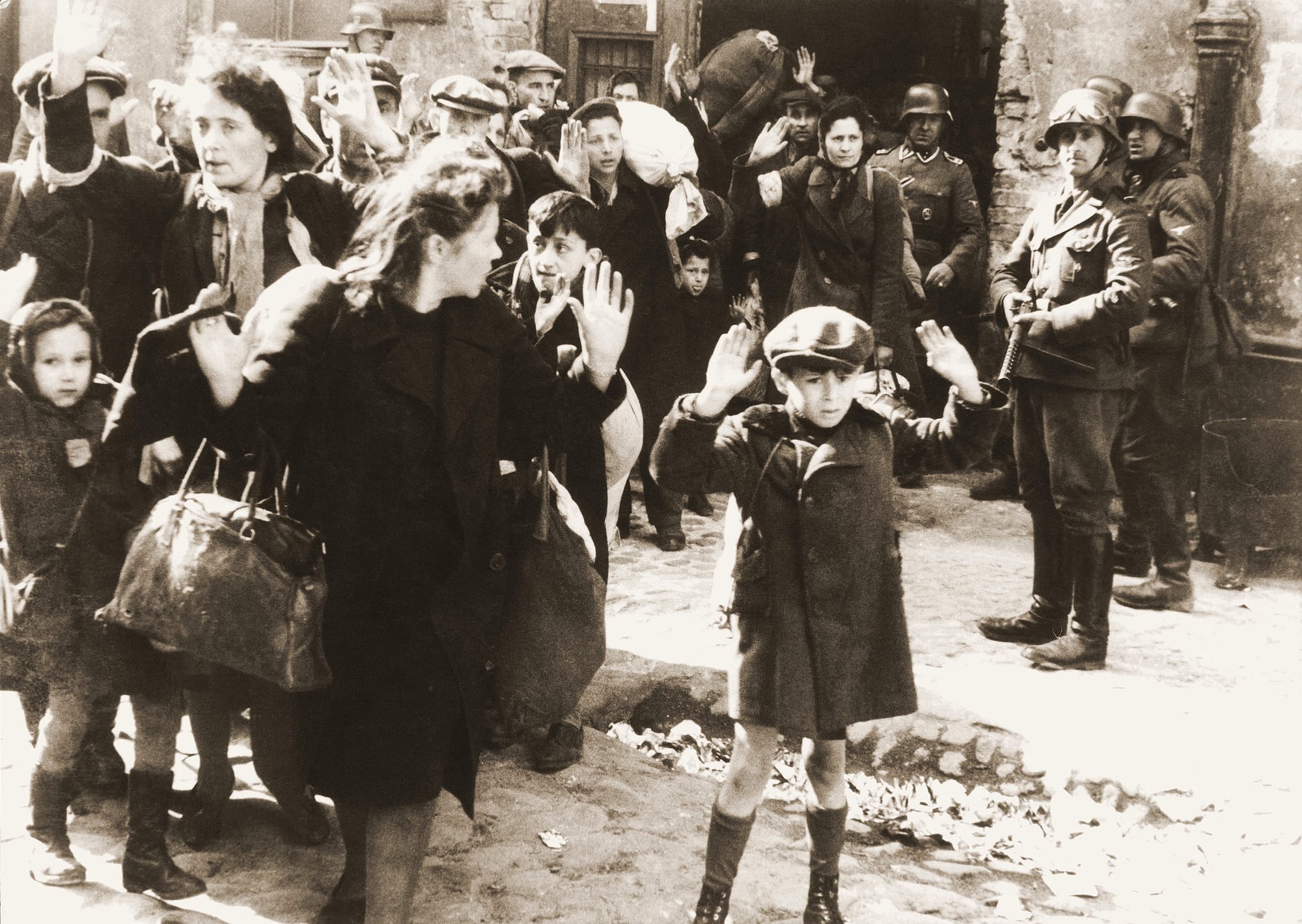
The Warsaw Ghetto existed for about two-and-a-half years. Over 300,000 Jews were deported to extermination camps, primarily to Treblinka, about 60 miles from Warsaw. Over 80,000 Jews died in the ghetto from starvation, disease, suicide, and direct violence by Germans, including defeat of the Warsaw Ghetto Uprising in April-May 1943, the first popular urban uprising in Nazi-controlled Europe (“Warsaw Ghetto”). The uprising followed deportations of about 265,000 Jews in July-September 1942, organized by underground groups under the name of ZOB, Jewish Combat Organization, with headquarters at 18 Mila Street, once the Szurek home. The Germans were victorious and destroyed the ghetto. Another signal act of resistance was Oyneg Shabos, founded by historian Emanuel Ringelblum to create records of ghetto life and preserve them in hiding, a large trove of Jewish firsthand accounts, stories, photographs, and diaries from the Holocaust in Warsaw (“Ernest”). Also, sheer survival was resistance.
Extraordinary Edna and Her Siblings
From age four in 1939, Edna wanted to fight back against the Germans and possessed the ability and courage to do so, supported by love and protection from siblings Miriam and Yakov, who took over her care after Papa and Schlomo didn’t return from Lublin and Mama died.
Edna couldn’t read but with Miriam had “street smarts” and recognized threatening situations. She called Miriam her best friend, mother, and protector; Miriam apparently once offered herself for sexual abuse to protect Edna. Miriam and Edna sang and danced in the streets for money, with success. Yakov taught Edna how to smuggle food through the ghetto wall. When she and Miriam were sent by Mama to the “Aryan side,” Yakov taught them how to be Polish and Catholic. Sometimes in peril, they moved from place to place, staying in churches, in bombed-out buildings, and with kind Polish families – through the window of an Aryan home, they saw the Warsaw Ghetto Uprising.
Yakov provided baptismal records and birth certificates with names from cemeteries of Polish girls the ages of Miriam and Edna. He told them never to say they were Jewish, even with guns to their heads. Yakov knew what to do: Edna wrote, “There was something remarkable about Yakov’s confidence in this alien world: he moved with the self-assurance of someone much older, shrewd and outgoing and hardworking beyond his years. . . . He possessed a worldliness that set him apart from everyone else in our family, even the adults in our building.”
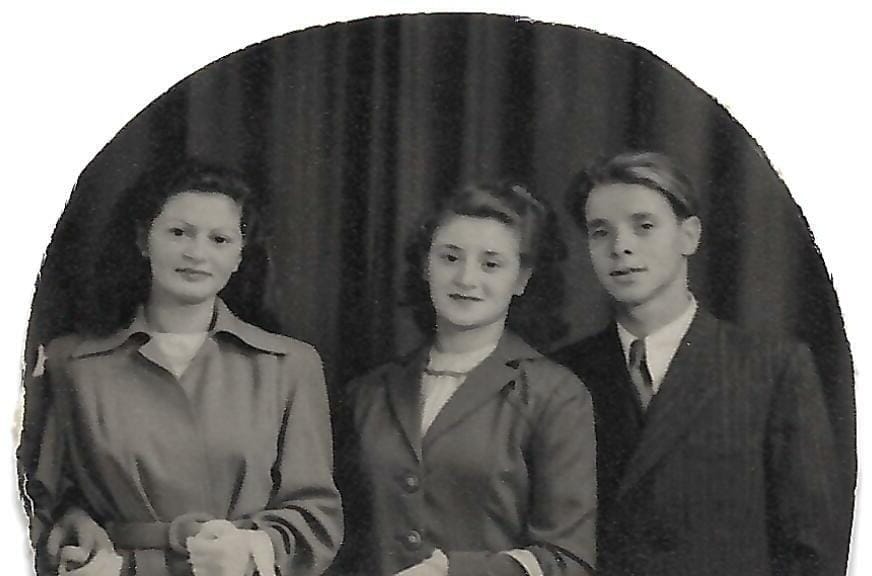
She noted that Aryans observed the mistreatment and murder of Jews as if at the circus or a theatrical performance. They seemed indifferent, which the Germans encouraged.
Edna shone when she served as an armed courier for the Polish Home Army during the Warsaw Uprising of August-October 1944. Her nom de guerre was Kajtek for her favorite book about a boy with special powers to fight evil. At age nine, she was awarded medals, the Badge of Honor for being wounded (she carried shrapnel for the rest of her life), and the Cross of Valor for exceptional courage in a battle against Germans in which she risked her life to deliver crucial intelligence: Edna returned fire though pinned down by machine guns, a grenade exploding nearby. The Germans defeated the Polish Army and razed Warsaw.
At age 12, Edna received an award from Pope Pius XII as a Christian war hero, one of 15 women honored. At the ceremony, seized by an impulse, Edna secretly used her penknife to chisel “Kajtek” into a door molding.
Near the end of the book, Edna asked the question that haunted her for years, why do people hate Jews? Miriam answered simply, “‘Because that’s what they’re taught from the time they are born . . . And no one can ever convince them that they’re wrong.’”
Edna’s change in identity from Jewish to Catholic to Jewish is explored. She credited her survival to life as a Polish Catholic, and returning to Judaism was not simple. When Yakov found her after the war, she denied that he, a Hebrew, was her brother until he sang a song to her that their mother sang to them. Yakov persuaded Edna and Miriam to join him in Israel, where Edna met her husband, Zvi (Harry) Brill. They married in 1953 and moved to the United States in 1960. Edna and Harry had two children, five grandchildren, and two great-grandchildren. In 1994, Edna recorded five hours of testimony for the Shoah Foundation at the University of Southern California, which preserves testimonies of Holocaust survivors and witnesses. She died in 2019 at age 84.
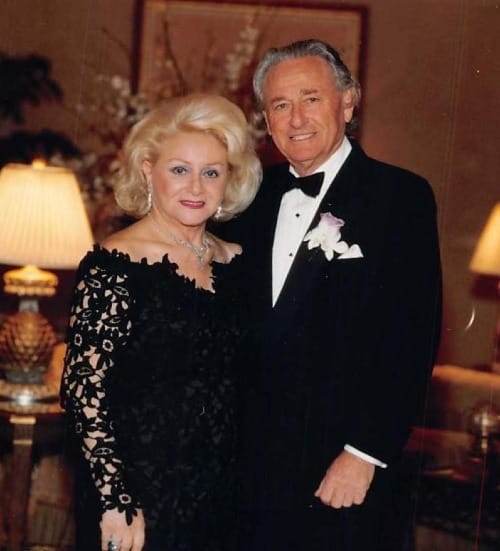
Among the remaining family members, Mama starved to death and Papa died at Flossenberg concentration camp in Bavaria. Mordecai, Hannah, and twins Jozeph and Binjamin presumably died in the Holocaust. Schlomo was sent to multiple camps, experienced atrocities, and was liberated from Buchenwald in Germany in 1945. He moved to Israel, married, and had two children. Schlomo became an alcoholic and died in 1977 at age 53; he was found on a street. Miriam, who divorced her first husband, remarried in Israel. She couldn’t have children because she had tuberculosis years before. Deemed emotionally unstable, she committed suicide in 1978 at age 49. Yakov was never in a concentration camp and found work on a Polish farm. In 1949, he co-founded an Israeli kibbutz for ghetto fighters. Brill arranged to translate his testimony to the Ghetto Fighters Museum from the Hebrew for this exceptional book. Yakov married and had two children. He died in 2011 at age 84.
References
“An Exercise in Depravity: The Establishment of the Warsaw Ghetto,” The National WWII Museum, New Orleans, https://www.nationalww2museum.org/war/articles/exercise-depravity-establishment-warsaw-ghetto#:~:text= When%20the%20German%20invasion%20of,Jews%20fell%20under%20Nazi%20 control. “No state has so brazenly constructed walls and barriers to restrict the free movement of people . . . as the [Adolf] Hitler dictatorship. Under the Third Reich’s rule, walls separated Jews from non-Jews in cities and towns, large and small, across Eastern Europe.”
Brill, Janet Bond. Little Edna’s War. Amsterdam Publishers, The Netherlands, 2026.
“Emanuel Ringelblum and the Oyneg Shabes Archive,” The National WWII Museum, New Orleans, May 21, 2025, https://www.nationalww2museum.org/war/articles/emanuel-ringelblum-and-oyneg-shabes-archive#:~:text=Amidst%20this%20assault%20on%20humanity,aspects%20of%20Polish%20Jewish %20history.
“Janet Bond Brill.” International March of the Living Webinar, Michael Berenbaum, Moderator, March 22, 2026, https://littleednaswar.com/international-march-of-the-living/.
“Mila 18 Bunker Site and Memorial in Warsaw, Poland, 1946,” Center for Jewish Art, Holocaust Memorial Monuments, https://cja.huji.ac.il/hmm/browser.php?mode=set&id=49737.
“Warsaw Ghetto,” YadVashem.org, https://www.yadvashem.org/holocaust/about/ghettos/warsaw.html#: ~:text=The%20crowded%20ghetto%20became%20a,suicide%20on%20July%2023%2C%201942.
“Warsaw Ghetto Uprising,” United States Holocaust Memorial Museum, https://encyclopedia.ushmm.org/ content/en/article/warsaw-ghetto-uprising.
Dianne R. Layden, Ph.D. is a semi-retired professor and writer in Albuquerque. Her field is American Studies. She published a booklet in 2024 about historic Temple Montefiore in Las Vegas, NM, which is available on the New Mexico Jewish Historical website, NMJHS.org. Dr. Layden won a national award for her 2017 article in Legacy, the NMJHS newsletter, about New Mexico Holocaust survivors. In 2022-2025, she portrayed Supreme Court Justice Ruth Bader Ginsburg for the New Mexico Humanities Council.
Community Supporters of the NM Jewish Journal include:
Jewish Community Foundation of New Mexico
Congregation Albert
Jewish Community Center of Greater Albuquerque
The Institute for Tolerance Studies
Jewish Federation of El Paso and Las Cruces
Temple Beth Shalom
Congregation B'nai Israel
Shabbat with Friends: Recapturing Together the Joy of Shabbat
New Mexico Jewish Historical Society
Policy Statement Acceptance of advertisements does not constitute an endorsement of the advertisers’ products, services or opinions. Likewise, while an advertiser or community supporter's ad may indicate their support for the publication's mission, that does not constitute their endorsement of the publication's content.
Copyright © 2026-27 New Mexico Jewish Journal LLC. All rights reserved.