
















Ruth Bader Ginsburg in New Mexico


By Dianne R. Layden, Ph.D.
U.S. Supreme Court Justice Ruth Bader Ginsburg had a presence in New Mexico since the 1980s, particularly at the Santa Fe Opera in 1995-2018. Ginsburg passed away in September 2020, but her presence has continued in my portrayals of her for the New Mexico Humanities Council and subsequent presentations about her life.
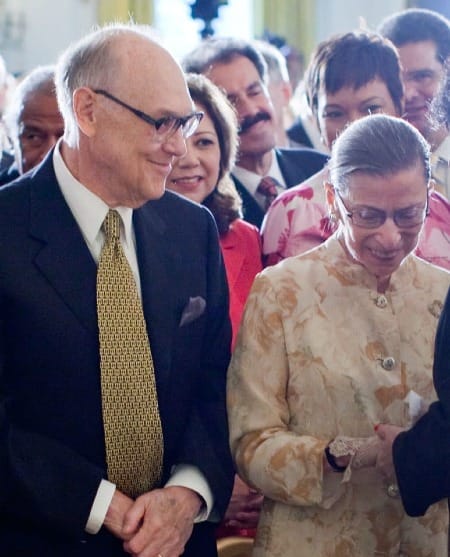
Ginsburg and her husband Martin visited Santa Fe during the Supreme Court’s summer breaks, often joined by their children and grandchildren. In 1995, she began attending the Santa Fe Opera, which she called the best summer opera company in the world. She went to preview buffet dinners and was an avid, knowledgeable listener to informal talks about that night’s opera in the rotating repertory of five operas each year.
Ginsburg knew many of the vocalists and staff to converse with and often met artists at intermission and post-performance, accompanied by a retinue of U.S. Marshals wherever she went. Her record of achievements and endearing, humble persona evoked royal treatment when she attended, and she often was given standing ovations – in Santa Fe and elsewhere in the U.S.
The former guest ranch of 199 acres seven miles north of Santa Fe was transformed by John Crosby in 1956-1957 into a theater open to the elements. Side walls of the building remain open to the land, and you can see the lights of Los Alamos at night through the back of the stage. The theater now seats over 2,000 people. When Ginsburg returned to Washington, D.C., she would say, “What happened to my beautiful skies?”
Ginsburg wanted to be a great diva, although she couldn’t sing. Most of the time, she thought about legal problems. But when she went to the opera, she was lost in it, loving it.
She started traveling to the Santa Fe Opera at the behest of Jean Seth, the first person to establish an art gallery on Canyon Road in Santa Fe. They met through Ginsburg’s acquaintance with Jean’s husband, Judge Oliver Seth of the Tenth Circuit Court of Appeals in Denver, and Ginsburg’s role as Supreme Court liaison to the Tenth Circuit. Judge Seth died in 1996. After Jean died in 2013, her daughter Laurel took over arranging outings for the Ginsburg family. Laurel also has been a gallery owner, and her sister Sandy in Taos is an artist.
Over the years, Ginsburg visited museums and galleries, hiked the hills, and climbed ladders at Bandelier National Monument. She toured artist Georgia O’Keeffe’s home in Abiquiu and met her assistant, visual artist Juan Hamilton, at his home and studio on Canyon Road. She performed a same-sex wedding and met a Taos Pueblo governor and Bataan Death March survivor. She spoke at an international women’s symposium and read to young children and their parents at a United Way event, at which a 10-year-old weaver in the Spanish Colonial style gave her a rug.
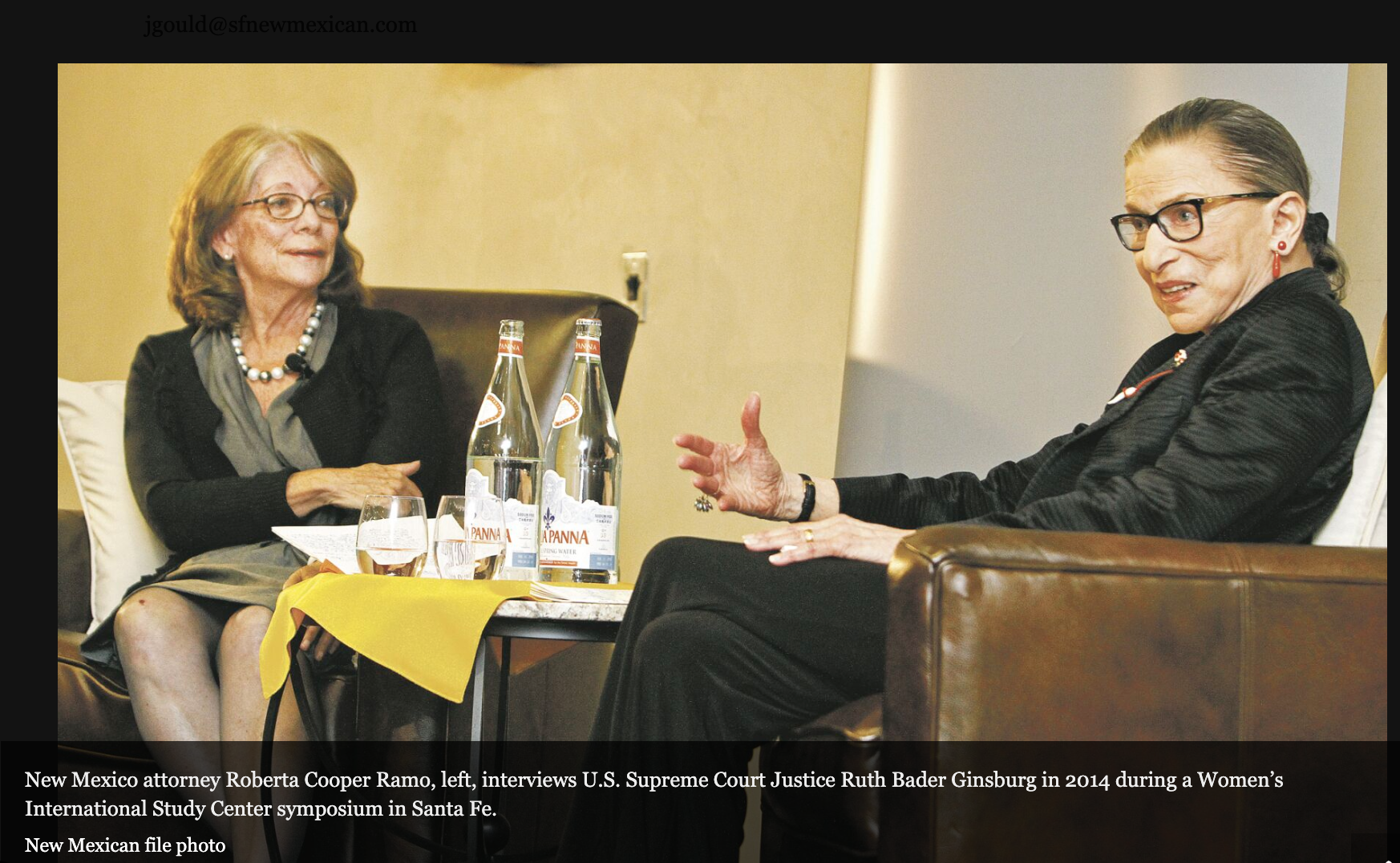
Notably, Ginsburg spoke to the 2016 State Bar of New Mexico annual meeting, a one-hour talk with longtime friend Roberta Cooper Ramo, New Mexico attorney and first female president of the American Bar Association, and the American Law Institute. The meeting was rescheduled to coincide with Ginsburg’s summer visit to Santa Fe so state bar association members could hear her speak. Some 900-1,000 people attended. In 2017, at the Lensic Theater, she provided the legal commentary in “Justice at the Opera,” a program of legal scenes in opera as performed by Santa Fe Opera apprentices.
Love of Opera
Ginsburg was introduced to opera as a child by conductor Dean Dixon, who sought to enrich children’s lives by early exposure to beautiful music, including opera. He organized, rehearsed, and conducted youth orchestra performances and presented condensed operas at New York City high schools. Ginsburg was born and raised in Brooklyn. At age 11, she attended Dixon’s production of La Gioconda – and was spellbound!
Ginsburg considered opera the perfect art form, and Marty loved opera, too. In addition to the Santa Fe Opera, the family attended the Glimmerglass Festival in Cooperstown, New York. In Washington, D.C., she attended productions of the Washington National Opera, often more than once, and other operas nearby. She traveled to opera in Dallas and San Francisco. Beginning in 2002, Ginsburg arranged the musicales the Supreme Court held twice each term.
To her delight, Ginsburg performed cameo parts at the Washington National Opera – in Ariadne auf Naxos with Justice Antonin Scalia; with Justices Arthur Kennedy and Stephen Breyer in Die Fledermaus, starring Placido Domingo; and a speaking role in La Fille du Regiment – to her embarrassment, audiences cheered for her in her tiny part. After Marty died in 2010, Ginsburg went to the opera more often to console herself.
Francesca Zambello, director of the Washington National Opera and the Glimmerglass Festival, called Ginsburg opera’s greatest advocate. For nine summers, she provided a program at Glimmerglass called “Law and Opera with R.B.G.,” with commentary on legal scenes from operas performed by company members. Auctions of Ginsburg’s property and memorabilia in 2022 raised millions of dollars for the Washington National Opera, SOS Children’s Villages, and other charities.
Scalia/Ginsburg: A (Gentle) Parody of Operatic Proportions
Derrick Wang is a composer, librettist, pianist, lawyer, and professor with degrees in music and law. As a law student in a constitutional law course, every time Wang read a Scalia dissent, he heard music in his head, a rage aria about the Constitution of the type made famous in Italian opera of the 1700s. To Wang, Ginsburg’s words appeared as a counterpoint, a beacon of lyricism with a steely strength and a fervent conviction all their own.
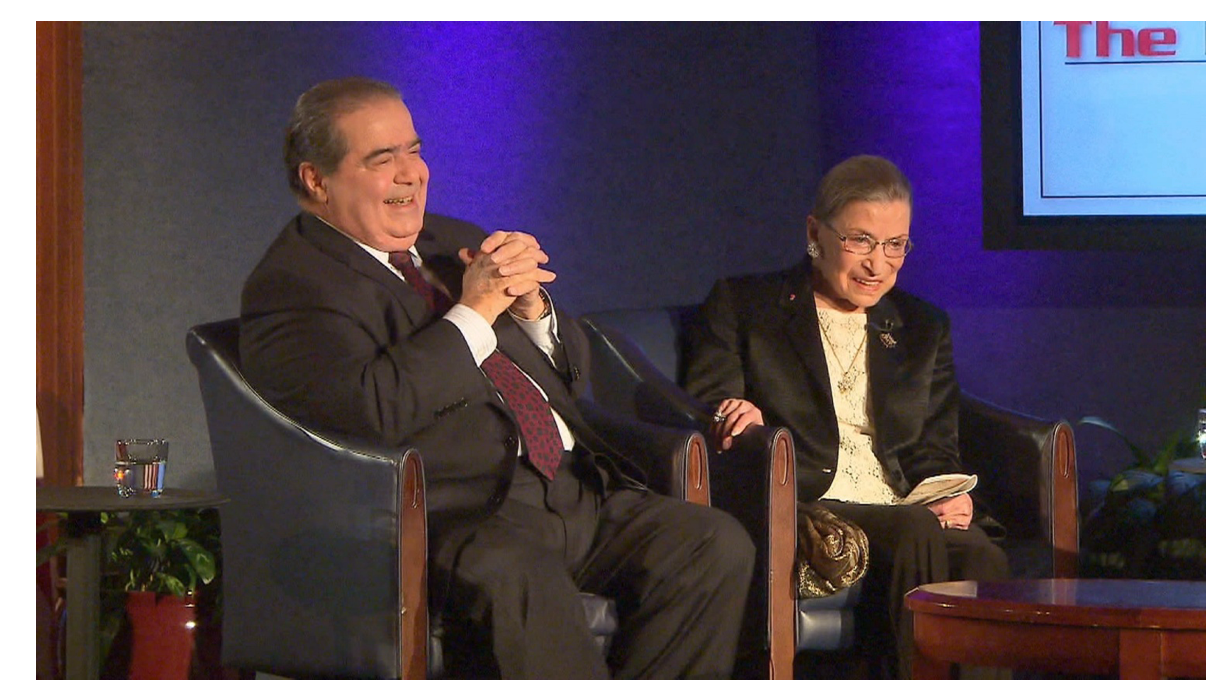
Wang thought he could make a funny opera about the two Justices’ widely divergent judicial views, as well as their deep friendship, which began when Scalia and Ginsburg served together on the District of Columbia Circuit Court of Appeals in the 1980s. Wang’s comic opera, Scalia/Ginsburg, was for Ginsburg a dream come true. The 70-minute opera integrates constitutional theory (Scalia’s originalism versus Ginsburg’s living Constitution), legal scholarship, judicial opinions, and speeches they gave. Almost every line of the libretto is documented in footnotes. The music was inspired by works of Handel, Mozart, Rossini, Verdi, Offenbach, Bizet, Puccini, Strauss, and others.
Wang published the libretto in the Columbia Journal of Law and the Arts in 2015, when Scalia/Ginsburg premiered at the Castleton Festival in Virginia, and on his website, DerrickWang.com/Scalia-Ginsburg. In 2017, after Scalia’s passing in 2016, the opera was revised for the Glimmerglass Festival. Performances have been broadcast on the radio in the U.S. and produced in U.S. cities and elsewhere. I saw the performance by Opera Las Vegas in Nevada in July 2021. In 2026, the opera will be performed in Kentucky, Utah, Arizona, and Texas.
The opera opens with Scalia’s rage aria, which begins:
“The Justices are blind / How can they possibly spout this / The Constitution says absolutely nothing about this.”
When he is locked in a dark room for excessive dissenting, Ginsburg comes to rescue him, entering through a glass ceiling (and noting that she has done so before). Later, Ginsburg sings a rage aria of her own:
“You are searching in vain for a bright-line solution, / To a problem that isn’t so easy to solve. / But the beautiful thing about our Constitution is that / Like our society, it can evolve.”
Toward the end, tenor Scalia and soprano Ginsburg sing a duet: “We are different, we are one,” different in their interpretation of written texts, one in their reverence for the Constitution and the institution they serve.
When asked why Scalia’s name appears first in the title, Ginsburg explained the Supreme Court emphasizes seniority. Scalia was appointed in 1986, and she was appointed in 1993.
Ginsburg died on September 18, 2020, at age 87, having served 27 years on the Supreme Court. She was the first woman to lie in state at the U.S. Capitol. She loved New Mexico and had many friends here. New Mexico loved her back: Governor Michelle Lujan Grisham lowered all flags in the state to half-staff; Roberta Ramo published an article in the New Mexico Bar Bulletin about her visits to Santa Fe; and the Santa Fe Opera dedicated one of Ginsburg’s favorite seats to her memory and shows the seat to opera visitors.
Ginsburg Portrayals and Presentations in New Mexico
In Fall 2020, I received a call for proposals from the New Mexico Humanities Council Speakers Bureau. A friend had told me recently I reminded her of Ruth Bader Ginsburg and gave me an RBG figurine. I had followed Ginsburg’s career for years in admiration. I submitted a proposal, auditions were held, and I was selected. In 2022-2025, I portrayed Ginsburg in Clovis, Los Alamos, the El Morro Valley 40 miles south of Grants, and twice in Albuquerque.
In my portrayals, I spoke about Ginsburg’s youth, education, family, and legal career; service on the American Civil Liberties Union Women’s Rights Project, for which she won five of six cases before the U.S. Supreme Court; and appointments by Presidents Jimmy Carter and Bill Clinton to the District of Columbia Circuit Court of Appeals (1980) and U.S. Supreme Court (1993). I showed 21 slides that include images of Ruth and her family, judicial colleagues, composer Derrick Wang, Justice Antonin Scalia, and attorney Roberta Ramo. I displayed my Ginsburg memorabilia and distributed Ramo’s article about Ginsburg in Santa Fe and my article about her legal career. The program, about an hour, ended with questions from attendees.
In April 2025, President Donald Trump’s administration canceled over $100 million in grants to the National Endowment for Humanities, which funds state councils. The New Mexico Humanities Council closed the Speakers Bureau. In May 2026, a federal judge in New York ruled the cuts of Congressionally-approved funds unconstitutional and violations of the First and Fourteenth Amendments because programs were targeted for their political views and diversity. To my knowledge, funds have not yet been restored.
To honor her memory, I now give presentations about Ginsburg, often free, and accompanied by slides, memorabilia, handouts, and questions by attendees. For many New Mexicans, Ruth Bader Ginsburg is a star in the firmament for her brilliant mind and legal achievements. We remember her.
Reference
Zambello, Francesca. “Ruth Bader Ginsburg Loved Opera, and Opera Loved Her Back.” NewYorkTimes.com, September 19, 2020, https://www.nytimes.com/2020/09/19/arts/music/ ruth-bader-ginsburg-opera.html.
Dianne R. Layden, Ph.D. is a semi-retired professor and writer in Albuquerque. Her field is American Studies. She published a booklet in 2024 about historic Temple Montefiore in Las Vegas, NM, which is available on the New Mexico Jewish Historical website, NMJHS.org. Dr. Layden won a national award for her 2017 article in Legacy, the NMJHS newsletter, about New Mexico Holocaust survivors. She also won an award in the 2026 NM Press Women Communications Contest for her NMJJ review, Tribute to Frances Levine’s New Book, Crossings: Women on the Santa Fe Trail