













Simchat Torah, everything seems to loosen.
By Misha Sauceda
We come in everyday clothes—worn jeans, scuffed sneakers, T-shirts, warm hoodies. Children play in the Social hall. We talk and laugh. The atmosphere feels charged, different from an ordinary Shabbat morning.
Then all the Torahs come out.
Usually, opening the ark is a special moment. We stand. We sing. A Torah is carefully removed. As it moves through the sanctuary, we reach toward it with a tallit or siddur, then kiss what has touched it. Ritual surrounds every movement.
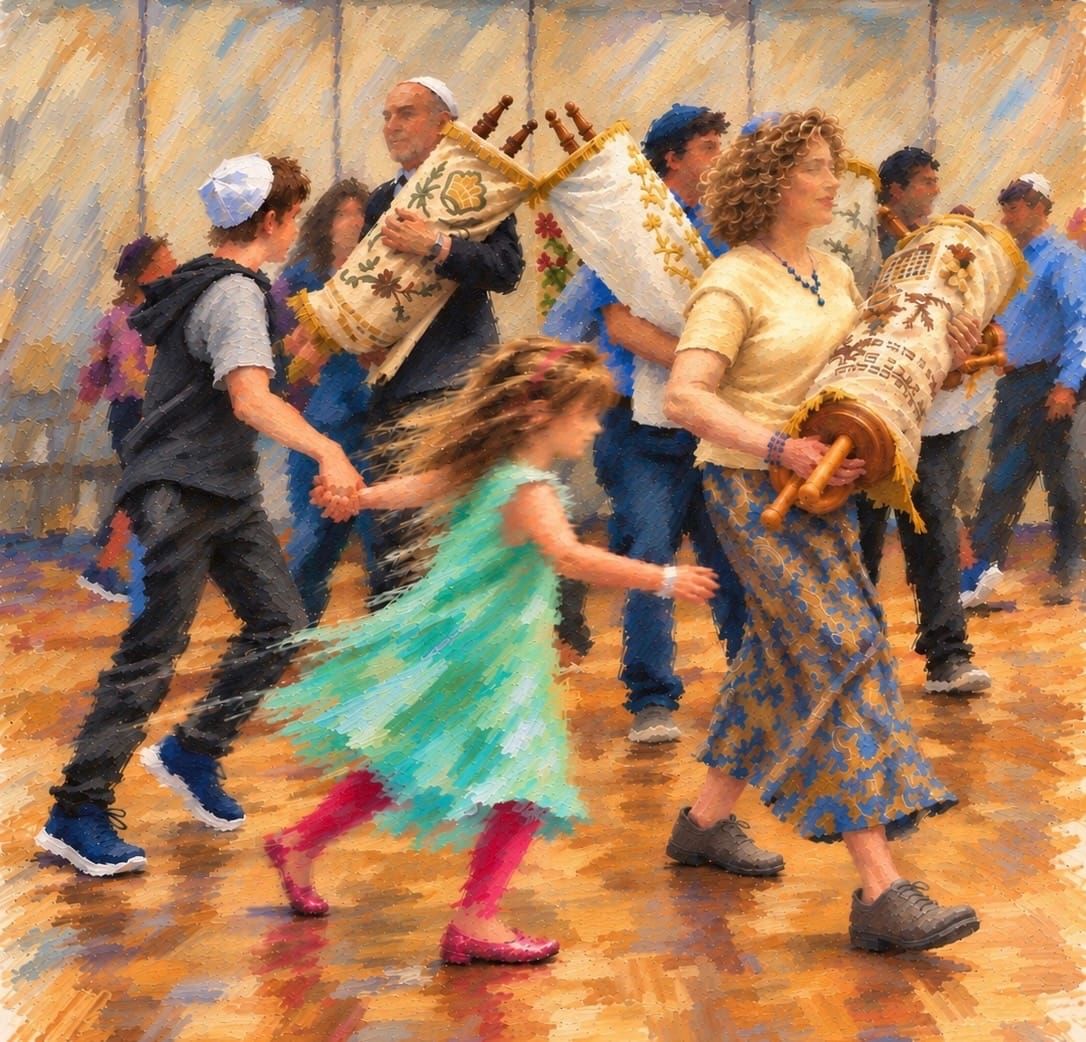
But on Simchat Torah, one Torah after another emerges until these sacred scrolls are everywhere, passing through the crowd.
The Torahs are still dressed in white, their High Holy Days finery. White carries the feeling of repentance, purity, beginning again. Beautiful, but serious.
And now those same white Torahs are bouncing around our social hall. I love the incongruity.
I am always a little afraid when someone hands me a Torah. The first time, it was Amanda Cohen-Bandy, with her wide smile and confident air, looking at me with her “do you wanna dance?” eyes. Before I could answer, the scroll was in my arms, her body moving away still in rhythm to the music.
Please, God, don’t let me be the one who drops the Torah.
Every Shabbat, ritual teaches us: Be careful. This is sacred.
Maybe Simchat Torah teaches something else.
Maybe this apparent casualness isn’t casualness at all. Maybe it is intimacy.
We dance with the Torah we love.
The dancing is called hakafot—seven go ‘rounds, echoing the seven days of Creation. Seven marks completion in Judaism, but completion doesn’t necessarily mean ending. Shabbat completes Creation, and another week begins. On Simchat Torah, we finish reading the Torah and another year begins.
Bereshit bara Elohim.
In the beginning, God created.
The text has stayed where it was. The reader has moved.
Somewhere amid all this theological thinking, a child runs around the circle of dancers in her bright blue dress and red tights. She holds her brother’s hand briefly, then continues on her journey.
Maybe that’s what continuity looks like: a living tradition carried by imperfect people in ordinary clothes with children running through the middle of it.
Someone might lose the rhythm. Someone might carry it differently. Another generation might sing a tune we don’t recognize.
And still, the white Torahs dance.
Maybe that’s what I need to remember when someone dancing beside me puts a Torah into my arms and I feel that flash of terror.
Hold on, not because Torah is fragile, but because it is precious.
Then hand it to somebody else.
Let them dance.
The words will still be there. The teachings will still be there. The fire in the words will still be there.
The Torah can survive the dance.
Misha Sauceda has called Albuquerque home for more than 35 years. Raised by an eccentric Jewish mother and an outspoken atheist father, she has spent a lifetime collecting stories — and a bit of perspective. These days, she writes in her flannel pajamas with two faithful dogs at her feet, convinced that humor is life’s most reliable survival skill.
This essay first appeared in Congregation B'nai Israel's new weekly newsletter Kibbitz, with Misha Sauceda as editor, designed to bring a more informal communication outlet for the CBI community in Albuquerque, New Mexico.