






The Séance Now Near You
Story and Photos by Paul Ross
One of THE big questions — right up there after “What is the Meaning of Life?”— is “Is There Life After Death?” Most religions have answers but seances try to put you in touch with the only ones who really know: the dead.
And now there’s someone new in town to facilitate that seemingly unbridgeable gap.
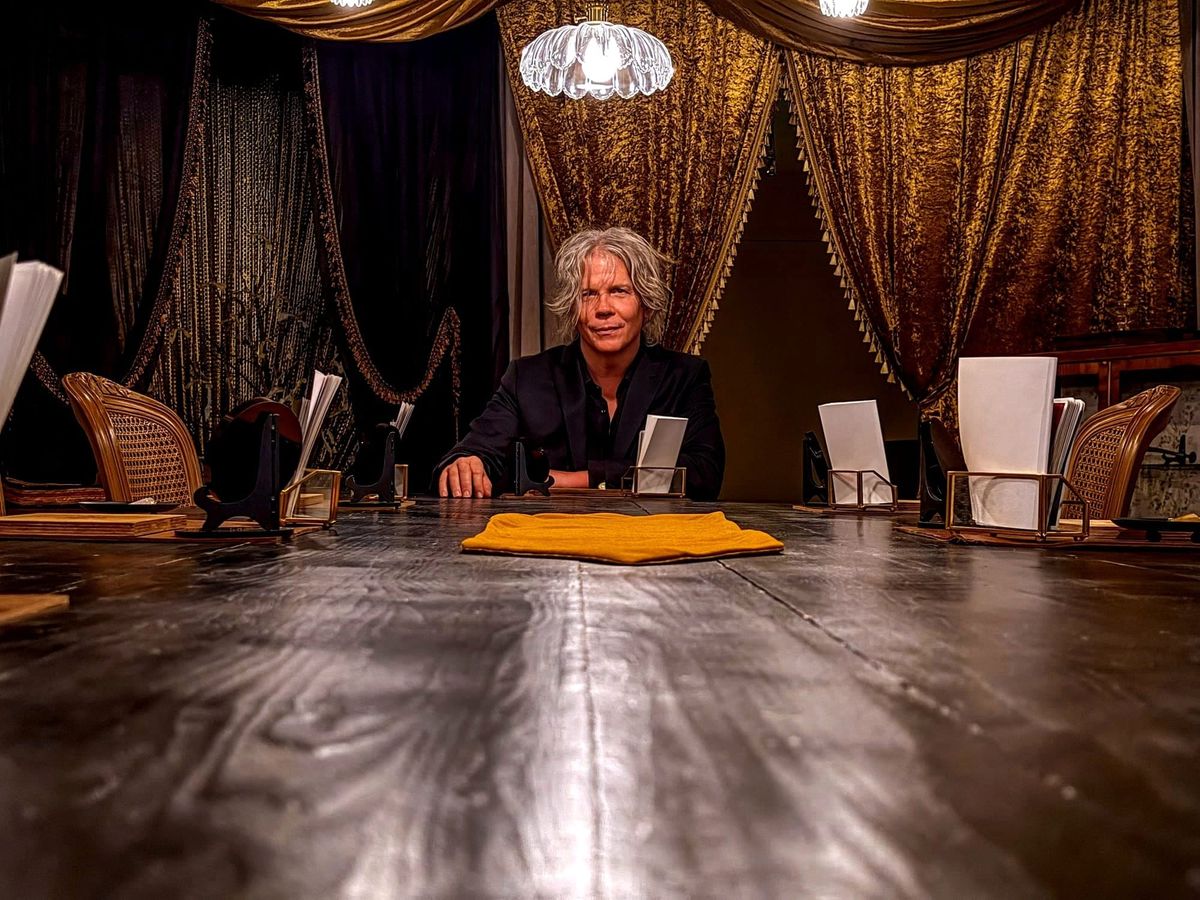
B.C. Smith is a professional stage magician whose curiosity has drawn him from performance to pursuit of the real thing. “I’ve been interested in magic my whole life. My mother is a tarot-reading housewife.” Largely autodidactic, Smith is also a highly respected musician and composer whose credits include the score for "Smoke Signals," the first Native American-made feature film released by a major studio.
He recently founded The Society of the Séance in Santa Fe, offering Phasmagorica, a word he coined meaning “a liminal space between belief and disbelief” which he designated as an experience for the inquisitive in experiments which seek to pierce the veil between the life and death.
Before Santa Fe, Smith had been creating theatrical séance shows in L.A. using magic tricks for entertaining effect. “But,” he hastens to add, “things kept happening.” He and his audiences had visual, audio and kinetic experiences that were unplanned and unexpected. He concluded that what he was unintentionally doing was (to employ fishermen’s terminology) “chumming the waters,” creating “induction” and true paranormal manifestations rose to the bait.
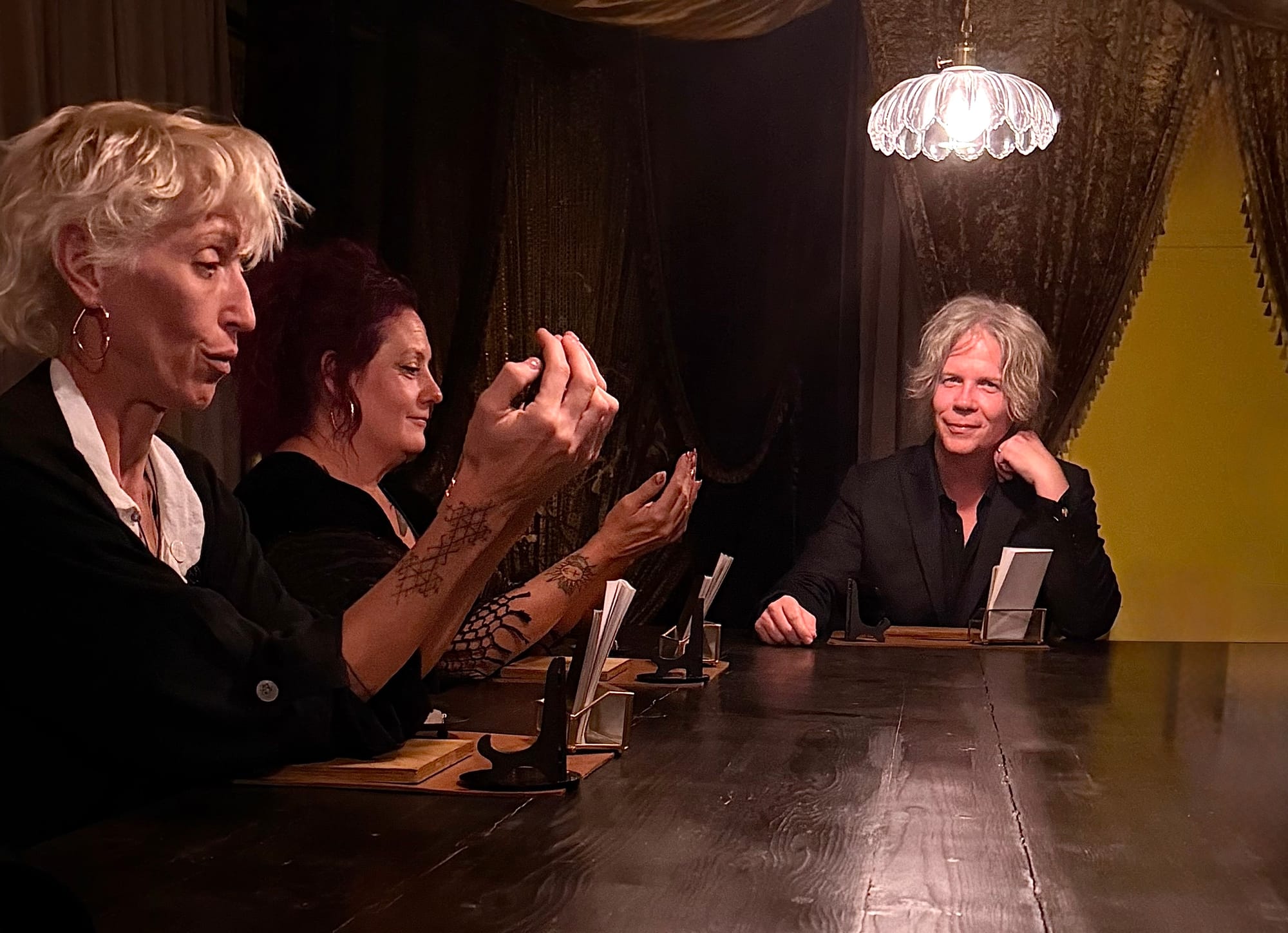
Now he uses “No tricks, it’s all honest and real.” In stating that, Smith steps beyond the standard definition of magic (that which is stage, illusion or fantasy) and into what cognoscenti deem “magick,” a term popularized by the oft ID’d as infamous Aleister Crowley, signifying ritual or spiritual practice.
The séances are structured to educate through recreations of classic Victorian-era mediumship but they are not presented in an authoritative or foreboding manner. The mood is casual, inviting and welcoming to everyone — even skeptics. All that is asked of participants is that they be open to possibilities. So, in effect, you are in charge.
The idea of ghosts has been with us pretty much since the beginning.
Each culture has its own interpretation with the spirits running the gamut from friendly and helpful to menacing and deadly.
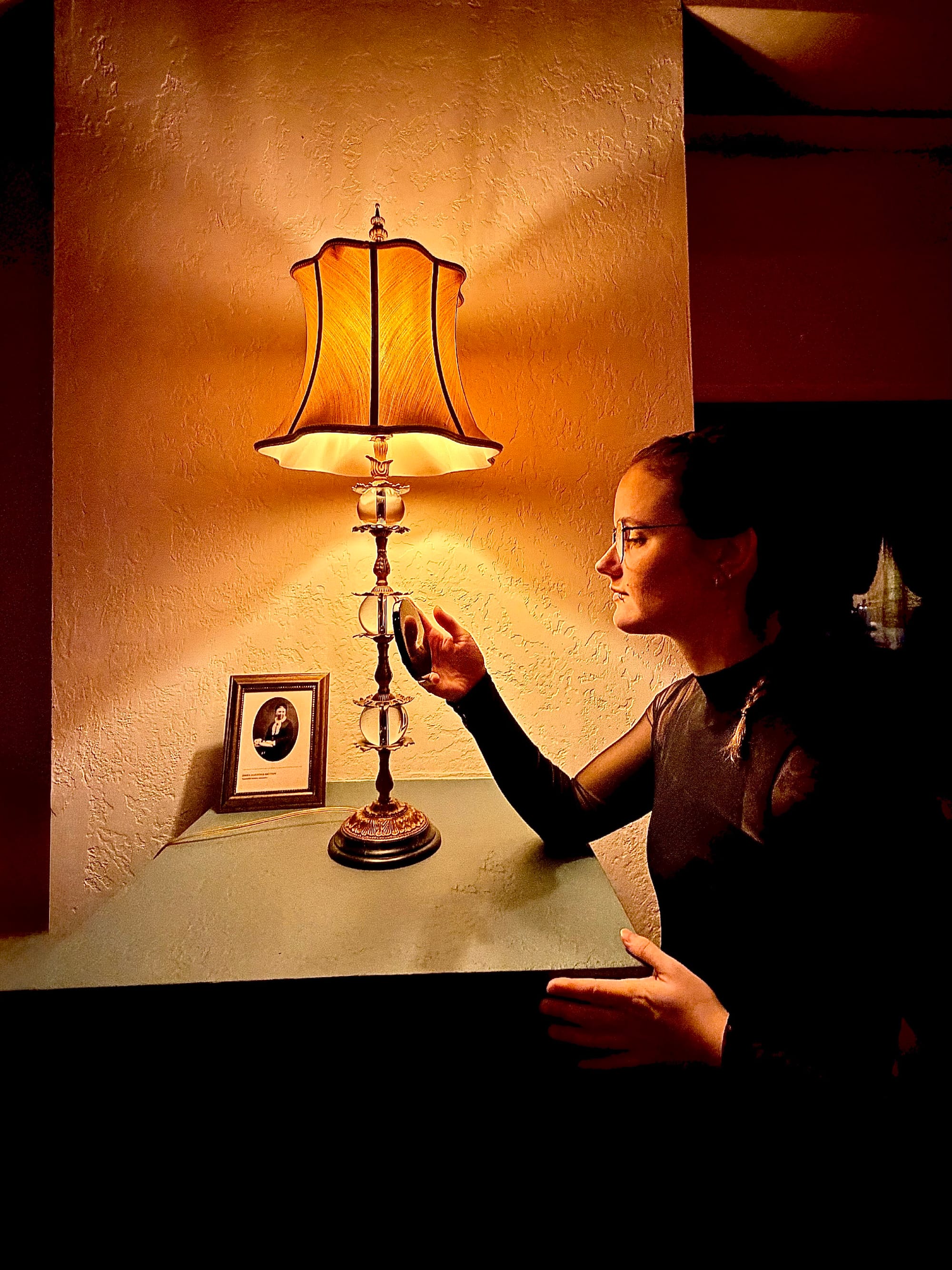
The mid-Victorian era ecumenicalized what had been the province of priests, shamans, and practitioners of “the dark arts” into salons. Among the celebrities who engaged were Queen Victoria, Mary Todd Lincoln, Thomas Edison, Alexander Graham Bell, Sir Arthur Conan Doyle, and 3 U.S. presidents (who hosted séances in the White House). When unable to contact his deceased mother, legendary magician Harry Houdini vengefully turned to exposing charlatans who used trickery to garner money by preying on the gullible and vulnerable. He even tried to get a law passed to prevent such. Nonetheless, the practice survives and is incorporated into religious beliefs such as Spiritualism and Divine Metaphysics which are found worldwide.
Many Jews and Christians are flat out against séances. But what does the Bible actually say? Deuteronomy (18:10) IDs “a medium, or a spiritist, or one who calls up the dead” as “an abomination to the LORD.” And yet— King Saul, who strictly banned soothsayers, etc., personally broke his own taboo to consult the “witch of Endor” about his fate in an impending battle. She summoned the reluctant specter of the prophet Samuel. This move was evidently ill-advised because Saul died the next day.
Both the five books of Moses and Jewish lore are rife with communication across the vital demarcation. Tombs of ancient rabbis and revered holy persons are petitioned in both oral and written words for wisdom and intervention, mirrors are covered following a death to — among other beliefs — prevent a transitional soul from being trapped. When visiting a gravesite, a small stone of marking the visit is left atop the memorial marker.
And there is Jewish belief in the afterlife with equivalent, though more forgiving, aspects of limbo, heaven and hell.
So, despite all prescriptions against and warnings about participating in a séance, I went. I’m not superstitious and if trick-or-treating at 5th grade Halloween parties, attending Umbanda ceremonies in Brazil, Santería in Cuba, Voodoo in New Orleans, and timeshare pitches in Tonga haven’t already put a lien on my soul, I figured once-removed research in Santa Fe wouldn’t either (cross fingers).
A far cry from those storefront affairs where “Madame Olga – Sees All, Knows all, Tells All, and Charges All” cons seer-suckers, an impressively large house sits atop a small hill at the end of a dirt driveway and behind a metal gate whose access code is provided to attendees. After parking, a series of stacked and cracked stone slabs lead to a large door in the white slump block wall cradling the structure.
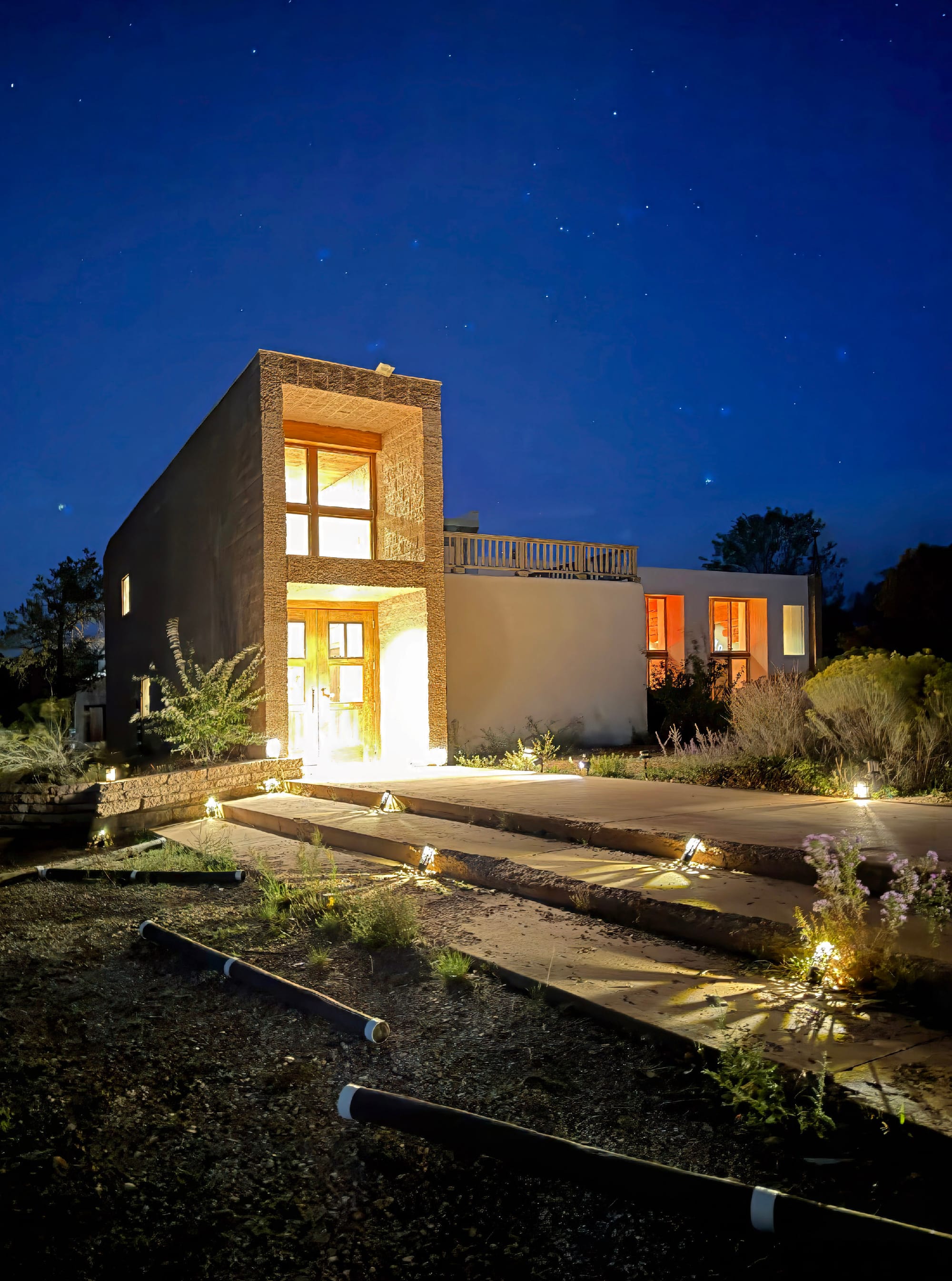
Once inside, you follow a polished cement arcing path around to a large room filled with cases of intriguing exhibits explaining arcane and esoteric subjects, experiments in mathematics and music, and the stories of the investigators and creatives who delved into mysterious realms less traveled.
Nonalcoholic drinks are offered (spirits being restricted to any conjured up during the séance) and guests mingle. Smith says that “The whole curated intention is to provoke conversation and thought.”
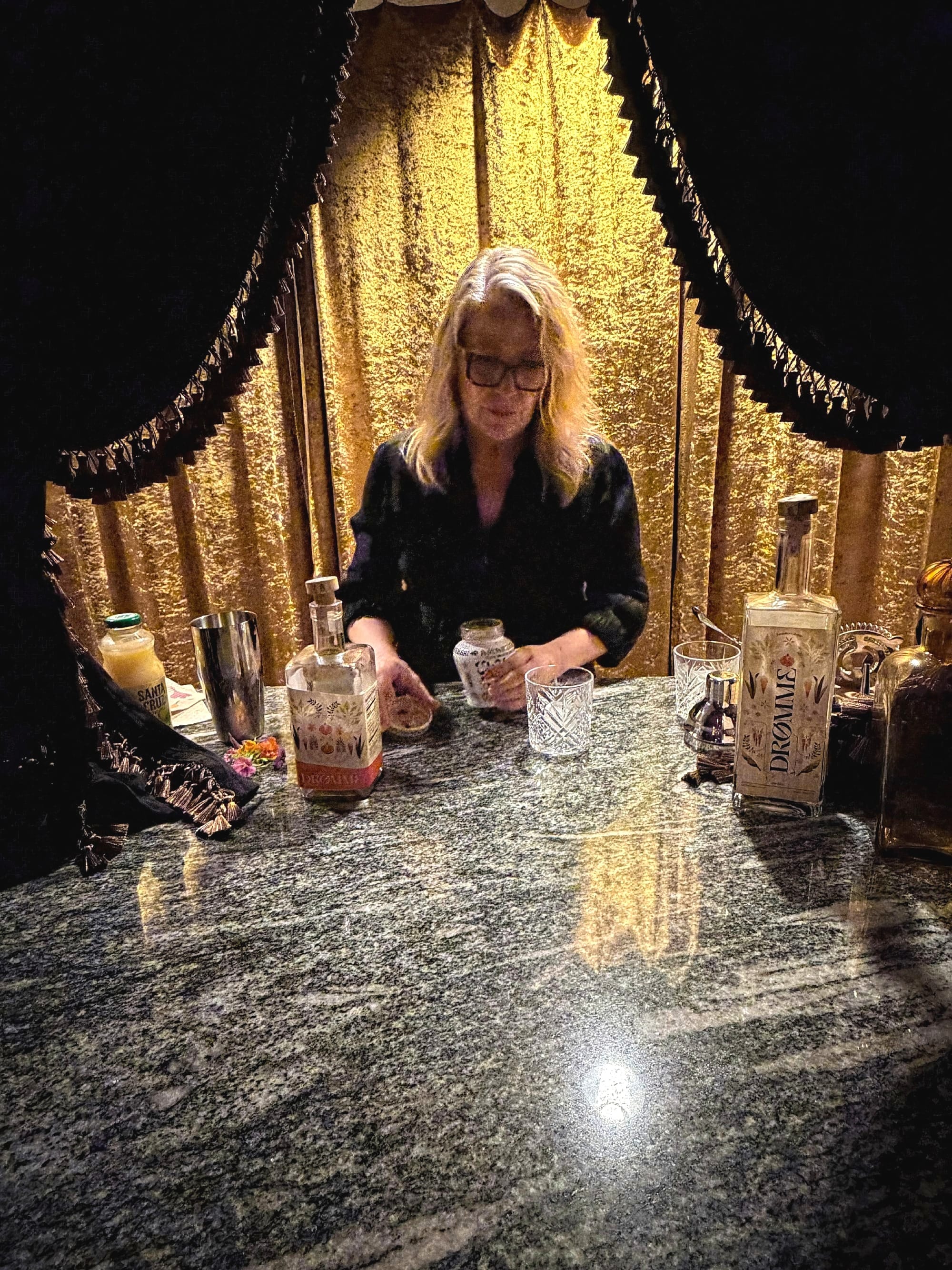
A short climb up some steep wooden stairs leads to a room where orientation takes place, questions are answered, fears assuaged, and guests are prepped for the main event.
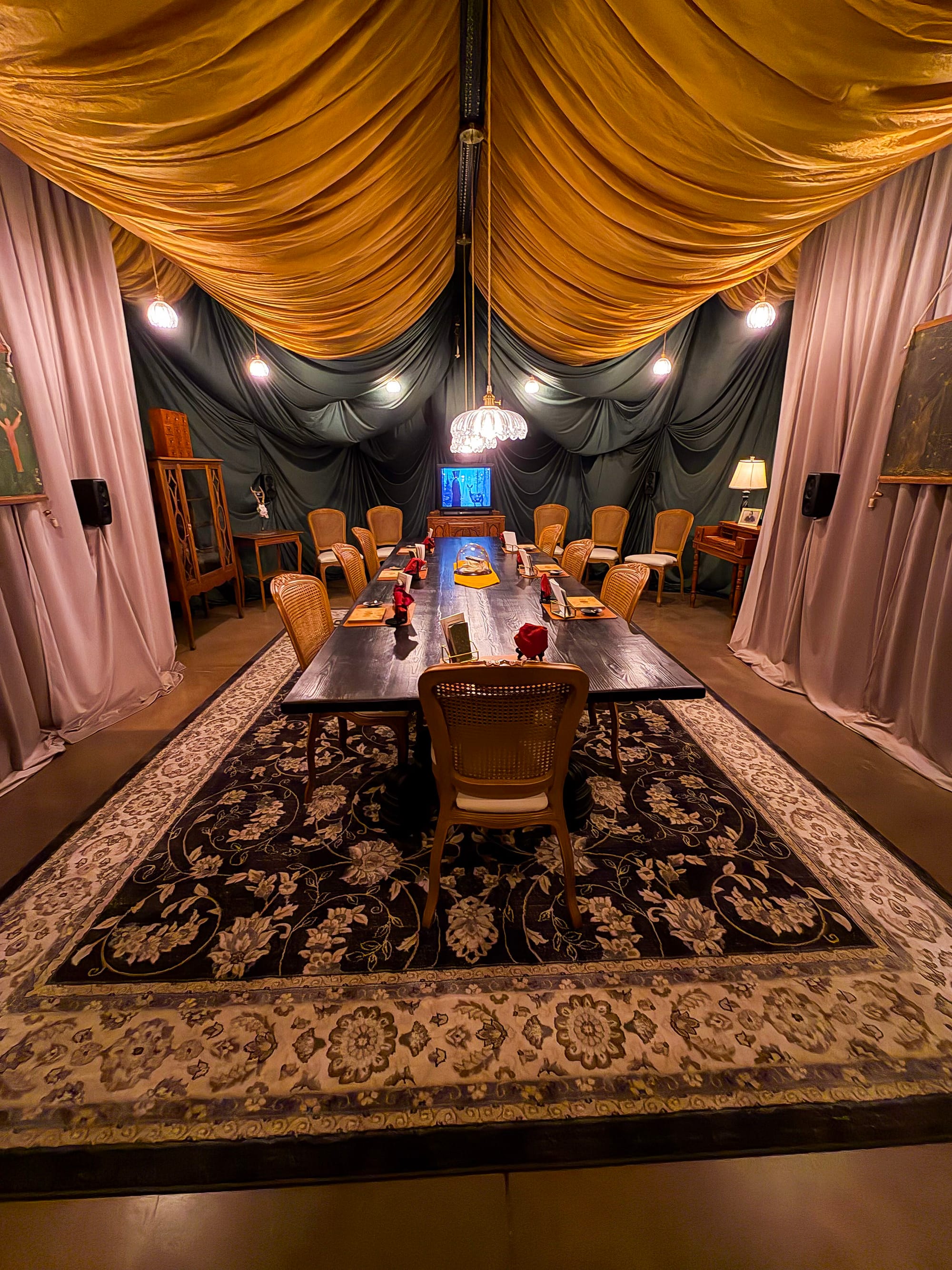
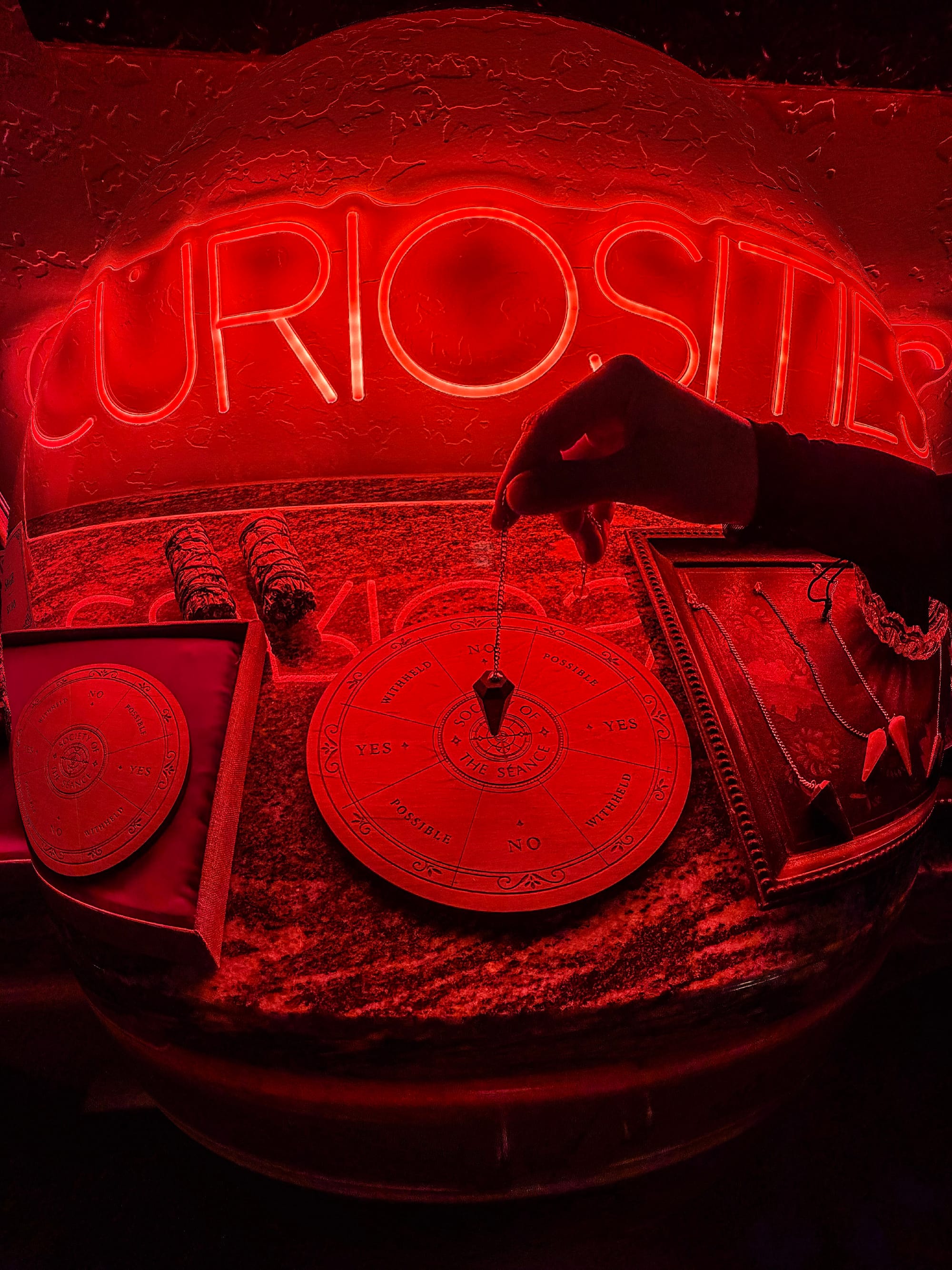
We went back downstairs and into an anteroom where visitors randomly select “haunted objects” said to help paranormal contact before entering a black curtain-draped space dominated by a long dark wooden table accommodating thirteen. B.C. relates stories, presents a sequence of tools: a pendulum, black obsidian scrying (reflective viewing) mirror and tarot cards. And he introduces the order of the séance before exiting, leaving guests to bathe in an immersive musical soundscape he seemingly created with a baton in one hand and a wand in the other. “It is not a musical score,” Smith insists, “but an invitation to an altered state and invocation of an opening of portals.” A video monitor flares into existence to instruct and conduct the proceedings. I won’t go into further details as I don’t want to spoil the experience nor impede the teasing suspense surrounding what happens.
Afterwards, B.C. returns to host and invite reactions. Several of the participants, including some self-professed skeptics, expressed surprise at what they’d seen, heard and/or felt. One received an answer to a personal question she’d been mulling over for weeks. All were relaxed, some relieved, and the shared experience led to a camaraderie which united the group who adjourned to the big room for further discussion and sharing.
It was a party of former strangers, previously diverse, now familiar.
Slowly, guests drifted off back into the night, filled with thoughts, imbued with questions, and having shared an individual AND collective adventure.
For further information and to book an experience: www.Phasmagorica.com and then click on “conditions of release.”
Also if this subject matter intrigues and you would like to learn more — particularly regarding history, global cultural expression, and even how to do-it-yourself — there’s Judith Fein’s best-selling and entertaining book How to Communicate with the Dead and how cultures do it around the world.
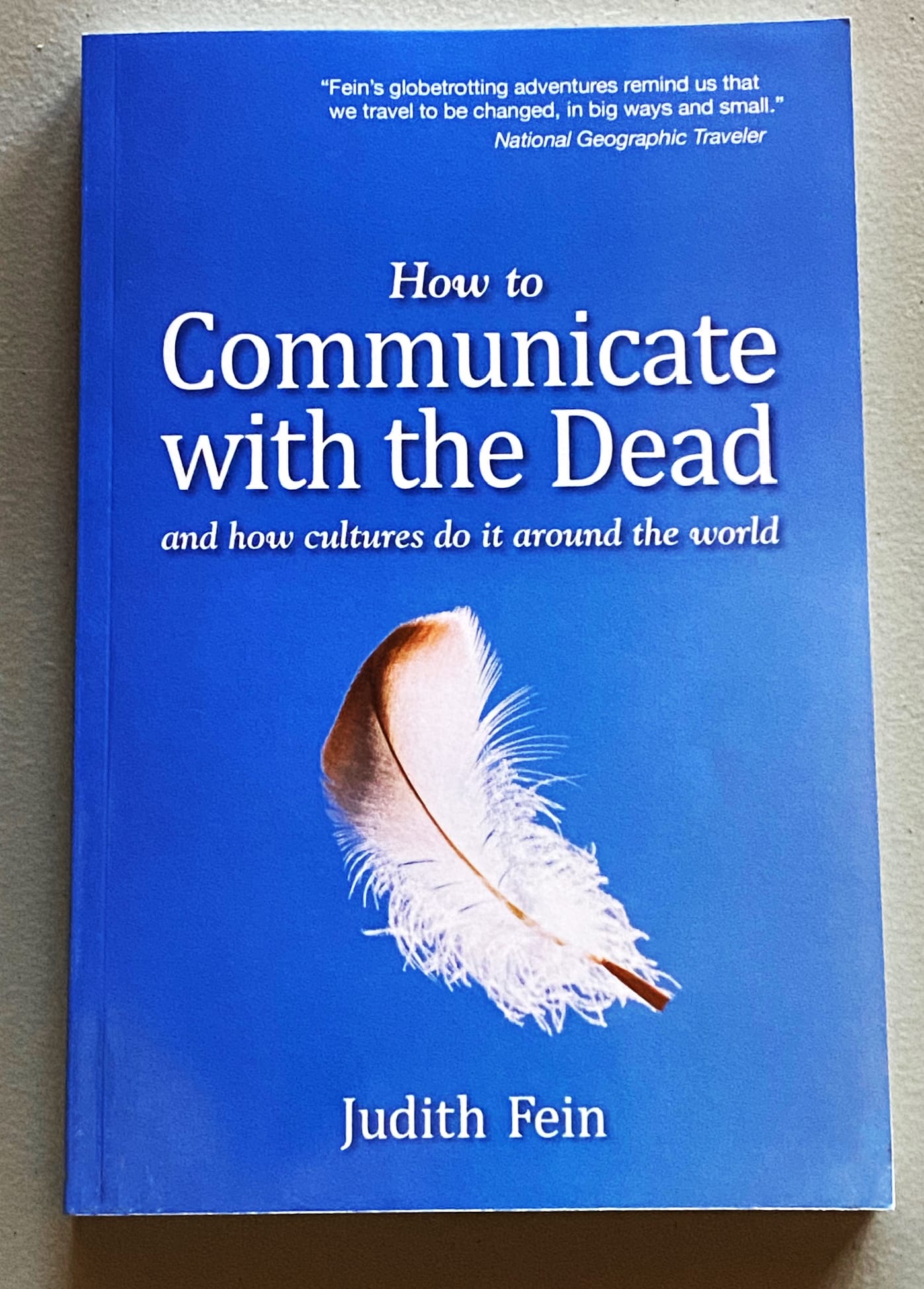
AND Judith & Paul will be teaching a class about “How to Communicate with the Dead” on March 27th at Oasis in Albuquerque.
Paul Ross is half an award-winning travel journalist/ photographer and half PJ “the world’s most unusual cowboy poet.” He has written and photographed for over 100 publications, and performed funny, unexpected, highly entertaining poetry at rodeos, resorts, parties, meetings, cowboy poetry gatherings and western music conventions. His website, shared with his travel journalist wife Judith Fein, is https://www.GlobalAdventure.us.
Get the New Mexico Jewish Journal free, twice a month.
Community Supporters of the NM Jewish Journal include:
Jewish Community Foundation of New Mexico
Congregation Albert
Jewish Community Center of Greater Albuquerque
The Institute for Tolerance Studies
Jewish Federation of El Paso and Las Cruces
Temple Beth Shalom
Congregation B'nai Israel
Shabbat with Friends: Recapturing Together the Joy of Shabbat
New Mexico Jewish Historical Society
Policy Statement Acceptance of advertisements does not constitute an endorsement of the advertisers’ products, services or opinions. Likewise, while an advertiser or community supporter's ad may indicate their support for the publication's mission, that does not constitute their endorsement of the publication's content.
Copyright © 2026-27 New Mexico Jewish Journal LLC. All rights reserved.