
















War: A Mirror to Ourselves

By Ron Duncan Hart
In 1901, shortly before becoming the 26th President of the United States, Theodore Roosevelt, a Republican, famously said, “Speak softly and carry a big stick—you will go far.” He went on to say, “If a man continually blusters, if he lacks civility, a big stick will not save him from trouble.” In that poignant statement, Roosevelt was also formulating a statement of how to govern, even a moral statement about controlling violent action.
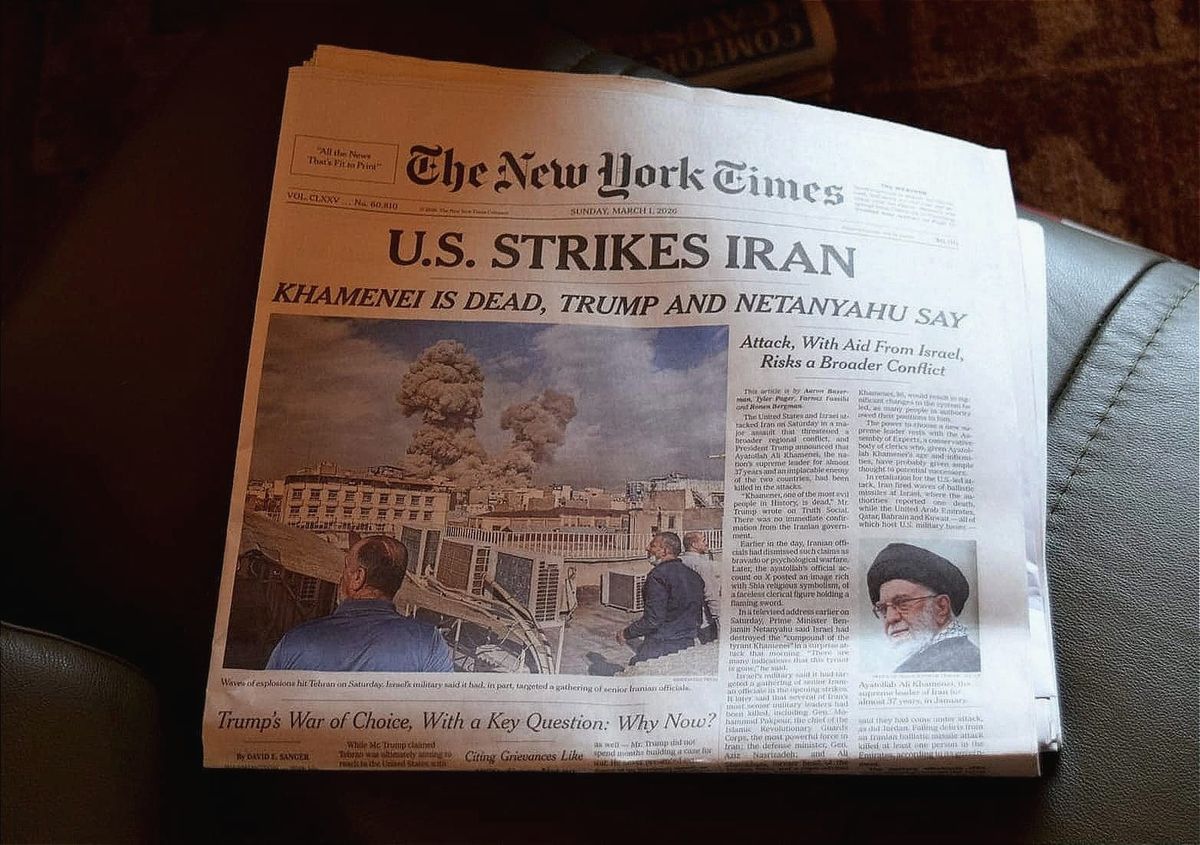
In the convoluted nature of any conflict like the recent war on Iran, we come back to Roosevelt’s warning. When do we talk, and when do we kill and destroy? Warring sides regularly each see themselves as defending their way of life and the god of their beliefs. Who can stop a conflict when true believers on each side feel obliged to destroy their enemy in the name of their god? When are we morally justified in beginning a killing campaign against a declared enemy? Modern warfare has gone beyond anything the sixth commandment (you shall not kill) might have anticipated. Today, warfare does not just kill, it annihilates hundreds of thousands of people, even millions, in military actions. Zeros pile up on zeros. In a war report can we even understand the meaning of the zeros that come after a number? Since it is impossible for us to grasp the meaning of 6,000,000 human lives with their talents, dreams, loves, and beliefs, the number with a lot of zeros becomes a numbing blur.
How do we understand the 25,000,000 Russians who are estimated to have died as a result of World War II, or the 8,000,000 Germans who died in that same war that they started? Then, there were 3,000,000 in Korea, and another 3,000,000 in Vietnam. An estimated 500,000 have been killed in the current Russia/Ukranian war. In the recent Syrian civil war, there were an estimated 600,000 deaths, human lives, men, women, and children, and in Gaza 70,000. Sometimes, we do not even know the numbers. In the ongoing conflict in the forgotten corner of Sudan, the estimates of the dead range from 150,000 to 400,000. In the 20th century, an estimated 200,000,000 people died as a result of wars. How many wars will we start in the 21st century? How many people will we kill? Is it for the good of humanity?
Although our moral consciousness says the loss of life is opprobrious, we continue building military capability to kill increasing numbers of people. Modern warfare rules of engagement focus on the destruction of military infrastructure, and people are counted as collateral damage, which seems like an obscene term when we see the charred and broken bodies that are the collateral damage. Warfare tactics changed from the WWI strategy of armies that fought opposing armies in the field of battle to the new WWII strategy of direct attacks on civilian populations with massive casualties. Germany launched the new warfare with its air attacks on London and the scorched earth destructiveness of its Russia campaign. World War II was book ended by the atomic bombs dropped on Hiroshima (140,000 casualties) and Nagasaki (75,000 casualties) by the United States showcasing that incredible breakthrough in the ability to destroy hundreds of thousands of human lives at a time.
Recently, a prominent government official in the United States said that the world had to be governed by force, and the United States is justified in using military force to carry out its policies whether it be deporting people or attacking nations. What he said is a version of the “survival of the fittest” argument by Herbert Spencer from the 1800s who argued that “might makes right”. Spencer argued in his concept of “Social Darwinism” that superior power gives legitimacy to the actions of the powerful. Long before Spencer, the classic version of this argument about the legitimacy of power was made in 1550 when two Spanish scholars and Catholic priests, debated whether Spain had the right to kill indigenous peoples in the Americas and take their lands.
Father Bartolomé de Las Casas and Father Juan Ginés Sepúlveda had a pivotal debate at the University of Valladolid in which Las Casas argued that the human rights of the indigenous people should be protected. Sepúlveda argued that Spain had the right to use force in killing and taking lands as needed because it was bringing a superior Spanish culture and the true god to the indigenous people in the Americas.
In America today, the argument that the might of the American military makes its exercise of power morally legitimate harkens back to the arguments of Spencer and Sepúlveda. Calling such attitudes the arrogance of power, former Senator William Fulbright once said, “Power confuses itself with virtue and tends also to take itself for omnipotence.”
Are we capable of questioning our readiness to use force and impose our will with the most destructive military machine that has ever existed? Are we capable of killing an entire civilization as the American president recently threatened to do? Who are the military leaders who are willing to obey such an order to destroy a civilization? Following WWII, Oppenheimer challenged the morality of the militarization of nuclear power, and he was ostracized from the seats of power. Now, we have the power to annihilate ourselves by mutually guaranteed extermination in nuclear warfare as Oppenheimer feared, and conventional warfare can now destroy cities and kill thousands of people in a night on the whim of a leader. The nuclear genie is out of the bottle, and in this century, more nations will have nuclear weapons. Are we capable of untying our Gordian Knot of warfare as we kill tens of thousands or millions of people who become anonymous zeros in bombing campaigns glorified for their technological precision? How many zeros? Are morality and warfare mutually exclusive?
Las Casas did win the moral argument, and his position has come to fruition in the Universal Declaration of Human Rights by the United Nations and the modern growth of jurisprudence against genocide and crimes against humanity. We are a species that is capable of creating monuments of social justice, beauty, and spiritual sublimeness combined with the political/military ability to destroy those monuments and the people who created them. We have made incredible scientific and cultural progress paralleled by the development of military force to bomb our enemies back to the stone age, as one leader recently promised.
Our prophets have dreamed of better times. Isaiah dreamed of a future when people would “beat their swords into plowshares”, and Dr. Martin Luther King, Jr. made the optimistic prediction that, “The arc of the moral universe is long, but it bends toward justice.” Given our human propensity for conflict and our unprecedented lethal potential, what will this century bring?
Ron Duncan Hart, Ph.D. is the Director of the Institute for Tolerance Studies in Santa Fe and the Santa Fe Distinguished Lecture Series. He is a cultural anthropologist and former Dean of Academic Affairs. He has awards from the National Endowment for Humanities, the National Science Foundation, Ford Foundation, and Fulbright among others. He is an award-winning author and his most recent book is Evangelicals and MAGA: The Politics of Grievance a Half Century in the Making, which received an American Jewish Press Association Rockower Award ("the Jewish Pulitzers") for Excellence in Writing about Antisemitism.
Read Hart's multi-award-winning series on Jews and Christian Nationalism in the NM Jewish Journal. “Prophetically terrifying and a great history of the Evangelical takeover of the government leading us to a U.S. theocracy,” commented one judge.
Community Supporters of the NM Jewish Journal include:
Jewish Community Foundation of New Mexico
Congregation Albert
Jewish Community Center of Greater Albuquerque
The Institute for Tolerance Studies
Jewish Federation of El Paso and Las Cruces
Temple Beth Shalom
Congregation B'nai Israel
Shabbat with Friends: Recapturing Together the Joy of Shabbat
New Mexico Jewish Historical Society
Policy Statement Acceptance of advertisements does not constitute an endorsement of the advertisers’ products, services or opinions. Likewise, while an advertiser or community supporter's ad may indicate their support for the publication's mission, that does not constitute their endorsement of the publication's content.
Copyright © 2026-27 New Mexico Jewish Journal LLC. All rights reserved.