



















Portrait of the Artist as a Young Schlemiel


By Corinne Joy Brown
Antitherapies, by Jacques Fux (University of New Mexico Press), winner of Brazil's prestigious São Paulo Prize, is one of those books you might have never discovered on your own. But once begun, you find yourself hooked, grateful you didn’t miss it.
Composed of twenty-one recollections, or sessions, gleaned supposedly from a therapist’s couch, the structure of this award-winning debut novel reveals a compelling trajectory—that of the narrator becoming a man, in spite of himself. A kind of fictional memoir, it’s as easily a reckoning, or confrontation with the self. However you perceive it, it resolves to be an unforgettable introduction to the mind and heart of a great Latin American writer who, along with a great sense of humor, is an uncanny observer of life. Released originally in 2012 in Portuguese, the English translation will be released in September of 2026.
The intriguing chapters reveal a series of monologues exploring dreams, aspirations, life-paths, hopes and disappointments wrapped in flashbacks and internal dialogue. Chapter titles like Astrophysicist, or He Who Dreams of the Stars and Archaeologist, or He Who Invents the Past, and Philosopher, or He Who Mocks Love offer promising content, inviting the reader to consider the doubts, regrets, achievements and failures of the self-proclaimed nerd who stands at its center.
Since childhood, he yearns for recognition and acceptance, bounding success (nothing less than a Nobel prize) and ultimately, sex, ever in search of the perfect woman and union. Until then, he’s addicted to self-pleasure. Not unlike many of us, the “womb of his childhood” left him unprepared for the realities of adolescence and adulthood. Further, he was raised, protected and loved in an insular Jewish community, except for the ominous shadow of Nazis, Eichmann, and a bully named Bormann in his midst, forever haunting his sense of safety and his psyche.
What shines through the novel by Fux, an award-winning writer of many books, as well as a mathematician and university professor recognized worldwide, is the universality of coming into manhood and the challenge of self-realization. More germane to our readers is the universal struggle of the Jew amidst Gentiles who is forever perceived as “the other.” That dilemma works both for and against the narrator’s sense of security and belonging.
The work is a translation from the author’s native Portuguese by three gifted writers, and moves with a particular cadence. Short sentences push the prose forward, and bold, single words act like stepping stones through the emotionally laden text, searing and precise. In a brilliant introduction by Ilan Stavans, an accomplished writer born in Mexico but at home in the United States, and well known to many, Fux’s narrator is lightly compared to other dreamers in the realm of Jewish literature: in particular: Sholem Alechem’s Tevye the Milkman, and Philip Roth’s Alexander Portnoy in Portnoy’s Complaint—men who are subjects of an inherited victimhood assigned to our nation, but who believe in themselves. One additional character not mentioned that I believe bears comparison is Woody Allen’s nebbish loser, Alex Felix in the film Play it Again, Sam, whose beleaguered self-esteem never rises high enough to see himself as anything other than the odd-man out. Unable to score with women, he’s a hopeless reject, an anti-hero of the first order. Yet, the viewer finds him remarkably sympathetic in his suffering, and believes in the possibility of his redemption which finally occurs when he scores a kiss with Diane Keaton.
Since this book is part of a Jewish Latin American Series offered by the University of New Mexico Press, I assumed a view of its contents would roll out through a particularly Latin American Jewish lens. One whose focus would be familiar, yet somehow uniquely different, since Jewish life in Brazil couldn’t possibly be the same as the United States. I was wrong. It resonates on a deeply familiar level and connects to Jewish life anywhere in the world. I further assumed this work was autobiographical, which it is to a certain degree. One critic refers to it as ‘autofiction”, an age-old approach defined as a form of fictionalized autobiography that blends fact and fiction. One reviewer refers to this work as a “Portrait of the Artist as a Young Schlemiel.”
A bonus to the progression of the anti-therapies are the gemlike quotes at the start of each chapter, excerpted from great works by a worldly host of writers, poets and philosophers. Worth anyone’s time, I can only add that the reader should enjoy the journey. Take it slow and when you’re done, start over and read it again. Once is not enough.
Corinne Joy Brown is an award-winning author of historical fiction and non-fiction inspired by the American West with ten books in print, including her acclaimed novel Hidden Star about crypto-Jews. She also writes memoirs, plus freelances for a variety of print publications focused on design, architecture, fine art, and popular culture. Corinne writes middle-grade fiction as well, and has published a series of art books for young readers who love horses. A past-president of the Denver Woman’s Press Club, a founding member of Women Writing the West, and the editor/publisher of HaLapid, an academic journal serving the Society for Crypto-Judaic Studies, she is a Fellow of the University of Colorado History Department at CU/Colorado Springs. She and her husband live in Colorado and enjoy their German Shepherd, Ziggy. Stav Appel has inspired her next novel. Visit her at https://corinnejoybrown.com/
MORE STORIES by Corinne Joy Brown:
 New Mexico Jewish Journal
 New Mexico Jewish Journal
 New Mexico Jewish Journal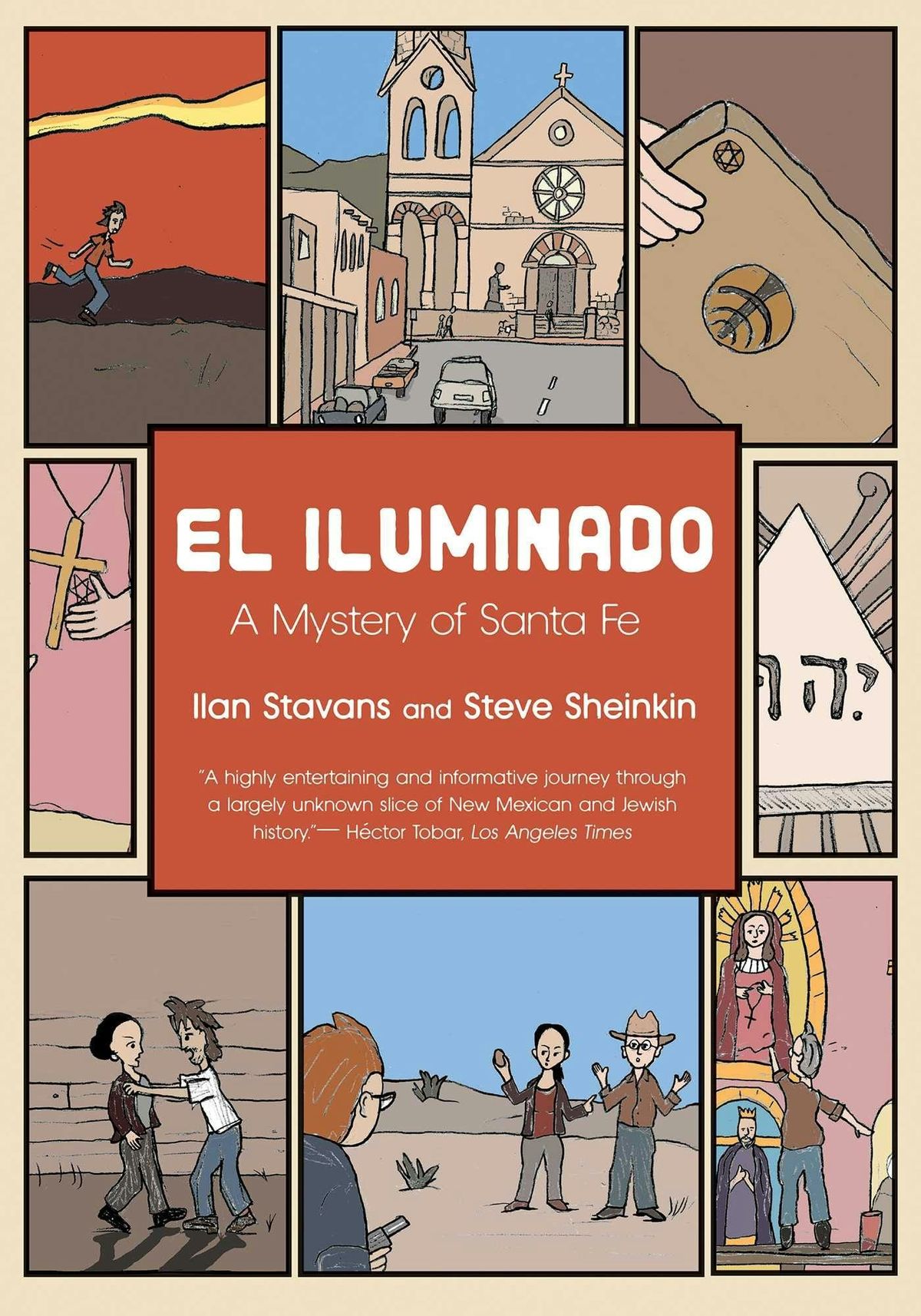
 New Mexico Jewish Journal
 New Mexico Jewish Journal
2025 ~ 1st Place Religion Feature Society Professional Journalists:
 New Mexico Jewish Journal
2025 ~ 2nd Place Personal Essay NM Press Women:
 New Mexico Jewish Journal
Community Supporters of the NM Jewish Journal include:
Jewish Community Foundation of New Mexico
Congregation Albert
Jewish Community Center of Greater Albuquerque
The Institute for Tolerance Studies
Jewish Federation of El Paso and Las Cruces
Temple Beth Shalom
Congregation B'nai Israel
Shabbat with Friends: Recapturing Together the Joy of Shabbat
New Mexico Jewish Historical Society
HaMakom - Passionate Judaism in Santa Fe
Policy Statement Acceptance of advertisements does not constitute an endorsement of the advertisers’ products, services or opinions. Likewise, while an advertiser or community supporter's ad may indicate their support for the publication's mission, that does not constitute their endorsement of the publication's content.
Copyright © 2026-27 New Mexico Jewish Journal LLC. All rights reserved.